
Amr moves the capital south to a …
Years: 532 - 675
The mosque he builds here bears his name and still stands, although it has been much rebuilt.
Locations
People
Groups
- Egyptians
- Polytheism (“paganism”)
- Arab people
- Jews
- Egypt (Roman province)
- Christianity, Nicene
- Egypt, Diocese of
- Christians, Monophysite
- Coptic Orthodox Church of Alexandria
- Greeks, Medieval (Byzantines)
- Egypt, Eastern Roman (Byzantine)
- Islam
- Egypt in the Middle Ages
Topics
Commodoties
Subjects
Regions
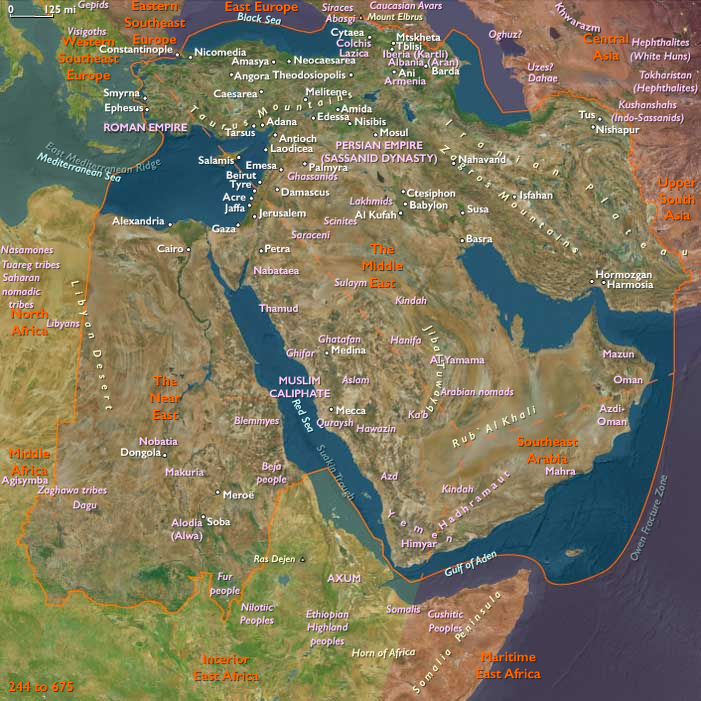
Subregions
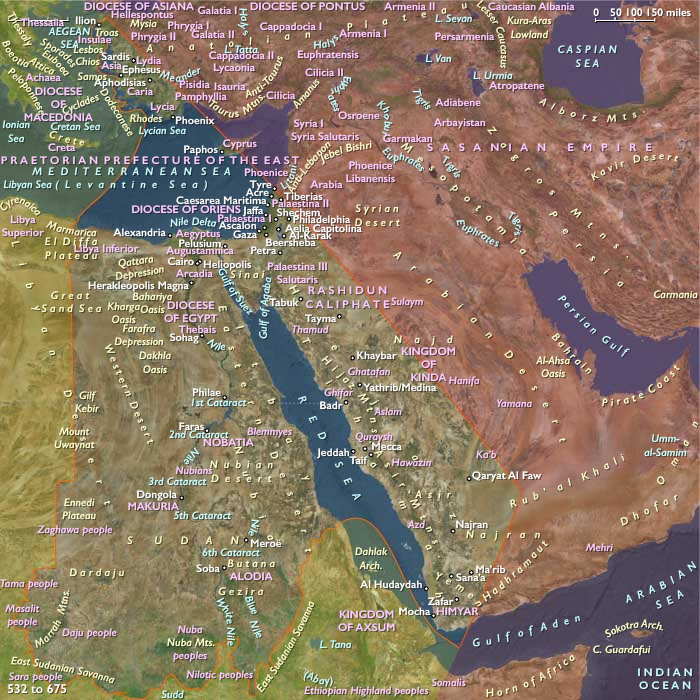
Related Events
Filter results
Showing 10 events out of 1597 total
Frankish Church Councils and the Strengthening of Catholic Rule
As Chalcedonian Christianity becomes the official faith of the Frankish Kingdom, the Franks hold a series of national church councils to reinforce Catholic orthodoxy and consolidate royal power. These councils, heavily influenced by the Frankish monarchy and episcopate, impose restrictions on Jews, regulate Christian behavior, and establish Paris as a religious and political center.
1. Anti-Jewish Policies in the Frankish Church Councils
The Frankish church councils, convened under the Merovingians, enact laws that:
- Ban Jewish judges – Preventing Jews from holding legal authority over Christians.
- Prohibit Jews from administrative positions – Excluding Jews from public office to limit their influence in governance.
- Strongly discourage Christian-Jewish intermarriage – Enforcing separation between the Christian and Jewish communities.
- Excommunicate those who consume food offered to idols – Strengthening Catholic doctrine against pagan and Jewish sacrificial practices.
These policies reflect the growing power of the Catholic Church within Frankish society and align with broader anti-Jewish measures seen in the Byzantine Empire.
2. The Foundation of St. Vincent Monastery (St-Germain-des-Prés)
- The Monastery of St. Vincent, later renamed St-Germain-des-Prés, is established just outside the gates of Paris.
- It is built to house a sacred relic—the tunic of St. Vincent, which had been plundered from the Visigoths in Spain after Clovis' victory at Vouillé (507 CE).
- The monastery becomes a major religious institution, associated with the Frankish royal family.
3. The Rise of Paris as the Frankish Capital
- Under Clovis I, Paris is chosen as the primary royal residence of the Merovingian dynasty.
- The foundation of the St. Vincent monastery further solidifies Paris’ religious and political significance.
- Over time, Paris emerges as the heart of the Frankish realms, serving as a center for governance, Christian authority, and cultural life.
Conclusion: The Merovingian Theocratic State
The Frankish national church councils, combined with the growth of religious institutions in Paris, reflect the increasing fusion of Church and state under the Merovingians. This period marks:
- The strengthening of Catholic authority, defining the religious identity of the Franks.
- The exclusion of Jews from political life, reinforcing Catholic dominance.
- The development of Paris into a Frankish royal and religious center, setting the foundation for its eventual role as the capital of France.
These events help establish the Merovingians as the foremost Catholic rulers in Western Europe, a position their Carolingian successors will later build upon.
Childebert I and the Foundation of St-Germain-des-Prés (c. 542 CE)
After returning from his expedition against the Visigoths in Spain, Childebert I, King of Paris, brings back one of the most sacred relics of the early medieval Frankish Church—the tunic of St. Vincent, a highly venerated martyr of the Hispanic Church.
1. The Spanish Campaign and the Acquisition of the Relic
- Childebert I, in alliance with his brother Chlothar I, launches a Frankish incursion into Visigothic Spain.
- After successfully besieging Zaragoza, they plunder the city’s Christian treasures, including the tunic of St. Vincent, a famous Spanish martyr from the early fourth century.
- Childebert brings the relic back to Paris, reinforcing his status as a pious Christian ruler and patron of the Catholic Church.
2. The Founding of the Monastery of St. Vincent (St-Germain-des-Prés)
- In honor of St. Vincent’s tunic, Childebert commissions a grand monastery at the gates of Paris.
- Originally named the Monastery of St. Vincent, it is later renamed St-Germain-des-Prés, after Saint Germain, Bishop of Paris.
- The monastery becomes one of the most significant religious institutions in medieval France, serving as:
- A royal burial site.
- A center of learning and monastic culture.
- A powerful symbol of Frankish Christian rule.
3. The Significance of the Relic and Monastic Foundation
- The acquisition of St. Vincent’s tunic and the monastery’s construction further solidify Paris as a major religious center in the Frankish kingdom.
- This act strengthens Frankish ties with the Catholic Church, reinforcing Childebert’s legitimacy as a Christian ruler.
- The monastery of St-Germain-des-Prés will later play a crucial role in the intellectual and monastic revival of medieval Europe.
Conclusion: A Lasting Religious Legacy
Through his expedition to Spain and the establishment of the Monastery of St. Vincent, Childebert elevates Paris as a religious and political capital. The monastery of St-Germain-des-Prés will remain an enduring symbol of Frankish piety, royal patronage, and monastic scholarship, influencing the spiritual and cultural landscape of medieval France for centuries to come.
3. Fredegund’s Swift Seizure of Power
- Immediately after Chilperic’s death, Fredegund seizes his treasury, securing the royal wealth for herself and her son.
- She flees to Paris, where she convinces the Neustrian nobles to recognize her infant son, Chlothar II, as king.
- Acting as regent, she ensures that Neustria remains politically intact, continuing her rivalries with Guntram of Burgundy and Brunhilda of Austrasia.
4. The Continuation of the Civil Wars
- Fredegund continues her war against Brunhilda, the widow of Sigebert I, keeping alive the decades-long feud between Austrasia and Neustria.
- She also must contend with Guntram, who, as the last surviving son of Clovis I, attempts to act as a mediatorin the Frankish realm.
- Despite the instability, Fredegund maintains her grip on power, using political cunning and assassination to eliminate rivals.
5. The Legacy of Chilperic’s Death and Fredegund’s Regency
- Chilperic’s violent death marks the end of a brutal reign, but his assassination does not bring stability—instead, it prolongs the bloody Merovingian civil wars.
- Fredegund emerges as the dominant figure in Neustria, ruling until her death in 597 CE, after which her son, Chlothar II, will consolidate power.
- Her rivalry with Brunhilda shapes the next three decades of Frankish history, defining one of the most treacherous and vengeful political feuds of the Merovingian period.
Conclusion: The Widow Who Ruled
With Chilperic’s assassination in 584 CE, Fredegund swiftly consolidates power, ensuring that her infant son remains king. Her ability to outmaneuver rivals, command loyalty, and use political violence makes her one of the most formidable figures of the Merovingian age. However, the Merovingian civil wars rage on, fueled by the unrelenting feud between Fredegund and Brunhilda, ensuring that the Frankish kingdom remains engulfed in bloodshed for years to come.
Fredegund’s Final Victory Over Brunhilda and Her Death (597 CE)
By 597 CE, Queen Fredegund of Neustria, after years of political intrigue, assassinations, and open warfare, defeats her old rival Brunhilda of Austrasia. Brunhilda had been supporting the claims of her grandsons, Theudebert II (Austrasia) and Theuderic II (Burgundy), against Fredegund’s son, Chlothar II.
Shortly after securing Neustria’s position, Fredegund dies in Paris and is buried in the Basilica of Saint Denis, leaving her thirteen-year-old son, Chlothar II, as the sole ruler of Neustria.
1. The Struggle Between Fredegund and Brunhilda
- Fredegund had long been at war with Brunhilda, seeking to secure the Frankish throne for her own lineage.
- While Brunhilda ruled Austrasia and Burgundy through her grandsons, Fredegund maneuvered politically and militarily to eliminate her influence.
- By 597, Fredegund achieves her final victory, though the war with Austrasia is far from over.
2. The Death of Fredegund and Chlothar II’s Rise to Power
- After securing Neustria’s stability, Fredegund dies in Paris.
- She is buried in the Basilica of Saint Denis, one of the first Merovingian rulers to receive this honor.
- Her thirteen-year-old son, Chlothar II, inherits the throne of Neustria and is immediately thrust into the ongoing civil war against Austrasia and Burgundy.
3. Chlothar II Prepares for War Against Austrasia
- As a young king, Chlothar II is advised by his mother’s loyalists to continue her feud with Brunhilda and her grandsons.
- Austrasia remains the primary obstacle to his ambitions, and he begins preparing for war against the eastern Frankish kingdom.
- This conflict will culminate in 613 CE, when Chlothar II captures Brunhilda and brutally executes her, marking the final victory of Neustria over Austrasia.
Conclusion: Fredegund’s Legacy and the Continued Frankish Civil War
Fredegund’s death in 597 CE does not end the Neustrian-Austrasian conflict—rather, it passes into the hands of her son, Chlothar II. Under his reign, the war escalates, leading to further bloodshed, betrayals, and the eventual downfall of Brunhilda. Fredegund’s ruthless ambition ensures that her dynasty survives, shaping the course of Merovingian politics for decades to come.
The Fifth Council of Paris (614 CE): Forced Baptism of Jews in the Frankish Kingdom
The Fifth Council of Paris (614 CE), the largest gathering of Merovingian bishops to date, issues a decree mandating the forced baptism of Jews holding military or civil positions within the Frankish domains, along with their families. This marks a significant intensification of anti-Jewish policies in Merovingian Gaul, reinforcing the growing exclusion and persecution of Jewish communities.
1. The Council’s Decree on Jewish Officials
- The council rules that all Jews in government or military service must convert to Christianity, along with their families.
- Those who refuse baptism would presumably be stripped of their positions, subjected to exile, or face other penalties.
- This decree reflects the increasing Church influence over royal policies, particularly in matters of religious conformity and state administration.
2. Context: The Rising Power of the Catholic Church in Frankish Law
- Earlier Frankish councils, such as Clermont (535 CE), Mâcon (581/582 CE), and Paris (Twice in 577 and 590 CE), had already imposed severe restrictions on Jews, barring them from:
- Serving as judges or tax officials.
- Holding Christian slaves.
- Appearing in public during Holy Days.
- The 614 decree escalates these policies by directly targeting Jewish officials, ensuring that only baptized Christians can serve in government and the military.
3. The Impact on Jewish Communities
- Jewish officials and their families face a stark choice: convert or lose their positions.
- Many likely fled the Frankish kingdom, seeking refuge in Visigothic Spain, Italy, or Byzantine territories, where Jewish communities still had some protections.
- The decree weakened Jewish economic and social influence, further isolating them within Frankish society.
4. The Legacy of the 614 Council’s Anti-Jewish Decrees
- This council represents an early example of state-enforced conversion policies, a practice that would later become common in medieval and early modern Europe.
- It solidifies the Frankish monarchy’s alignment with the Catholic Church, reinforcing the idea that state service required Christian faith.
- These policies foreshadow later anti-Jewish measures in the Carolingian and Capetian eras, leading to even greater segregation and persecution.
Conclusion: A Milestone in the Systematic Marginalization of Jews
The Fifth Council of Paris (614 CE) marks a critical turning point in the treatment of Jews in the Frankish kingdom, pushing them further to the margins of society. By excluding Jews from state and military service unless they converted, the Merovingian Church and monarchy reinforce religious orthodoxy as a requirement for political power, setting a precedent that would shape European religious policies for centuries to come.
The Death of Chlothar II and the Rise of Dagobert I (629 CE)
Chlothar II, King of the Franks, dies in 629 CE, marking the end of a 45-year reign, the longest of any Merovingian ruler since his grandfather Chlothar I (511–561 CE). His reign had seen the reunification of the Frankish kingdoms but also the increasing power of the nobility, setting the stage for the rise of the Mayors of the Palaceand the later rois fainéants ("do-nothing kings").
1. Chlothar II’s Reign: A Long but Weakening Rule
- Chlothar II had consolidated power in 613 CE, defeating Brunhilda and the Austrasian nobility, briefly ruling over a united Frankish kingdom.
- However, his rule increasingly relied on the support of the aristocracy, particularly the Mayors of the Palace, leading to a decline in royal authority.
- The Edict of Paris (614 CE) had formally granted greater power to the Frankish nobility, reducing the ability of kings to govern without aristocratic support.
2. Chlothar II’s Death and the Rise of the Mayors of the Palace
- With Chlothar’s death in 629 CE, the Frankish monarchy is left weakened, as real power shifts to the Mayors of the Palace, who act as the kingdom’s chief administrators.
- This shift paves the way for the later rois fainéants ("do-nothing kings"), Merovingian monarchs who were kings in name but lacked real authority, while the Mayors of the Palace governed on their behalf.
3. The Succession of Dagobert I and the Move to Paris
- Dagobert I, Chlothar’s son and successor, ascends to the throne, becoming the first Merovingian king to rule from Paris as his capital.
- His rule is heavily influenced by two key figures:
- Bishop Arnulf of Metz, a leading ecclesiastical figure and later a saint, ensuring the Church’s continued political role.
- Pepin of Landen, the Mayor of the Palace, who represents the growing power of the Frankish aristocracy.
4. The Legacy of Chlothar II’s Reign
- His long reign ended with a monarchy diminished in power, with the real authority increasingly held by noble factions.
- The position of the Mayors of the Palace becomes entrenched, preparing the way for the rise of the Carolingians, who will later replace the Merovingians entirely.
- Dagobert I briefly restores royal prestige, but the monarchy’s decline continues after his death, leading to the final phase of Merovingian rule dominated by aristocratic power.
Conclusion: The End of Strong Merovingian Kingship
With Chlothar II’s death in 629 CE, the Merovingian monarchy enters a period of irreversible decline. While his son Dagobert I attempts to restore Frankish royal authority, the true power now lies with the Mayors of the Palace, marking the beginning of the era of aristocratic dominance that will eventually lead to the rise of the Carolingian dynasty.
Dagobert I Secures His Realm and Expels Non-Converted Jews
Following the death of his half-brother Charibert II in 632 CE, Dagobert I consolidates power, securing his rule through diplomacy, military campaigns, and religious policies. His reign marks the last strong Merovingian kingship before the decline of royal authority in favor of the Mayors of the Palace.
1. Diplomatic Alliance with the Byzantine Empire
- Dagobert strengthens Frankish diplomacy by forming a friendship treaty with Emperor Heraclius of Byzantium.
- This alliance provides mutual strategic benefits:
- Heraclius gains Frankish support against the advancing Muslim forces in the east.
- Dagobert gains recognition as the dominant Western European ruler, reinforcing his legitimacy and authority.
2. Military Campaigns: Securing Frankish Borders
To stabilize and expand his realm, Dagobert wages three significant military campaigns:
- Defeat of the Gascons (Vascones) in the Pyrenees
- Dagobert subjugates the Basque tribes, reinforcing Frankish control over Gascony and the southwestern frontier.
- War Against the Bretons
- Dagobert defeats the Bretons, who had long resisted Frankish rule in western Gaul.
- Eastern Campaign Against the Slavs
- Facing Slavic incursions along the Frankish eastern frontier, Dagobert leads a campaign against them, securing Austrasia’s borderlands.
These successful military operations reinforce Dagobert’s image as a strong Merovingian king, ensuring the stability of the Frankish realm.
3. Forced Conversions and the Expulsion of Jews
- Encouraged by Emperor Heraclius, Dagobert issues an ultimatum to the Jews:
- Convert to Christianity or face exile.
- This policy leads to the expulsion of all non-converted Jews from Frankish lands, marking one of the first large-scale forced conversions or expulsions of Jews in medieval Europe.
- The edict aligns with Heraclius’ own anti-Jewish policies, as the Byzantine emperor had recently blamed the Jews for supporting Persian invasions in the East.
- This breaks the relative tolerance of previous Frankish rulers, marking a shift toward greater religious uniformity under royal and ecclesiastical authority.
4. The Decline of Royal Authority After Dagobert
- While Dagobert secures the realm militarily and diplomatically, his reign marks the last period of strong Merovingian kingship.
- After his death in 639 CE, the Mayors of the Palace begin to dominate Frankish politics, leading to the emergence of the "do-nothing kings" (rois fainéants).
Conclusion: The Last Strong Merovingian King
Dagobert I’s reign is marked by military victories, diplomatic alliances, and religious enforcement. By securing alliances with Byzantium, defeating regional opponents, and enforcing Christian uniformity, he strengthens the Frankish kingdom, though his policies—especially his anti-Jewish decree—foreshadow the rise of religious persecution in medieval Europe. His death in 639 CE paves the way for the decline of Merovingian royal authority, setting the stage for the Carolingian takeover in the following century.
Dagobert I’s Campaign Against Samo and the Slavic Victory at Wogastisburg (631 CE)
In 631 CE, Dagobert I, King of the Franks, launches a three-pronged military campaign against Samo, ruler of the Slavs (Wends). However, his Austrasian forces suffer a decisive defeat at the Battle of Wogastisburg, as recorded in the Chronicle of Fredegar—one of the most important Frankish historical sources of the early medieval period.
1. The Chronicle of Fredegar and Its Account of Samo
- The Chronicle of Fredegar (written c. 660 CE) is the primary contemporary source detailing the Frankish-Slavic conflict.
- While once thought to be written by multiple authors, modern scholars largely accept the idea of a single compiler, "Fredegar".
- Fredegar’s account provides the only known contemporary information on Samo, making it a key historical document on early Slavic state formation.
2. The Three-Pronged Frankish Invasion of 631 CE
- Dagobert I assembles three armies to crush Samo’s growing power among the Slavs (Wends).
- His forces invade from different directions, with the Austrasian army playing the main role.
- Despite superior Frankish organization and weaponry, the campaign ends in disaster.
3. The Frankish Defeat at the Battle of Wogastisburg
- The Austrasian army, Dagobert’s primary force, engages Samo’s troops at Wogastisburg, an unidentified Slavic fortress.
- The Slavs successfully defend the stronghold, inflicting a crushing defeat on the Franks.
- Following the battle, Frankish influence in Central Europe collapses, and Samo continues to rule his Slavic federation independently.
4. The Aftermath: Frankish Retreat and Slavic Independence
- The defeat forces Dagobert to abandon his expansionist ambitions in the east.
- Samo’s victory strengthens the first known Slavic political entity in Central Europe, creating an early Slavic state.
- The battle underscores the limits of Frankish power beyond the Rhine, as Slavic resistance proves too formidable for Austrasia to subdue.
Conclusion: A Turning Point in Frankish-Slavic Relations
The Frankish defeat at Wogastisburg (631 CE) is a major setback for Dagobert I, marking the failure of Merovingian expansion into Slavic lands. The Chronicle of Fredegar remains the only contemporary source on Samo, preserving crucial details about early Slavic political organization. This battle ensures that Samo’s rule remains secure, shaping the development of Slavic states in medieval Central Europe.
2. Dagobert I’s Consolidation of Power Elsewhere
Despite his loss of Austrasia, Dagobert strengthens his rule elsewhere:
-
Breaking Free from Pepin of Landen
- Pepin of Landen, the Mayor of the Palace of Austrasia, had been one of Dagobert’s most powerful advisors.
- Around this time, Dagobert removes Pepin from power, asserting greater personal control over Neustria and Burgundy.
- This marks an attempt to curb noble influence, though it will ultimately be short-lived.
-
Extending Frankish Rule Over the Bretons
- Dagobert successfully extends Frankish authority over Brittany, reinforcing Neustrian control over the region.
- This achievement ensures that Brittany, though semi-independent, remains a tributary to the Frankish crown.
3. Long-Term Consequences: The Decline of Merovingian Royal Authority
- The installation of Sigebert III marks the beginning of the "rois fainéants" (do-nothing kings), as the Mayors of the Palace start to exercise real power in Austrasia.
- Though Dagobert remains a dominant king, his concessions to the Austrasian nobility show that Merovingian kings are becoming increasingly reliant on aristocratic support.
- The separation of Austrasia from direct Neustrian control will lead to future conflicts between the two regions, ultimately weakening the Merovingian dynasty.
Conclusion: A Key Turning Point in Frankish Politics
By 633 CE, Dagobert I faces a crucial shift in power dynamics:
- The Austrasian nobles force him to install his young son, Sigebert III, as king, taking control of Austrasia for themselves.
- He removes Pepin of Landen from power, briefly curbing noble influence in Neustria.
- He extends Frankish control over Brittany, reinforcing his authority in the West.
Despite his efforts to preserve royal authority, these events mark the beginning of the aristocratic dominance that will eventually lead to the rise of the Carolingian dynasty, signaling the gradual decline of Merovingian rule.
Dagobert I Founds the Abbey of Saint-Denis (635 CE)
In 635 CE, King Dagobert I establishes the Abbey of Saint-Denis in the suburbs of Paris, dedicating it to Saint Denis, the third-century martyr and first Bishop of Paris, venerated as the Apostle of France. This act strengthens the connection between the Merovingian monarchy and the Church, reinforcing Paris as a religious and political center.
1. The Importance of Saint Denis
- Saint Denis, a third-century missionary and bishop, was believed to have been beheaded by Roman authorities on Montmartre.
- According to legend, he carried his severed head several miles before collapsing at the site where the abbey was built.
- He became one of the most revered saints in Frankish Christianity, symbolizing royal protection and divine favor.
2. The Abbey as a Royal Burial Site
- Dagobert chooses Saint-Denis as the future royal necropolis, ensuring that it becomes the burial site for Frankish kings.
- He himself is later buried at Saint-Denis in 639 CE, beginning a tradition that will continue through the Carolingians and Capetians, making the abbey the final resting place of French royalty for centuries.
3. The Political and Religious Significance
- The foundation of Saint-Denis Abbey reinforces the Merovingian monarchy’s alliance with the Church, securing ecclesiastical support for royal authority.
- It helps elevate Paris as a central religious city, further strengthening Frankish identity around Catholicism.
- The abbey later becomes one of the most important monastic institutions in medieval France, serving as a center for learning, pilgrimage, and royal ceremonies.
Conclusion: A Lasting Symbol of French Kingship
Dagobert I’s foundation of the Abbey of Saint-Denis in 635 CE marks a pivotal moment in Frankish religious and political history. By dedicating it to France’s patron saint, he establishes a spiritual and dynastic center that will endure as the primary royal burial site and a symbol of the sacred nature of kingship in medieval France.
Years: 532 - 675
Locations
People
Groups
- Egyptians
- Polytheism (“paganism”)
- Arab people
- Jews
- Egypt (Roman province)
- Christianity, Nicene
- Egypt, Diocese of
- Christians, Monophysite
- Coptic Orthodox Church of Alexandria
- Greeks, Medieval (Byzantines)
- Egypt, Eastern Roman (Byzantine)
- Islam
- Egypt in the Middle Ages
Topics
Commodoties
Subjects
Regions
Subregions