
The ancient country of Lycia (Lycian chieftains …
Years: 168BCE - 168BCE
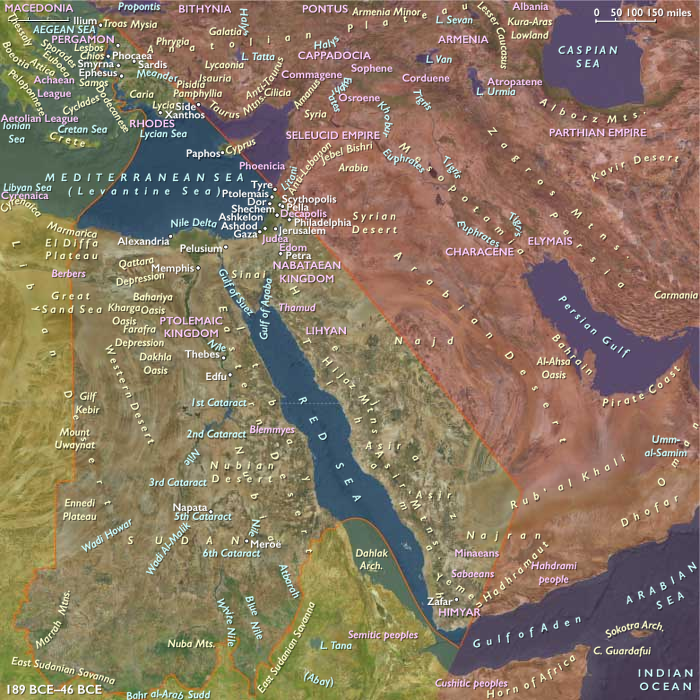
The ancient country of Lycia (Lycian chieftains Glaucus and Sarpedon figure in Homer's Iliad as allies of Troy in the Trojan War) occupies a mountainous promontory on the Mediterranean coast of southwestern Anatolia.
Having by 240 BCE become part of the Ptolemaic Kingdom, Lycia remained in their control through 200 BCE, and had apparently come under Seleucid control by 190 BCE, when the Seleucids' defeat in the Battle of Magnesia resulted in Lycia being awarded to Rhodes in the Peace of Apamea in 188 BCE.
The Lycian League (Lukiakou systema in Strabo's Greek, transliterated, a "standing together") is first known from two inscriptions of the early second century BCE in which it honors two citizens. T. Bryce ("Bryce, T.; Zahle, J. [1986]. The Lycians. 1. Copenhagen: Museum Tusculanum Press) hypothesizes that it was formed as an agent to persuade Rome to rescind the annexation of Lycia to Rhodes.
A fragment from Livy records a "pitiful embassy" in 178 BCE from Lycia to the Roman Senate complaining that the Lycians were being treated as slaves.
Whipping had been instituted as corporeal punishment and the women and children were being abused.
The Romans sent back a stern warning with the Lycians to Rhodes saying that they had not intended the Lycians or any other people born in freedom to be enslaved by Rhodes, and that the assignment was only a protectorate.
A fragment from Polybius tells a slightly different version of the story, which has the Romans sending legates to Rhodes to say that "the Lycians had not been handed over to Rhodes as a gift, but to be treated like friends and allies."
The Rhodians sent an embassy in return claiming that the Lycians had made the story up for reasons of their own and that in fact they were a financial burden on Rhodes.
The continuation of the story has not survived, but in 168 BCE, Rome takes Lycia away from Rhodes and turns over home rule to the League.
There is no question of independence.
Lycia is not to be sovereign, only self-governing under democratic principles.
It can neither negotiate with foreign powers nor disobey the Roman Senate.
It is not independent.
It can govern its own people and (for a time) mint its own coins as a right granted by Rome.
It does not determine its own borders.
Land and people can be assigned or taken away by the Senate.
This native government is an early federation with democratic principles; these will later came to the attention of the framers of the United States Constitution, influencing their thoughts.
Locations
Groups
- Rhodes, City-States of
- Roman Republic
- Macedon, Antigonid Kingdom of
- Egypt, Ptolemaic Kingdom of
- Pergamon (Pergamum), Kingdom of
- Seleucid Empire
- Lycian League
Topics
Commodoties
Subjects
Regions
Subregions
Related Events
Showing 10 events out of 63247 total
Years: 168BCE - 168BCE
Locations
Groups
- Rhodes, City-States of
- Roman Republic
- Macedon, Antigonid Kingdom of
- Egypt, Ptolemaic Kingdom of
- Pergamon (Pergamum), Kingdom of
- Seleucid Empire
- Lycian League
Topics
Commodoties
Subjects
Regions
Subregions