The ancient Black Sea Port of Odessus …
Years: 681 - 681
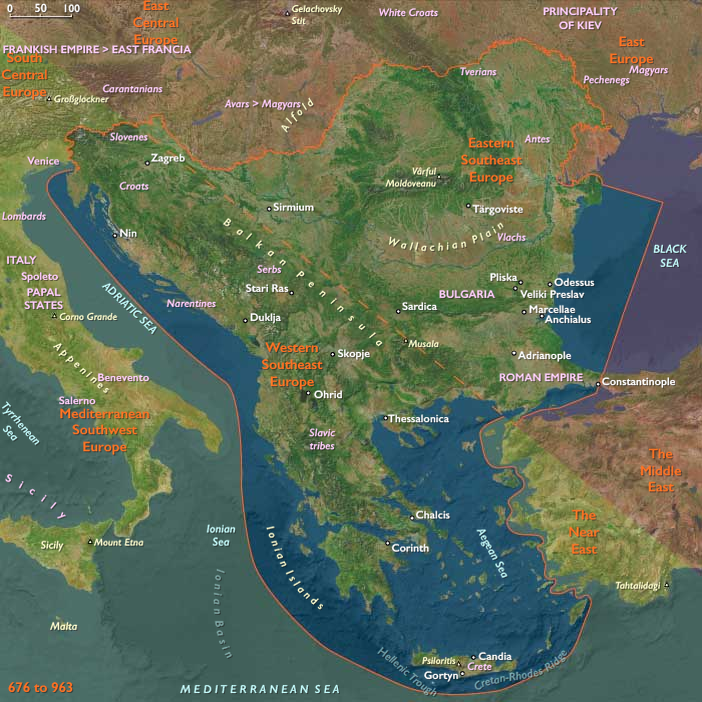
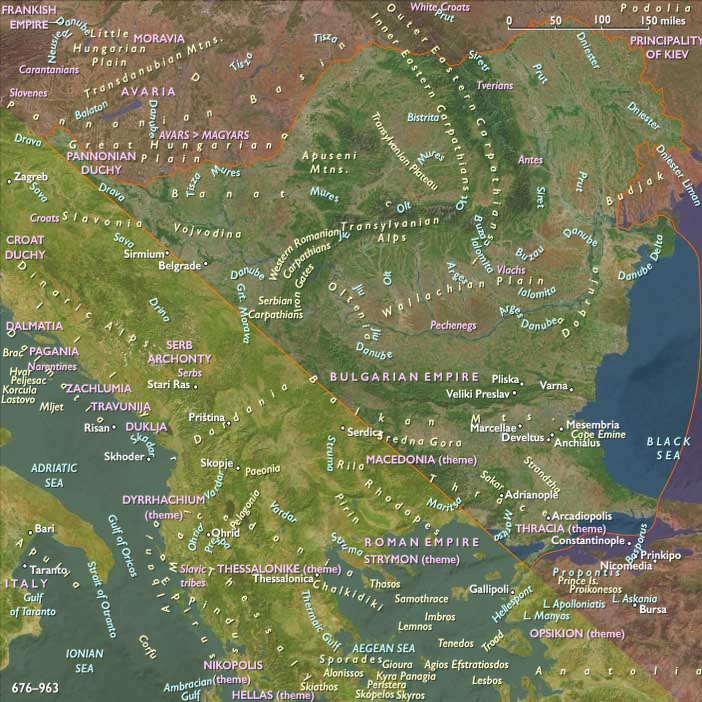
The ancient Black Sea Port of Odessus in the northeastern portion of the Bulgars' kingdom becomes known under them as Varna.
Locations
People
Groups
Topics
Commodoties
Subjects
Regions
Subregions
Related Events
Filter results
Showing 10 events out of 56024 total
The Göktürks, known in medieval Chinese sources as Tujue, had originated from the Ashina tribe, an Altaic people who lived in the northern corner of the area presently called Xinjiang.
Under the leadership of Bumin Khan and his sons, the Göktürks had in the late sixth century succeeded the Xiongnu as the main Turkic power in the region and taken hold of the lucrative Silk Road trade.
Rapidly expanding to rule huge territories in northwestern China, North Asia and Eastern Europe as far west as the Crimea, they are the first Turkic tribe known to use the name "Turk" as a political name.
A civil war at the beginning of the seventh century had left the empire divided into the eastern and western parts.
The eastern part, still ruled from Ötüken, had remained in the orbit of the Sui Empire and retained the name Göktürk.
The khans Shipi and Khieli of the East had attacked China at its weakest moment during the transition between the Sui and Tang dynasties, but in 657, the eastern part of the khaganate had been overrun by the Tang general Su Ding Fang, while the central part had emerged as the independent khaganate of Khazaria, led by a branch of the Ashina dynasty.
The Tang Emperor of China could by 659 claim to rule the entire Silk Road as far as Persia, as the Eastern Göktürks now carried Chinese titles and fought by their side in their wars.
The eastern steppes from 659 to 681 have been characterized by numerous independent rulers, weak, divided, and engaged in constant petty wars.
To the east, the Uyghurs had defeated their one-time allies the Syr-Tardush, a Tiele people and khanate in central and northern Asia, while to the west the Turgesh of the Ili Valley had emerged as successors to the Western Göktürks, or Onoq.
Despite these setbacks, Ilteris Sad, or Idat, and his brother Bakçor Qapagan Khan, or Mo-ch'o, after revolting against Chinese domination, succeed in 681 in reestablishing the Khanate.
The Eastern Göktürk Khagans over the following decades will steadily gain control of the steppes beyond the Great Wall.

The Danube Bulgars, a Turkic tribe, had conquered the Slavs immediately south of the Danube, absorbing a large portion of ancient Dacia in 676.
The Bulgars, who will soon be permeated by Vlach and, even more thoroughly, by Slavic elements, will unite with the Slavs to oppose Imperial control.
At the same time, their conquests will carry them deeper into the ambit of Constantinopolitan Christianity.
The Bulgarian khan Asparukh, eluding Constantine IV's attempts to defeat him, has by 681 forced the emperor to recognize the first Bulgarian state, which, with its capital at Pliska (near modern Shumen), combines a Bulgarian political structure with Slavic linguistic and cultural institutions.
Occupying lands south of the Danube into the Thracian plain—much to the humiliation of Constantinople—the Bulgars have thus deprived the empire of control in the north and central Balkans.
The armies of the Bulgars and Slavs had advanced after their decisive victory at Ongala in 680 to the south of the Balkan Mountains, defeating again the forces of Constantinople.
The Empire is compelled to sign a humiliating peace treaty that acknowledges the establishment of a new state on the borders of the Empire.
They are also to pay an annual tribute to Bulgaria.
The First Bulgarian Empire will be a regional power for more than two centuries.
The emperor in 680 summons the sixth ecumenical Council of Constantinople.
Some eastern Christians, forbidden to talk of the concept of one nature of Christ, think to enforce the unity of the person of Christ by talking of one will (thelema) and one operation (energeia) from the two natures.
Persons holding this view are called Monothelites.
Sergius, patriarch of Constantinople, and Honorius, pope of Rome, appear to have embraced the Monothelite doctrine.
The council of 680 condemns the Monothelites, among them Honorius, dead for forty-two years, and asserts two wills and two operations, the orthodox christological doctrine as laid in 451 by the Council of Chalcedon (451).
“Each nature with the communion of the other willed and wrought that which was proper to itself.”
The council does not, however, posthumously accuse Honorius of the formal teaching of heresy.
Yazid, whose mother Maysun was Christian, lightens the taxation of some Christian groups and abolishes the tax concessions granted to the Samaritans as a reward for aid they had rendered in the days of the early Arab conquests.
He energetically tries to continue the policies of Mu'awiyah and keeps many of the men who had been in his father's service.
He reforms the financial system, strengthens the administrative structure of the empire, and improves the military defenses of Syria.
Concerning himself with agricultural matters, he improves the irrigation system of the Damascus oasis.
The Shiites, ridden with grief and shame for not having risen in support of Hussein, begin to consolidate Shiitism into a distinct sect within Islam.
Kerbala will soon become the major pilgrimage center for the Shiites.
The Rise and Fall of Ebroin: Power and Assassination
By 679, Ebroin, the ambitious and ruthless mayor of the palace of Neustria, consolidates his control over both Neustria and Burgundy after escaping imprisonment in Burgundy. In his bid for dominance, he captures his chief rival, Leodegar, the powerful Bishop of Autun, and has him executed—eliminating one of the last major obstacles to his rule.
With Leodegar removed, Ebroin reigns as the undisputed power behind the Merovingian throne, maintaining a firm grip on the Frankish court through a combination of political cunning and military force. However, his rule is short-lived; in 681, he is assassinated, bringing an abrupt end to his dominance.
His death marks yet another turn in the ongoing power struggles between Frankish mayors of the palace, further destabilizing the fragile unity of the Merovingian kingdoms and accelerating the rise of the Arnulfing and Carolingian factions that would soon reshape the political landscape of Francia.
Itzamnaaj Bʻalam II, known to modern writers as Shield Jaguar II, becomes in 681 the ruler of Yaxchilan, a prosperous Maya site on an omega-shaped loop in the Usumacinta River in present-day Chiapas, Mexico.
Born in 647 to Lady Pacal and Yaxun B'alam III, is grandmother was Lady Xibalba, a noblewoman.
Little is known of Itzamnaaj Bʻalam's early life except that when he was eleven years old one of his siblings participated in a war that involved Pacal, the famous king of Palenque.
In order to become king, Itzamnaaj Bʻalam defeats Ah Ahaual (a Mayan noble) in war and takes him captive to Yaxchilan.
At the age of thirty-four, around October 23, 681, he becomes king of Yaxchilan.
He is married to his aunt, Lady Xoc, who holds a great amount of power.
Emperor Temmu issues a decree in 682 forbidding the Japanese-style cap of ranks and garments, and changing them into Chinese ones.
He also makes a decree forbidding men to wear leggings and women to let down their hair on their backs.
It is from this time that the practice begins of women riding on horseback like men.
He issues an edict prescribing the character of ceremonies and language to be used on ceremonial occasions.
Ceremonial kneeling and crawling are both abolished, and the Tang Court’s ceremonial custom of standing is practiced instead.
A widespread famine in China, due to a culmination of major droughts, floods, locust plagues, and epidemics, breaks out in the dual capital cities of Chang'an (primary capital) and …