
The ambitious Philip V of Macedon, now …
Years: 215BCE - 215BCE
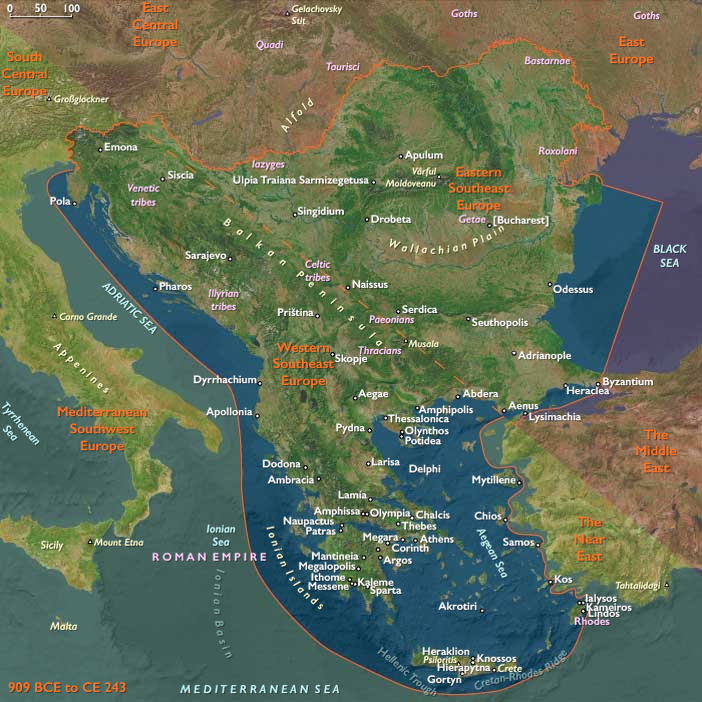
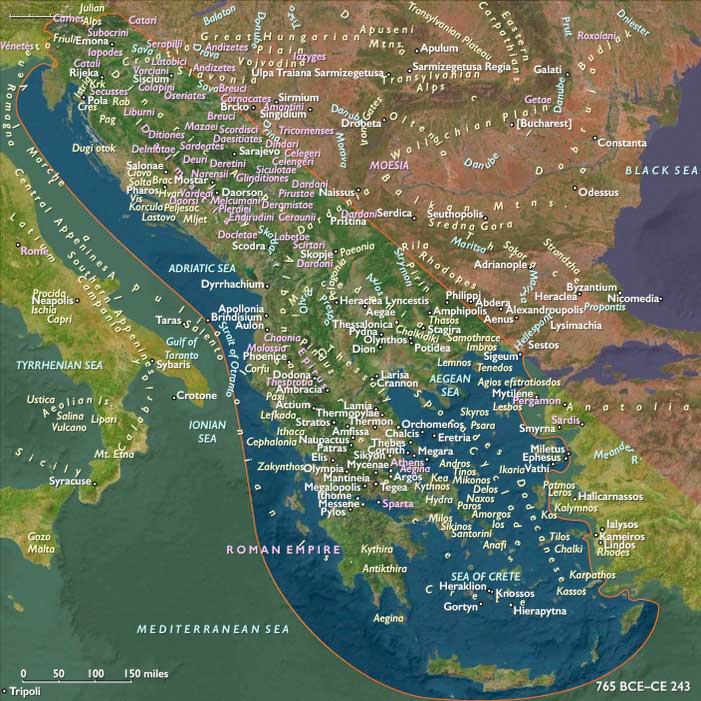
The ambitious Philip V of Macedon, now popular throughout much of Greece following his decisive actions in the so-called War of the Allies (also the Social War of 219—217), looks to extend his empire while Rome is preoccupied with fighting Carthage in the Second Punic War.
In an attempt to stem the tide of Roman expansion, sets out to attack Rome's client states in neighboring Illyria.
He confirms his purpose in 215 by making an alliance against Rome with Hannibal, the Carthaginian general who is invading Italy and is interested to protect supply lines from North Africa.
Philip, currently the most powerful ruler in the Balkans, thus initiates ten years of inconclusive warfare against Rome (First Macedonian War, 215-205).
Rome responds by supporting Philip's many enemies in the Balkans as they fight the war, which expands Roman interests into the Balkans.
Locations
People
Groups
- Carthage, Kingdom of
- Roman Republic
- Greece, Hellenistic
- Illyria, Kingdoms of
- Greeks, Hellenistic
- Macedon, Antigonid Kingdom of
Topics
- Iron Age Europe
- Classical antiquity
- Punic War, Second (Hannibalic War)
- Macedonian War, First
- Roman Age Optimum
Commodoties
Subjects
Regions
Subregions
Related Events
Filter results
Showing 7 events out of 7 total
William I of Aquitaine and the Founding of Cluny Abbey (910): A Turning Point in Medieval Monasticism
William I of Aquitaine, also known as William the Pious, emerges as a powerful noble in post-Carolingian France, ruling over a vast domain that stretches from Austrasia to Toulouse, including Auvergne, the Limousin, Poitou, the Autunois, and the Mâconnais. His legacy, however, is most enduringly tied to his founding of Cluny Abbey in 910, which sparks a monastic revival across Europe.
William’s Rise to Power
- Son of Bernard II of Auvergne and Ermengard, William inherits Auvergne and the Limousin.
- In 893, he conquers Poitou and Aquitaine on behalf of Ebalus Manser, but keeps Aquitaine for himself and is proclaimed duke.
- His marriage to Engelberga, daughter of Boso of Provence and Ermengard of Italy, strengthens his political alliances with the Bosonid dynasty.
The Founding of Cluny Abbey (910)
In 910, William I of Aquitaine donates land in the forests of Burgundy to establish Cluny Abbey, laying the foundation for one of the most influential monastic movements in medieval Europe.
- Unlike most noble patrons, William relinquishes all control over the monastery.
- He places the abbey under direct papal authority, answering only to Pope Sergius III, thus freeing it from secular influence and noble interference.
- This is a radical departure from the common practice, where noble founders retained control over monasteries and installed their relatives as abbots.
The Cluniac Reforms and Berno’s Leadership
- William nominates Berno of Baume as the first abbot of Cluny, entrusting him with high standards of monastic observance.
- Cluny follows strict Benedictine Rule, emphasizing:
- Liturgical prayer and elaborate divine office recitations.
- Moral and spiritual discipline among monks.
- A centralized system, where Cluny exerts direct control over its daughter houses, ensuring uniformity in monastic life.
The Expansion of the Cluniac Movement
- By the 12th century, the Congregation of Cluny will include over a thousand monasteries across Europe.
- The Cluniac Order becomes a spiritual and cultural force, influencing papal politics, monastic discipline, and medieval art and architecture.
- Cluny’s independence from feudal lords serves as a model for later monastic movements, reinforcing the Church’s authority over secular rulers.
Legacy of William I of Aquitaine
- His political achievements in Aquitaine cement his rule as a strong feudal lord.
- His founding of Cluny transforms medieval monasticism, leading to:
- Greater monastic autonomy from secular interference.
- Revival of discipline and learning within the Benedictine tradition.
- A major step toward Church reform movements, culminating in the Gregorian Reforms of the 11th century.
While William I is a powerful feudal ruler, it is his visionary support of monastic reform that shapes the future of Western Christianity. His decision to free Cluny from secular entanglements ensures that the Cluniac movement will become one of the defining religious forces of medieval Europe.
The Cluniac Influence on Western European Iconography (c. 1000 CE)
By 1000 CE, the Benedictine Abbey of Cluny, the preeminent center of Western monasticism, began to exert a profound influence on the development of medieval European art and iconography. The Cluniac vision of the world, which emphasized the divine order of all creation, led to a broadening of artistic themes beyond strictly religious subjects.
The Cluniac Perspective on Art and Symbolism
- The Cluniac monks believed that all human activities and creatures played a role in the divine plan, making them appropriate subjects for artistic representation.
- This expanded worldview encouraged the integration of secular motifs alongside sacred imagery in sculpture, wall paintings, and manuscript illumination.
- Religious and allegorical themes merged with depictions of daily life, nature, and mythical creatures, giving medieval art a richer and more diverse visual language.
Major Themes in Cluniac-Inspired Art
-
The Twelve Labors of the Months
- A cycle depicting the annual agricultural and pastoral activities associated with each month, often showing farmers plowing, sowing, harvesting, and feasting.
- These scenes reflected an emerging awareness of the seasons and the rhythms of peasant life as part of God's order.
-
The Bestiary: Allegorical Natural History
- A popular artistic and literary motif, the bestiary featured animals and birds, each with symbolic meaning.
- For example, the lion symbolized Christ, while the pelican feeding its young with its own bloodrepresented sacrificial love.
-
Monstrous and Mythical Creatures
- Western European art increasingly depicted bizarre humanoid monsters, believed to inhabit the Earth’s outer regions.
- These included creatures from ancient and medieval folklore, such as the Cynocephali (dog-headed men), Sciapods (one-legged people), and Blemmyae (headless beings with faces on their chests).
- Their inclusion reflected both medieval curiosity about the unknown world and the allegorical use of monstrosities to symbolize sin, heresy, or the wonders of divine creation.
Impact on Medieval Art and Architecture
- This new iconographic approach influenced Romanesque sculpture, frescoes, and illuminated manuscripts, enriching monastic and ecclesiastical art.
- Monastic cloisters and church portals began incorporating narrative reliefs of both sacred and secular themes, reinforcing the idea that all creation was worthy of depiction in a house of God.
Legacy
The Cluniac artistic vision helped shape the broader medieval aesthetic, bridging the gap between the sacred and the worldly. By incorporating secular and allegorical imagery into Christian art, Cluny paved the way for the expressive visual culture of the Romanesque and Gothic periods, leaving a lasting imprint on Western European artistic traditions.
Cluny III and the Expansion of Cluniac Architecture (1090–1095)
The fast-growing monastic community at Cluny in Burgundy, the spiritual and architectural center of the Benedictine order in France, required ever-larger buildings to accommodate its expanding influence and religious mission. The three successive abbey churches, known as Cluny I, II, and III, profoundly shaped Western European architectural practice from the 10th through the 12th centuries.
The latest and greatest of these, Cluny III, was undertaken under Abbot Hugh of Cluny, funded largely by the Alfonsine census from the kings of León-Castile, and became the largest building in Europe upon its consecration in 1095, a title it would hold until the construction of St. Peter’s Basilica in Rome in the 16th century.
Cluny II: The Predecessor to Cluny III (955–981)
- Built after the Hungarian raids of 953, Cluny II established the Burgundian trend of stone-vaulted churches.
- It was an important milestone but would eventually prove too small for the rapidly expanding Cluniac order.
The Alfonsine Census: A Royal Gift to Cluny (1053–1090)
- The construction of Cluny III was made possible by royal patronage from the kings of León-Castile.
- Ferdinand I of León had established an annual tribute (census) for Cluny between 1053 and 1065, fixing it at 1,000 golden aurei.
- In 1077, Alfonso VI of León-Castile reestablished the tribute and doubled it in 1090, providing Cluny with its largest financial gift ever.
- The Alfonsine census remained the most significant monetary contribution to the order, surpassing later grants, such as Henry I of England’s annual gift of 100 marks of silver from 1131.
Cluny III: A Monumental Architectural Achievement (1090–1095)
- Construction of Cluny III began in 1090 under Abbot Hugh, a major proponent of Cluniac expansion.
- The church's monumental plan included:
- Five aisles, far larger than traditional Romanesque basilicas.
- Two transepts, adding to the majestic scale of the structure.
- A chevet with radiating chapels, reflecting Cluniac liturgical preferences.
- A massive westworks and narthex, giving the church a commanding entrance.
- A stone barrel vault, which allowed for an exceptionally broad nave.
- Consecrated in 1095, Cluny III became the largest building in Europe, dwarfing even the imperial cathedrals of Germany and remaining unrivaled until the construction of St. Peter’s Basilica in Rome in the 16th century.
The Legacy of Cluny III
- Benedictine churches across France and beyond followed the architectural model set by Cluny III, influencing later Romanesque and Gothic styles.
- The liturgical innovations of Cluny, reflected in its multiple chapels, vast ambulatory, and grand processional spaces, shaped medieval monastic worship.
- Cluny III stood as a symbol of monastic power and papal influence, reinforcing Cluny’s role as a center of European spirituality and reform.
The construction and consecration of Cluny III (1095) was a defining moment in medieval architecture and monasticism, establishing a model that would shape Romanesque church design for centuries.
Bernard of Clairvaux and the Debate Over Church Decoration: The Apologia (1127 CE)
In 1127, Bernard of Clairvaux, the leading advocate of monastic austerity and spiritual purity, delivered a forceful critique of artistic embellishment in churches, particularly in monastic architecture, through his treatise, the Apologia.
Bernard sought to define the proper relationship between art and worship, denouncing the excessive adornment of sacred spaces, which he viewed as a distraction from true devotion. His argument was particularly aimed at Cluniac monasticism, which had embraced richly decorated churches, elaborate sculptures, and opulent furnishings.
Bernard’s Criticism of Artistic Excess
-
Bernard condemned ornate architecture, lavish sculptures, and excessive decoration in monasteries, arguing that they led monks away from spiritual contemplation and toward vanity.
-
He believed that overly adorned churches turned places of worship into spectacles for the senses rather than spaces for humble devotion.
-
He specifically criticized the use of grotesque sculptures and elaborate carvings, stating:
“What is the point of these ridiculous monstrosities… foul and deformed figures… beautiful deformities and deformed beauties?”
Bernard insisted that the purpose of religious art should be to serve devotion, not distract from it.
Bernard’s Acknowledgment of the Argument for Rich Church Decoration
Despite his staunch opposition, Bernard recognized the theological justification for richly decorated churches. He acknowledged the powerful argument that:
- Since Christ is believed to be physically present in the church through the miracle of transubstantiationduring the Mass, then:
- No sacrifice is too great in the effort to enrich and glorify that sacred moment.
This argument reflected a fundamental tension between monastic simplicity and the grandeur of ecclesiastical worship, particularly in the growing movement of Gothic architecture, which sought to elevate the experience of the divine through soaring spaces and radiant light.
Impact and Legacy of the Apologia
- Bernard’s critique played a significant role in shaping Cistercian architecture, which embraced simplicity, functionality, and the rejection of elaborate ornamentation.
- His vision led to the construction of austere yet beautifully proportioned monasteries, emphasizing spiritual focus over sensory indulgence.
- However, his concessions to the liturgical argument for grand church decoration revealed that even the strictest critics of ornamentation could not dismiss the role of art in deepening religious experience.
While Bernard’s vision of monastic austerity influenced Cistercian architecture, his acknowledgment of the sacred role of beauty in worship foreshadowed the continued rise of ornate medieval cathedrals—monuments to both spiritual devotion and artistic splendor.
Cluny III: The Apex of Romanesque Architecture (Consecrated 1130 CE)
The third and final church of the Abbey of Cluny, known as Cluny III, represented the culmination of Romanesque architectural ambition, setting new standards for scale, engineering, and design. Consecrated in 1130 CE, Cluny III remained the largest building in Europe until the Italian Renaissance, reflecting the power and influence of the Cluniac Order.
Innovations in Scale and Structure
- Unprecedented Nave Design – Unlike traditional churches with three aisles, Cluny III’s nave featured five aisles, creating an expansive and monumental interior.
- Soaring Vaults – The central barrel-vaulted aisle reached a staggering height of 96 feet (29.29 meters), making it the tallest Romanesque church ever built.
- Dual Transepts and Towered Crossings – The two lofty transepts, each crowned with towers at their crossings, emphasized the monumentality and complexity of the layout.
Architectural Innovations and Structural Challenges
- Pointed Arches – The builders employed pointed arches throughout the ground-story arcade and the side aisles, foreshadowing Gothic structural techniques that would later redefine European church architecture.
- Revolutionary Clerestory Windows – Instead of the solid masonry upper walls traditionally used to buttress barrel vaults, Cluny III incorporated three round-headed windows in each bay of the clerestory, allowing unprecedented natural light to penetrate the nave.
- This innovation, however, compromised structural stability, and some vaults collapsed in 1120, requiring urgent repairs before the church’s general consecration in 1130.
The Legacy of Cluny III
- Cluny III represented the zenith of Romanesque architecture, combining monumentality with innovative engineering.
- The church’s pointed arches and clerestory windows would directly influence the emerging Gothic style, particularly in Île-de-France.
- Though largely dismantled during the French Revolution, Cluny III’s architectural innovations paved the way for later medieval cathedrals, making it a landmark in European architectural history.
For nearly four centuries, Cluny III stood as a symbol of monastic grandeur, reflecting the Cluniac Order’s unparalleled influence in the medieval world.
Peter the Venerable and the First Latin Translation of the Qur’an (1143 CE)
By 1143 CE, Peter the Venerable, the Abbot of Cluny, had restored his monastery to great prominence through spiritual, intellectual, and financial reforms, reaffirming Cluny’s place as one of the most influential religious institutions in Europe.
Unlike many of his contemporaries, who viewed the Crusades primarily as military ventures, Peter sought to engage Islam through scholarship and missionary efforts, promoting intellectual confrontation rather than outright warfare.
The First Latin Translation of the Qur’an
- Peter the Venerable commissioned the first Latin translation of the Qur’an, intending it to serve as a tool for Christian refutation of Islamic theology.
- This translation was completed by Robert of Ketton, an English scholar active in Toledo, Spain, a major center of cross-cultural intellectual exchange.
- The resulting work, known as the "Lex Mahumet pseudoprophete" (The Law of Muhammad the False Prophet), became the primary source for European understanding of Islam for centuries.
Peter’s Vision: A Nonviolent Approach to the Crusades
- Unlike many Crusader-era church leaders, Peter the Venerable did not advocate for conquest alone, instead seeing conversion through reasoned debate as a more effective means of engagement.
- His translation project was meant to arm Christian scholars with knowledge of Islam, enabling them to refute it intellectually rather than by force.
- He believed that by understanding the Qur’an, Christians could better argue against Islamic theology, leading to potential conversions rather than mere destruction.
Impact of Peter’s Qur’an Translation
- Influence on Medieval Scholasticism – This translation introduced European scholars to Islamic teachings, influencing medieval theological debates.
- Foundation for Future Studies – The text was later used by Thomas Aquinas and other medieval scholars in their examinations of Islamic philosophy.
- The First Step Toward Comparative Religion – While intended as a refutation, the translation fostered a more nuanced understanding of Islam, marking an early attempt at cross-cultural religious study.
Though Peter the Venerable’s approach did not replace the military Crusades, his work pioneered a more intellectual and theological engagement with Islam, reinforcing his status as one of the most forward-thinking church leaders of the 12th century.
Peter the Venerable: Defender of Papal Authority and Architect of Christian-Muslim-Jewish Polemics (1146 CE)
Peter the Venerable, Abbot of Cluny, played a key role in the consolidation of papal authority, intellectual engagement with Islam, and the Church’s evolving stance on Jews in medieval Europe.
By 1146, Peter had already:
- Supported Pope Innocent II alongside Bernard of Clairvaux, helping to weaken the legitimacy of Antipope Anacletus II.
- Served as papal ambassador to Aquitaine, Italy, and England, strengthening Cluniac influence and Church authority.
- Advocated for intellectual engagement over military confrontation with Islam, commissioning the first Latin translation of the Qur’an (completed in 1143 by Robert of Ketton).
Peter the Venerable’s Views on the Jews (1146 CE)
- In 1146, during the rising anti-Jewish sentiment that accompanied the Second Crusade, Peter the Venerable urged King Louis VII of France to take a specific stance on the treatment of Jews.
- He advised that Jews should be "execrated and hated but not killed," instead advocating for punishment fitting to their supposed perversity.
- His words reflect the shifting Church policy toward Jews:
- Earlier medieval rulers had often viewed Jews as protected subjects of the crown.
- However, growing economic resentment, religious hostility, and Crusader fervor led to increased calls for persecution.
Peter’s position aligned with Church doctrine at the time, which did not endorse massacres but did encourage social and economic restrictions on Jewish communities. His views likely contributed to:
- The expansion of anti-Jewish laws and restrictions in France and other parts of Europe.
- A theological foundation for increased marginalization, as Jews were increasingly seen as perpetual outsiders in Christendom.
Peter the Venerable’s Legacy
- A Leading Cluniac Reformer – He revitalized Cluny as a major intellectual and religious center, strengthening monastic influence across Europe.
- A Crusading Theorist and Translator of Islam – His commissioning of the first Latin Qur’an marked the beginning of scholarly Christian engagement with Islamic theology.
- A Key Figure in Medieval Jewish-Christian Relations – His statements helped shape the Church’s restrictive policies on Jews, reinforcing anti-Jewish sentiment without endorsing mass violence.
Peter the Venerable’s complex legacy reflects the intellectual, religious, and political tensions of the 12th century, as Christianity navigated its relationships with Islam, Judaism, and internal Church reform.
Years: 215BCE - 215BCE
Locations
People
Groups
- Carthage, Kingdom of
- Roman Republic
- Greece, Hellenistic
- Illyria, Kingdoms of
- Greeks, Hellenistic
- Macedon, Antigonid Kingdom of
Topics
- Iron Age Europe
- Classical antiquity
- Punic War, Second (Hannibalic War)
- Macedonian War, First
- Roman Age Optimum
