The Almoravid governor of Zaragoza, Muhàmmad ibn …
Years: 1113 - 1113
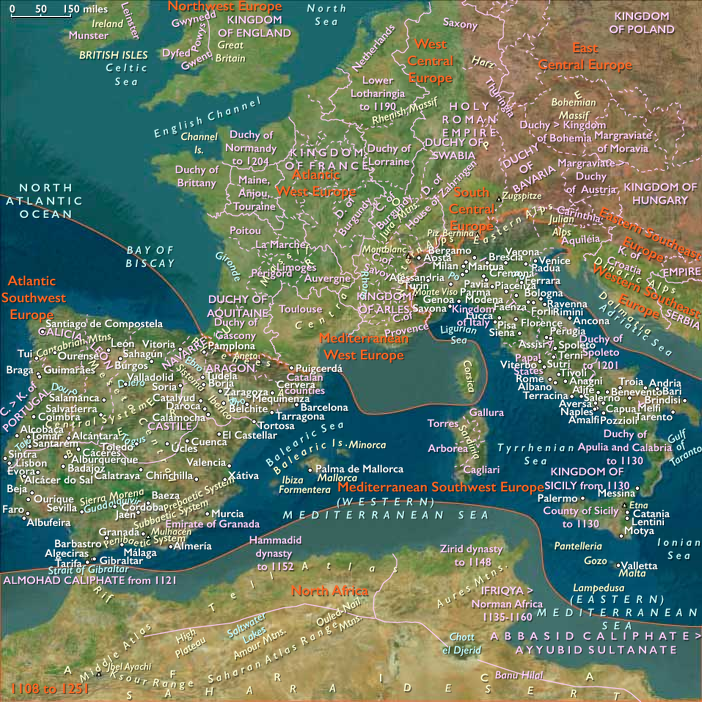
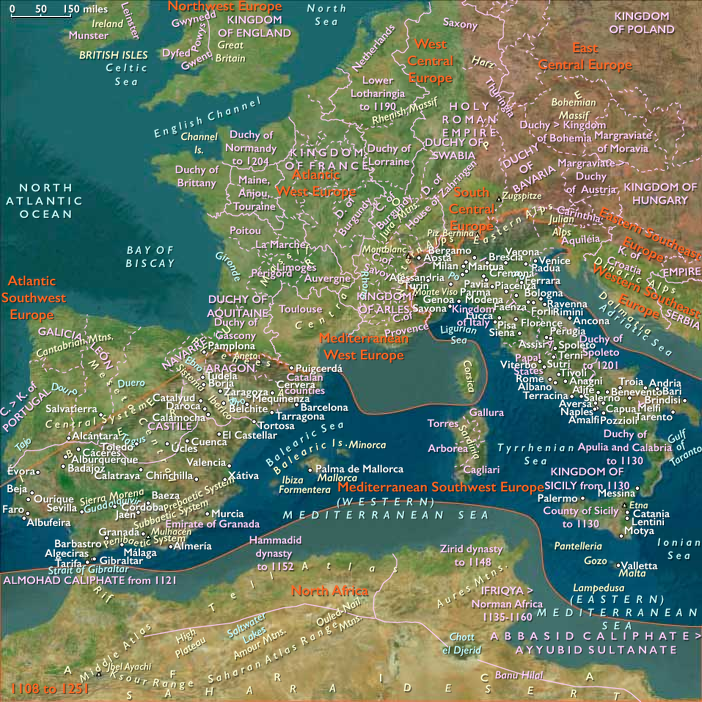
The Almoravid governor of Zaragoza, Muhàmmad ibn al-Hajj, launches an offensive against the County of Barcelona; Ramon Berenguer II defeats him at the Battle of Martorell.
Locations
People
Groups
Topics
Commodoties
Subjects
Regions
Subregions
Related Events
Filter results
Showing 10 events out of 49476 total
King Kyansittha has successfully melded the diverse cultural influences introduced into Pagan by Anawrahta's conquests.
He has patronized Mon scholars and artisans who have emerged as the intellectual elite.
He has appeased the Pyus by linking his genealogy to the real and mythical ancestors of Sri Ksetra, the symbol of the Pyu golden past, and by calling the kingdom Pyu, even though it had been ruled by a Burman ruling class.
He supports and favors Theravada Buddhism while tolerating other religious groups.
To be sure, he has pursued these policies all the while maintaining the Burman military rule.
By the end of his twenty-eight-year reign, Pagan has emerged a major power alongside the Khmer Empire in Southeast Asia, recognized as a sovereign kingdom by the Chinese Song Dynasty, and the Indian Chola Dynasty.
Several diverse elements—art, architecture, religion, language, literature, ethnic plurality—have begun to synthesize.
His grandson and successor was born Zeyathura Sithu to Sawyun (son of King Sawlu) and Shwe Einthi (daughter of King Kyansittha) on December 13, 1089.
At Sithu's birth, Kyansittha, who had thought that he had no son, had been so delighted that he had crowned the infant as king, and presented the baby to the people saying "Behold your king!
Henceforth, I reign only as his regent."
(It turned out that Kyansittha did have a son by a wife during one of his exiles in the 1070s.
That son, Yazakumar, makes no claims of the throne.)
Following the death of Kyansittha in 1112 or 1113, Sithu faces no opposition to the throne.
His coronation is presided over by an aging Primate Shin Arahan who had also presided over the coronations of the two predecessor kings, and has been adviser to three previous kings.
Wang Ximeng, a prodigy, is one of the most renowned court painters of the Northern Song period, and has been taught personally by Emperor Huizong of Song himself.
He will die at the age of twenty-three.
Wang's only surviving work is an 11.9 meter (thirty-nine feet) long scroll titled A Thousand Li of Rivers and Mountains.
The painting, finished by Wang when he was only eighteen in 1113, is one of the largest in Chinese history, and has been described as one of the greatest works of Chinese art.
The painting is in the permanent collection of the Palace Museum in Beijing.
The Primary Chronicle, a comprehensive history of the Kievan Rus' from around 850 to 1110 is originally compiled in Kiev about 1113.
Written in the Russian vernacular and compiled by monks, it is the most significant literary product of the so-called Kievan period.
Unmatched in other sources, although important correctives are provided by the Novgorod First Chronicle, it is also valuable as a prime example of the Old East Slavonic literature.
Sviatopolk II, prince of Kiev and Chernigov, has been supreme ruler of the Kievan Rus for twenty years, from 1093.
A popular prince, his reign has been marked by incessant rivalry with his cousin, Prince Vladimir Monomakh, the son of Vsevolod I by Anastasia, the probable daughter of Emperor Constantine IX Monomachos, from whom he takes his nickname of Monomakh ("One who fights alone").
Sviatopolk had married twice; to a Bohemian princess and then in 1094 to a daughter of Tugor Khan of the Kipchaks.
By his first wife he had two daughters, Zbyslava, whom he married to king Boleslaw III of Poland, and Predslava to Prince Álmos of Croatia.
His son Yaroslav reigned in Volhynia and was married three times—to Hungarian, Polish, and Kievan princesses.
In consequence of Yaroslav's early death, his descendants have forfeited any right to the Kievan throne and must content themselves with Turov and Pinsk.
Following the death of the Grand Prince in 1113, the Kievan citizens raise a rebellion against the Jewish merchants and Varangian officials who speculate in grain and salts, attacking and robbing the city’s Jewish inhabitants.
The populace summons to the capital Vladimir, who enters Kiev to the great delight of the crowd; he will reign here until his death in 1125, promulgating a number of reforms in order to allay the social tensions in the capital.
According to later claims by Russian historians, the new monarch expelled all the Jews from Russia but there is no evidence that this actually occurred.
Succeeding generations will often refer to his reign as the golden age of Kiev.

The Turks have resumed their offensive operations against the Empire following the success of the First Crusade and the failure of the Crusade of 1101.
Emperor Alexios, aged and suffering from an illness that will prove to be terminal, is unable to deal with the swift Turkish raids into what remains of Roman Anatolia, penetrating as far as the Bosporus, but internal dissension has caused disunity following the death of Sultan Kilij Arslan.
Nonetheless, in the aftermath of the Frankish invasions, much land has been reconsolidated by the Seljuq Turks under the centralized authority of Iconium, where the Sultanate of Rum has established itself under Malik Shah.
After the imperial forces thwart an attempt to take Nicaea in 1113, the Seljuq Turks make a forced withdrawal across Anatolia.
Joscelin, the son of Joscelin I, Lord of Courtenay, born in 1034, and wife Isabella (or Elizabeth), daughter of Guy I of Montlhéry, had arrived in the Holy Land during the Crusade of 1101 after the First Crusade, and entered into the service of his relative Count Baldwin II, who had invested him with the lordship of Turbessel.
By 1113, Joscelin has carved out a semiautonomous state around Turbessel to the west of the Euphrates, where the land is prosperous, while Baldwin II controls the territory east of the Euphrates around Edessa itself, which is depopulated and continually harassed by the Turks.
In this year, Baldwin dispossesses him of Turbessel, and Joscelins travels to Jerusalem, where he is given the title of Prince of Galilee.
Fakhr al-Muk Radwan, Seljuq ruler of Aleppo, had frequently come into conflict with Tancred until the latter reduced Aleppo to a tributary state in 1111.
The qadi of Aleppo, Ibn al-Khashshab, had traveled to Baghdad to meet with the Abbasid caliph when Radwan was unwilling to pursue war with Tancred.
Ibn al-Khashshab had succeeded in having Mawdud of Mosul sent to Aleppo's aid, but Radwan was also antagbeen murdered by the Hashshashin, possibly with Radwan's approval.
Upon his death on December 10, 1113, Radwan is succeeded by his teenage son Alp Arslan al-Akhras, under the regency of Lulu and ibn al-Khashshab.
Lulu does not continue Radwan's policy of support for the Hashshashin, and has them all expelled or killed, although this leaves Aleppo without any powerful allies.
The city falls into near chaos, and soon comes under the control of Sulaiman, Ilghazi's son, who had married Radwan's daughter.
The Knights Hospitaller, or Hospitallers, of Saint John of Jerusalem, is formally named and recognized in a papal bull issued by Pope Paschal II on February 15, 1113, as an order of canons regular.
Italian merchants from Amalfi had in the last century founded a hospital in Jerusalem to care for sick and poor pilgrims.
After the Christian conquest of Jerusalem in 1099 during the First Crusade, the hospital's superior, a monk named Gerard de Martignes, had intensified his work in Jerusalem and has founded hostels in Provençal and Italian cities on the route to the Holy Land.
Following the loss of the Holy Land by Christian forces, the Order will operate from Rhodes, over which it will be sovereign, and later from Malta where it will administer a vassal state under the Spanish viceroy of Sicily.
When Napoleon captures Malta in 1798, the Knights will cease to be associated with any one place, but will give rise to Christian successor successor organizations in existence until the present day.
Mawdud joins Toghtekin of Damascus in 1113 and their combined army aims to cross the Jordan River south of the Sea of Galilee.
Baldwin I offers battle near the bridge of Al-Sannabra.
Mawdud uses the device of a feigned flight to entice Baldwin I into rashly ordering a charge.
The Frankish army is surprised and beaten when it unexpectedly runs into the main Turkish army.
The surviving Crusaders keep their cohesion and fall back to a hill west of the inland sea where they fortify their camp.
In this position they are reinforced from Tripoli and Antioch but remain inert.
A number of Christian pilgrims newly arrived from Europe also rally to the army after Al-Sannabra.
Unable to annihilate the Crusaders, Mawdud watches them with his main army while sending raiding columns to ravage the countryside and sack the town of Nablus.
In this, Mawdud anticipates the strategy of Saladin in two later campaigns that will be marked by the Battle of Belvoir Castle (1182) and the Battle of Al-Fule (1183).
As in these campaigns, the Frankish field army can oppose the main Muslim army, but it cannot stop raiding forces from doing great damage to crops and towns.
While the Turkish raiders roam freely through Crusader lands, the local Muslim farmers enter into friendly relations with them.
This deeply troubles the Frankish land magnates, who ultimately depend upon rents from cultivators of the soil.
Baldwin marries Adelaide del Vasto in 1113; he had abandoned his Armenian wife Arda in 1108, on the pretext that she had been unfaithful, or, according to Guibert of Nogent, because she had been raped by pirates on the way to Jerusalem.
It is more likely however that she was simply politically useless in Jerusalem, which has no Armenian population.
Under the marriage agreement, if Baldwin and Adelaide have no children, the heir to the kingdom will be Roger II of Sicily, Adelaide's son by her first husband Roger I. Technically the marriage to Adelaide is bigamous because Arda is still alive in a monastery in Jerusalem, and it will later cause many problems both for Baldwin and Patriarch Arnulf, who has sanctioned it.