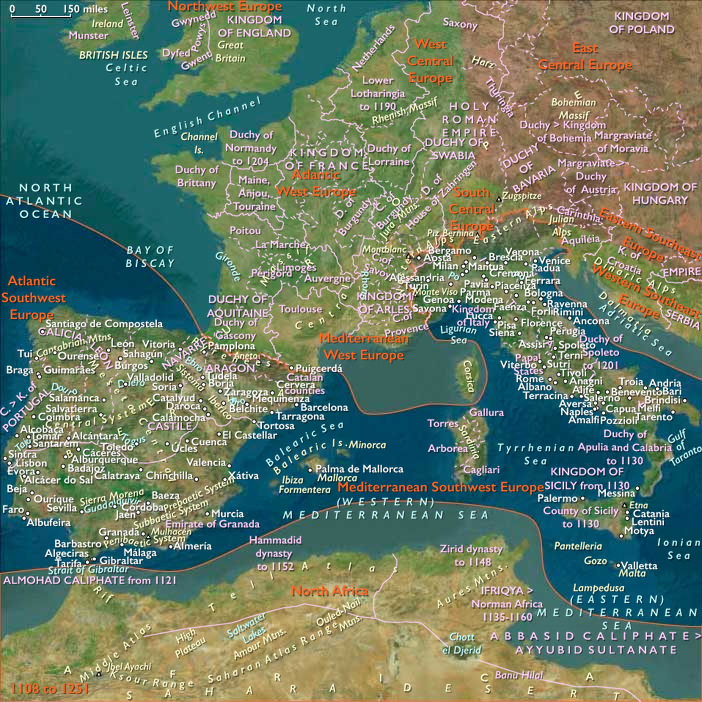
The Almoravid army led by Ali ibn …
Years: 1109 - 1109
The Almoravid army led by Ali ibn Yusuf fails in 1109 to reconquer Toledo (lost in 1085).
Locations
People
Groups
- Berber people (also called Amazigh people or Imazighen, "free men", singular Amazigh)
- Muslims, Sunni
- Christians, Roman Catholic
- Almoravid dynasty
- Castile, Kingdom of
- Aragón, Kingdom of
Topics
Commodoties
Subjects
Regions
Subregions
Related Events
Filter results
Showing 10 events out of 49542 total
The Crusaders take the city of Tiberias, one of the four cities holy to Jews, in 1109.
It is to be the central city of the Principality of Galilee. (The Principality will be destroyed by Saladin in 1187, although the title will afterwards be used as dignity by relatives and younger sons of the kings of Cyprus, the titular kings of Jerusalem.)
Palestine's Jewish urban-dwellers, with the notable exception of Jerusalem in 1099, are, as a rule, left alone once the military conquests end.
Urraca, the eldest surviving child of Alfonso VI of León with his second wife Constance of Burgundy, as eldest legitimate child of her father had been heiress presumptive from her birth until 1107, when Alfonso recognized his illegitimate son Sancho as his heir.
Urraca had become heiress presumptive again after Sancho’s death the following year, when he was killed after the Battle of Uclés.
Urraca’s place in the line of succession makes her the focus of dynastic politics, and she had become a child bride at age eight to Raymond of Burgundy, a mercenary adventurer.
Author Bernard F. Reilly suggests that, rather than a betrothal, the eight-year-old Urraca had been fully wedded to Raymond of Burgundy, as he almost immediately appeared in protocol documents as Alfonso VI's son-in-law, a distinction that would not have been made without the marriage.
Reilly doubts that the marriage was consummated until Urraca was thirteen, as she was placed under the protective guardianship of a trusted magnate.
Her pregnancy and stillbirth at age fourteen suggest that the marriage had indeed been consummated when she was thirteen or fourteen years old.
Urraca's marriage to Raymond had been part of Alfonso VI's diplomatic strategy to attract cross-Pyrenees alliances, and in 1105 she had given birth to a son, who will become Alfonso VII.
However, after Raymond died in 1107, Urraca’s father had contracted with Alfonso I of Aragon, known as the Battler, for a dynastic marriage with Urraca, opening the opportunity for uniting León-Castile with Aragón.
Marriage negotiations are still underway when Alfonso VI dies at the end of June 1109 and Urraca becomes queen.
Many of Alfonso VI’s advisers and leading magnates in the kingdom had formed a “quiet opposition” to the marriage of the Queen to the King of Aragon.
According to Bernard F. Reilly, these magnates feared the influence the King of Aragon might attempt to wield over Urraca and over Leonese politics.
Urraca had protested against the marriage but honors her late father’s wishes (and the Royal Council's advice) and continues with the marriage negotiations, though she and her father’s closest advisers are growing weary of Alfonso I's demands.
Despite the advisers' initial opposition, the prospect of Count Henry of Portugal filling any power vacuum leads them to go ahead with the marriage.
As events unfold, these advisers will turn out to have underestimated Urraca's political prowess, and will later advise her to end the marriage.
The marriage of Urraca and Alfonso I almost immediately sparks rebellions in Galicia and scheming by her illegitimate half-sister Theresa and brother-in-law Henry, the Countess and Count of Portugal.

Almoravid leader Ali ibn Yusuf organizes an auto-da-fé of the works of Al-Ghazali in front of the great mosque of Cordoba.
Recognized as the heir of his father Yusuf ibn Tashfin in 1102, he had succeeded his father upon his death in 1106.
Ruling from Morocco, he has appointed his brother Tamin ibn Yusuf as governor of Al-Andalus.
The Growing Threat to Normandy and the Conflict Between Louis VI and Henry I (1108–1109 CE)
Following the accession of Louis VI of France in 1108, the Duchy of Normandy faced increased pressure from a coalition of France, Anjou, and Flanders, as the new king sought to reassert royal authority over his vassals. Unlike his father, Philip I, whose influence had been limited to the Île-de-France, Louis VI pursued a more aggressive policy against the Anglo-Norman realm, directly challenging the authority of Henry I of England, Duke of Normandy.
Louis VI’s Demands and Henry I’s Defiance
Soon after taking the throne, Louis VI asserted his overlordship by demanding that Henry I pay homage for Normandy. Additionally, he insisted that two disputed castles along the Normandy border be placed under the control of neutral castellans, effectively reducing Henry’s control over these contested frontier strongholds.
Henry I, who had consolidated power in England and Normandy following his victory over Robert Curthose at the Battle of Tinchebray (1106), refused to acknowledge Louis’s authority in such matters. His response was outright defiance, rejecting both the homage and the demand to relinquish control of the castles.
Military Posturing and Diplomatic Stalemate
In response, Louis VI mobilized an army, preparing for a potential military campaign against Normandy. However, despite the show of force, neither side was eager to engage in open conflict at this stage. After heated negotiations, the two kings reached a truce, agreeing to withdraw without battle, yet leaving the core disputes unresolved.
This diplomatic impasse marked the beginning of a long-standing rivalry between the Capetian and Norman-Angevin realms. Though open war was avoided in 1109, tensions between Louis VI and Henry I would continue to escalate in the following years, culminating in further confrontations over Normandy’s borders, feudal allegiances, and the balance of power in Western France
Fulk V of Anjou and the Renewal of Angevin Power (1109 CE)
In 1109, Fulk V assumed control of Anjou, embarking on a campaign to rebuild Angevin authority and assert independence from Norman and English domination. His succession marked the beginning of a more assertive and ambitious Angevin policy, directly challenging Henry I of England, Duke of Normandy and King of England.
The Control of Maine and the Alliance with France
Along with Anjou, Fulk V inherited the County of Maine, a strategically vital territory contested by both Normandy and Anjou. Instead of recognizing Henry I as his feudal overlord, as his predecessors had done, Fulk chose to ally with King Louis VI of France, reinforcing Capetian efforts to counterbalance Norman power.
This move represented a direct rejection of Norman influence and strengthened the anti-Norman coalition, as both Louis VI and Fulk V sought to weaken Henry’s control over northern and western France.
Rising Tensions Between Anjou and Normandy
- Fulk’s refusal to pay homage to Henry I heightened tensions along the Normandy-Anjou frontier, exacerbating long-standing rivalries.
- His alliance with Louis VI provided the Capetians with a key ally, while positioning Anjou as a central player in the struggle for dominance in France.
- Henry I, preoccupied with securing Normandy’s borders and dealing with Flemish and Breton threats, sought to contain Fulk’s ambitions but refrained from immediate military action.
Fulk V’s defiance of Henry I and alignment with Capetian France set the stage for further Norman-Angevin conflicts, shaping the shifting balance of power in Atlantic West Europe over the next several decades.
Louis VI and the Struggle for Normandy (1109–1113 CE)
Upon ascending the throne in 1108, Louis VI ("the Fat") embarked on a lifelong campaign against the Norman kings of England, seeking to challenge their hold over Normandy and extend Capetian influence. Though, like his predecessors, he ruled only the Île-de-France and a few adjacent lands, Louis was determined to contest English power on the continent and position himself as the rightful overlord of Norman and Angevin territories.
A Lifelong Ambition for the English Throne
Even before becoming king, Louis VI had actively opposed the Anglo-Norman rulers:
- He had supported rebellion in Normandy, encouraging Duke Robert Curthose and his sons to resist the rule of Henry I of England.
- He had mentored Robert II of Normandy, fostering instability within the duchy and challenging Henry I’s authority.
- As king, he continued to claim feudal suzerainty over Normandy, insisting that Henry I owed him homage as Duke of Normandy.
However, rather than making direct claims to the English throne, Louis's ambitions were focused on undermining Anglo-Norman control in France, particularly in Normandy and the Vexin.
The Vexin and the War Against Henry I (1109–1113)
The Vexin, a valuable and contested region between Normandy and the Île-de-France, became the primary battleground in Louis VI’s war with Henry I. The territory was politically divided:
- Part of the region was controlled by Henry I, who had captured Duke Robert Curthose and consolidated power in Normandy.
- The other portion was aligned with Louis VI, who sought to exploit divisions among the Norman nobility to weaken Henry’s hold.
By 1109, Henry I launched an invasion of Capetian France, initiating a four-year war (1109–1113) marked by:
- Sporadic French raids into Normandy, aiming to disrupt Henry’s control.
- Counter-invasions by the English, devastating the lands of rebellious Norman barons loyal to Louis.
- Repeated truces, none of which resolved the underlying conflict.
Despite military setbacks, Louis VI solidified his authority in France, emerging as one of the strongest Capetian rulers since the division of the Carolingian Empire. His struggles with Henry I would set the stage for later Capetian-Plantagenet conflicts, defining the political landscape of Atlantic West Europe for generations to come.
Bertrand, the eldest son of the Raymond IV, has been ruling Toulouse in his absence.
After Raymond's death, the Barons of Toulouse had chosen Raymond’s six-year-old son Alfonso-Jordan to replace Bertrand, who, thus overthrown, has traveled to the east with fresh Genoan, Pisan and Provençal troops, arriving at Mons Peregrinus in 1108 to claim it for himself.
Here, he quarrels with the regent, William-Jordan, over the inheritance of the Raymond's lordship, and over the regency of still-unconquered Tripoli.
William allies himself with Tancred, Prince of Galilee, Regent of the Principality of Antioch, while Bertrand asks Baldwin I of Jerusalem to intervene.
Baldwin I, Baldwin of Bourcq, and Joscelin of Courtenay allied with Bertrand and William and Tancred were forced to compromise.
The Franks gather in force outside Tripoli in 1109.
Besieged for the past seven year and partially destroyed, Tripoli waits in vain for reinforcements from Fatimid Egypt.
A compromise decided in the course of a dispute beneath the walls of the city, and arbitrated by Baldwin of Jerusalem, allows the city to be captured: the County of Tripoli will be divided between the two claimants, William-Jordan, as a vassal of the Principality of Antioch, and Bertrand, as a vassal of Jerusalem.
The city falls on July 12, and is sacked by the crusaders.
One hundred thousand volumes of the Dar-em-Ilm library are deemed "impious" and burned.
The Egyptian fleet arrives eight hours too late.
Most of the inhabitants are enslaved, the others are deprived of their possessions and expelled.
A short time later William dies of an arrow wound sustained during the siege, and the county passes to Bertrand alone.
Tripoli joins the Kingdom of Jerusalem, and the Principality of Antioch and the County of Edessa as a fourth crusader state; unexpectedly defeated by an army under Shahriyar and his son Qarin III
…the Crusaders also capture Beirut.
Henry is furious and desires to avenge the Polish intervention that had caused his Hungarian fiasco.
He is poised to invade Poland in the summer of 1109 when the Polish ruler organizes an expedition into Pomerania in order to secure his northern boundary.
According to Gallus Anonymus, the purpose of the expedition wasn't just the taking of the castle of Nakło, but to force the Pomeranians into a decisive battle.
Gallus describes the battle in the first chapter of the third book of his chronicle.
On August 10, 1109, Boleslaw's force, which is besieging Naklo, engages the Pomeranian relief forces and defeats them.
As a result, the city surrenders to him.
Later, Boleslaw will incorporate Pomerania into his realm.
In Gallus' chronicle, the defeat of the Pomeranians and their conversion to Christianity are presented as one of Boleslaw's great achievements, comparable to the victory of King Otto I of Germany over the Hungarians at the 955 Battle of Lechfeld.
Boleslaw shortly afterwards has to rush to the south to meet Henry and his Imperial army at the Battle of Glogów.
He will later send Bishop Otto of Bamberg as a missionary to christianize Pomerania.
Henry invades Poland on behalf of Zbigniew, again with the support of Svatopluk, who leads a Bohemian army across the Sudetes into Silesia to join the German forces at the Battle of Głogów.
The German forces had gathered in late summer 1109 at Erfurt, crossed the Polish border near Krosno on the Bóbr river and on St. Bartholomew's Day approached the fortified town of Glogów with the support of Svatopluk, whose troops arrive in September).
Defeating a Polish army stationed near the town, and knowing that Boleslaw III is in the city, Henry decides to grant Glogów's citizens a five day ceasefire to ask their king to surrender.
Henry makes the citizens of Glogów give up their sons as hostages as a guarantee of the ceasefire and promises to give them back alive, no matter what the answer of the Polish king will be.
Receiving no reply after the time limit passes, Henry lays siege to the city and, breaking his promise, chains the hostages to his siege engines, gambling that the people of Glogów will not shoot their own children.
His cruelty only strengthens the resolve of Glogów's defenders, who repulse several attacks by the Imperial army.
During the siege, Svatopluk is assassinated on September 21, 1109 in the tent of the emperor by a member of the family of Vršovice, whose chief, Mutina, he had decapitated for the support he had given to Borivoj, who is now returned to the Bohemian ducal throne.
After many days of unsuccessful fighting, Henry is forced to abandon the siege and march south.
Years: 1109 - 1109
Locations
People
Groups
- Berber people (also called Amazigh people or Imazighen, "free men", singular Amazigh)
- Muslims, Sunni
- Christians, Roman Catholic
- Almoravid dynasty
- Castile, Kingdom of
- Aragón, Kingdom of