
The alliterative verse fragment known as the …
Years: 820 - 831
The alliterative verse fragment known as the Lay of Hildebrand (Das Hildebrandslied), written in Old High German alliterative verse, emphasizes fate in a decidedly pagan context.
The manuscript of the Hildebrandslied, discovered around 1715 by Johan Georg von Eckertis now in the Murhardsche Bibliothek in Kassel.
It is assumed to derive, like much else in the library's collection, from the monastery of Fulda.
It is written on two leaves of parchment, the first and last in a theological codex.
The codex itself was written in the first quarter of the ninth century, with the text of the Hildebrandslied added in the 830s on the two remaining blank leaves.
There is no evidence to support the suggestion of a missing third leaf which would have contained the end of the poem.
One of the earliest literary works in German, it tells of the tragic encounter in battle between a son and his unrecognized father.
It is the only surviving example in German of a genre which must have been important in the oral literature of the Germanic tribes.
Although there is no evidence that Hildebrand himself was a historical character, the background to the poem is formed by historical events in the late fifth century, when the Ostrogothic King Theodoric fought for mastery of Italy against Odoacer, the Germanic general who had deposed the last western Roman emperor, Romulus Augustulus, and reigned as King of Italy (476-493).
Theodoric appears widely in Germanic legend as Dietrich von Bern (Verona).
Theodoric's Gothic Kingdom of Italy was subsequently seized by the Lombards, who had close connections with the Bavarians in South Germany, both speaking closely related Upper German dialects.
This accounts for the transmission of legendary material relating to Theodoric northwards.
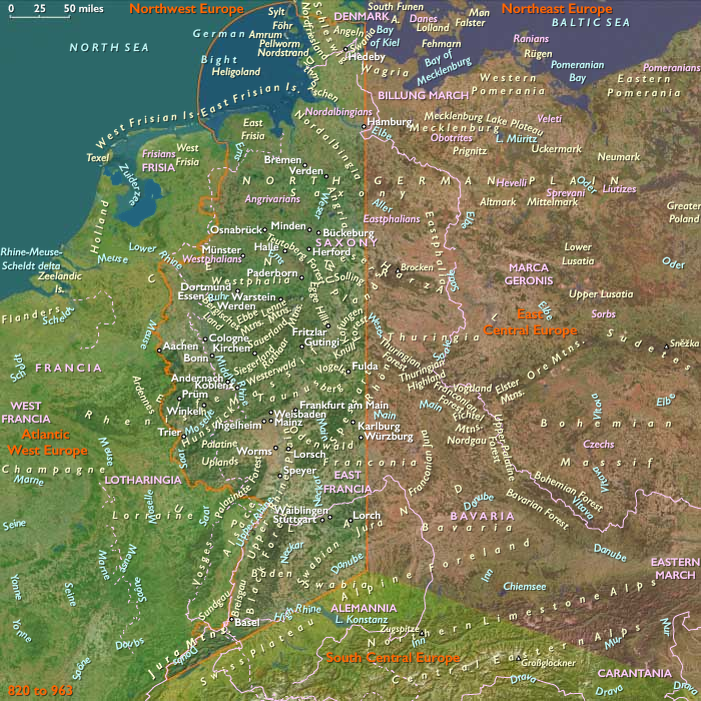
Even if the Scandinavian analogues did not suggest wider dissemination, the close links between Bavaria and Fulda—the first abbot, Sturmi, was a member of the Bavarian nobility—would in any case be sufficient to account for knowledge of this material in the monastery.
Locations
Groups
- Germans
- Christianity, Chalcedonian
- Bavaria, Carolingian Duchy of
- Frankish, or Carolingian (Roman) Empire
Topics
Subjects
Regions

Subregions
Years: 820 - 831
Locations
Groups
- Germans
- Christianity, Chalcedonian
- Bavaria, Carolingian Duchy of
- Frankish, or Carolingian (Roman) Empire
Topics
Subjects
Regions
Subregions