
The Alemanni are first mentioned by Cassius …
Years: 213 - 213
The Alemanni are first mentioned by Cassius Dio describing the campaign of Emperor Antoninus in 213.
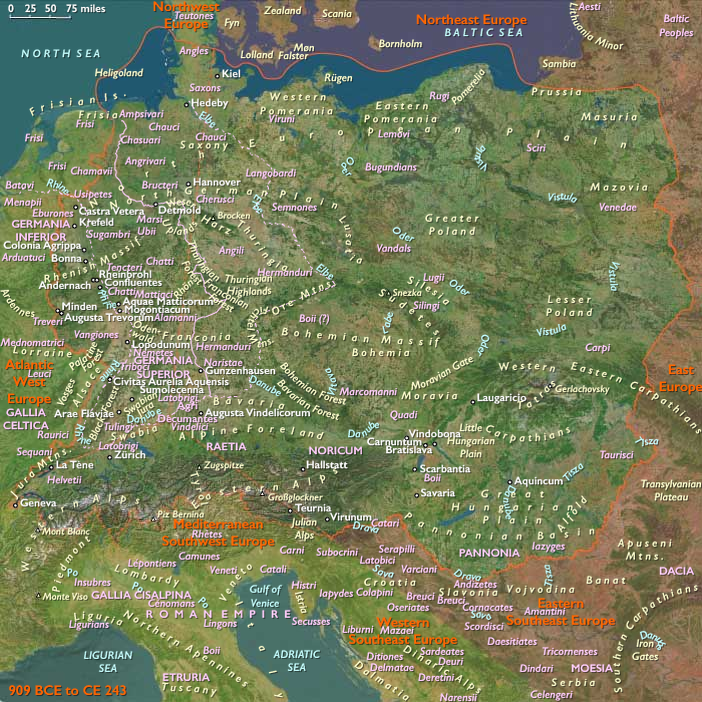
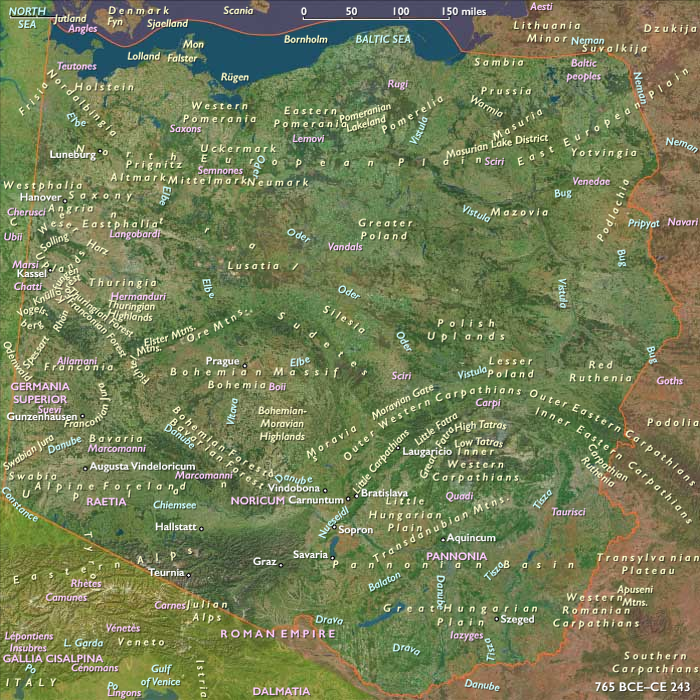
At this time they apparently dwell in the basin of the Main, to the south of the Chatti.
Cassius Dio (78.13.4) portrays the Alemanni as victims of this treacherous emperor.
They had asked for his help, says Dio, but instead he colonized their country, changed their place names and executed their warriors under a pretext of coming to their aid.
When he became ill, the Alemanni claimed to have put a hex on him (78.15.2).
The emperor, it was claimed, tried to counter this influence by invoking his ancestral spirits.
In retribution, Antoninus leads the Legio II Traiana Fortis against the Alemanni.
The Romans do defeat the Alamanni in battle near the river Main, but fail to win a decisive victory over them.
After a peace agreement is brokered and a large bribe payment given to the invaders, the Senate confers upon him the empty title of Germanicus Maximus.
The legion is as a result honored with the name Germanica.
The Gallic hooded tunic the emperor habitually wears while campaigning, and which he makes fashionable, gives him his historical nickname, Caracalla.
The Historia Augusta, Life of Antoninus Caracalla, relates (10.5) that Caracalla then assumed the name Alemannicus, at which Helvius Pertinax jested that he should really be called Geticus Maximus, because in the year before he had murdered his brother, Geta.
Not on good terms with Caracalla, Geta had been invited to a family reconciliation, at which time he was ambushed by centurions in Caracalla's army and slain in his mother Julia's arms.
True or not, Caracalla, pursued by devils of his own, had left Rome, never to return.
Caracalla soon departs for the eastern frontier, where for the rest of his short reign he will be known for his unpredictable and arbitrary operations launched by surprise after a pretext of peace negotiations.
If he had any reasons of state for such actions they remained unknown to his contemporaries.
Whether or not the Alemanni had been previously neutral, they are certainly further influenced by Caracalla to become hereafter notoriously implacable enemies of Rome.
This mutually antagonistic relationship is perhaps the reason why the Roman writers persist in calling the Alemanni barbari, "savages".
The archaeology, however, shows that they were largely Romanized, lived in Roman-style houses and used Roman artifacts, the Alemannic women having adopted the Roman fashion of the tunic even earlier than the men.
Most of the Alemanni are probably at the time in fact resident in or close to the borders of Germania Superior.
Although Dio is the earliest writer to mention them, Ammianus Marcellinus used the name to refer to Germans on the Limes Germanicus in the time of Trajan's governorship of the province shortly after it was formed, circa 98/99.
At that time the entire frontier was being fortified for the first time.
Trees from the earliest fortifications found in Germania Inferior are dated by dendrochronology to 99/100.
People
Groups
- Germania
- Germania Superior (Roman province)
- Germania Inferior (Roman province)
- Roman Empire (Rome): Severan dynasty
- Alamanni (Germanic tribal alliance)
Topics
Commodoties
Subjects
Regions
Subregions
Years: 213 - 213
People
Groups
- Germania
- Germania Superior (Roman province)
- Germania Inferior (Roman province)
- Roman Empire (Rome): Severan dynasty
- Alamanni (Germanic tribal alliance)
Topics
Commodoties
Subjects
Regions
Subregions