
The Alamanni had been defeated in 496 …
Years: 919 - 919
The Alamanni had been defeated in 496 by King Clovis I, brought under Francia, and governed by dukes who were dependent on the Frankish kings.
In the seventh century, the people had converted to Christianity, bishoprics had been founded at Augsburg and Konstanz, and in the eighth century abbeys at Reichenau Island and Saint Gall.
The Alamanni had gradually thrown off the Frankish yoke, but in 730 Charles Martel had again reduced them to dependence, and his son Pepin the Short had abolished the tribal duke and ruled the duchy by county palatines, or kammerboten.
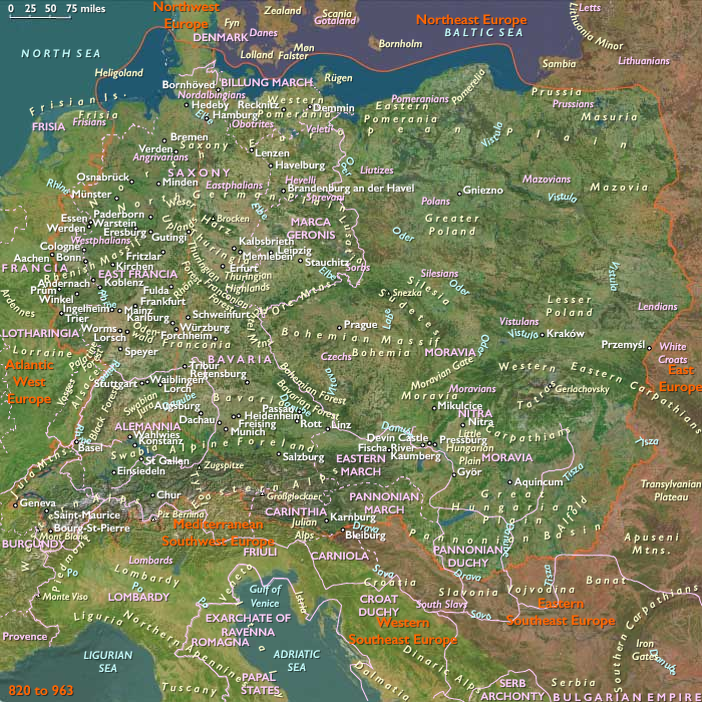
At this time the Duchy of Swabia, which was divided into gaus or counties, took the shape which it will retain throughout the Middle Ages.
It is bounded by the Rhine, Lake Constance, the Lech River and the Duchy of Franconia.
The Lech, separating Alamannia from the Duchy of Bavaria, does not form, either ethnologically or geographically, a very strong boundary, and there is a good deal of intercommunion between the two people.
During the later and weaker years of the Carolingian Empire the counts had become almost independent, and a struggle for supremacy has taken place between them and the Bishopric of Constance.
The chief family in Alamannia is that of the counts of Raetia, who are sometimes called margraves, and one of whom, Burchard I, was called duke of the Alaminnia.
Erchanger, originally a missus dominicus in Swabia, had allied with Bishop Solomon III of Constance due their common political goals.
Erchanger is at this time striving for ever greater power in Swabia alongside Burchard I and Burchard II, his son, who had taken part in the early wars over Swabia.
His family being from Franconia, Burchard II had founded the monastery of St Margarethen in Waldkirch to extend his family's influence into the Rhineland.
Erchanger plays a conspicuous part in the downfall of the elder Burchard, who is convicted of high treason and executed, in 911.
On his father's arrest and execution, Burchard II and his wife, Regelinda, daughter of Count Eberhard I of Zürich, had gone to Italy: either banished by Count Erchanger or voluntarily exiling themselves to their relatives over the Alps.
With the fall of the Burchards, Erchanger and his younger brother Berthold became the most powerful counts in the tribe.
Erchanger and King Conrad I of Germany had fallen out in 913, but Erchanger married off his sister Cunigunda, whose husband, Luitpold, had just died, to the king.
With this diplomatic marriage, Erchanger became the king's representative in Swabia.
With this, his alliance with Bishop Solomon had broken and the bishop had opposed his rise.
Seeing his income diminished by the bishop, Erchanger had imprisoned Solomon in 914.
Conrad had opposed this and freed the bishop, exiling Erchanger.
Burchard II had meanwhile returned from exile and had taken control over his father's property.
In 915, he had joined Erchanger and Arnulf, Duke of Bavaria, in battle against the Magyars.
Then Burchard and Erchanger had turned on King Conrad I and, at the Battle of Wahlwies in the Hegau, had defeated him.
Erchanger had been proclaimed duke.
However, at a high court in Hohenaltheim in September 916, Erchanger had been condemned to a monastery for offenses against king and bishop.
After Erchanger was killed on the instructions of the king on January 21, 917, Burchard had seized all his lands and in 919 is recognized as duke by King Henry I.
Locations
People
Groups
- Franks
- Alamanni (Germanic tribal alliance)
- Christianity, Chalcedonian
- Mainz, Electoral Archbishopric of
- Francia Orientalis (East Francia), Kingdom of
- Franconia, Duchy of
- Bavaria, Luitpolding Duchy of
- Swabia, Duchy of
Commodoties
Subjects
Regions
Subregions

Years: 919 - 919
Locations
People
Groups
- Franks
- Alamanni (Germanic tribal alliance)
- Christianity, Chalcedonian
- Mainz, Electoral Archbishopric of
- Francia Orientalis (East Francia), Kingdom of
- Franconia, Duchy of
- Bavaria, Luitpolding Duchy of
- Swabia, Duchy of
Commodoties
Subjects
Regions
Subregions