The Al-Khalifa, allying with the Al Saud-Wahhabis, …
Years: 1802 - 1802
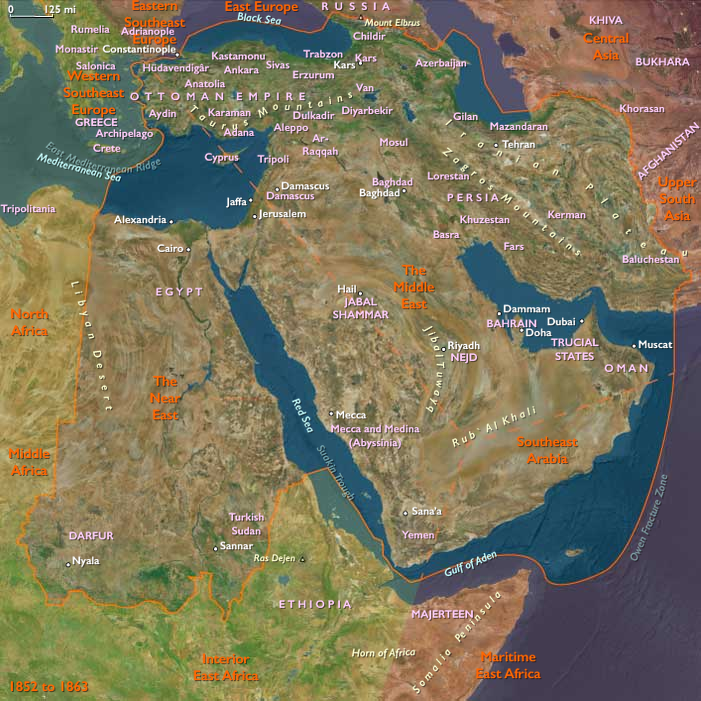
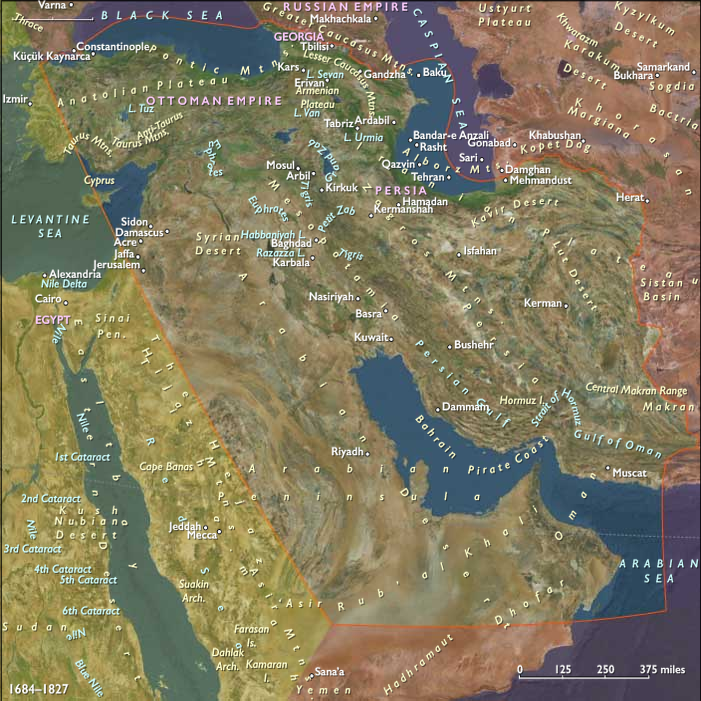
The Al-Khalifa, allying with the Al Saud-Wahhabis, return to Bahrain in 1802, with the Wahhabis in actual control.
Locations
Groups
- Al Khalifa family
- Wahhabism
- Diriyah, Emirate of
- Oman, Sultanate of
- Bahrain, Omani
- Bahrain, Saudi-Wahhabi
Subjects
Regions
Subregions
Related Events
Filter results
Showing 10 events out of 22648 total
The experimental March 27 Treaty of Amiens ends France’s war with Britain in 1802.
Anders Gustaf Ekeberg, a Swedish chemist investigating some rare earth minerals later called yttrotantalite, discovers a new element in 1802.
Because of the tantalizing problem of dissolving the oxide in acids, Ekeberg calls it tantalum, after mythical Greek king Tantalus, condemned to eternal thirst.
The Treaty of Amiens (1802) – A Brief Peace in the Napoleonic Era
The Treaty of Amiens, signed on March 25, 1802, between Britain and France, officially ended the War of the Second Coalition, marking the only significant period of peace between 1792 and 1815. This treaty is often regarded as the transition point between the French Revolutionary Wars (1792–1802) and the Napoleonic Wars (1803–1815), although Napoleon would not declare himself Emperor until 1804.
Terms of the Treaty of Amiens
- Britain recognized France’s territorial gains in continental Europe.
- France agreed to withdraw from Naples and the Papal States, restoring their independence.
- Britain returned Egypt to the Ottoman Empire, following its victory over the French in 1801.
- France agreed to evacuate Portugal (though Spain retained Olivença).
- Britain returned most of its overseas conquests, including the Dutch Cape Colony, Martinique, and Guadeloupe.
- Malta was to be returned to the Knights of St. John, though this clause would later spark renewed conflict.
The Longest Peace of the Napoleonic Era (1802–1803)
For the first time in a decade, Britain and France were at peace, allowing both nations to recover from the immense strain of war. This was the longest break in hostilities during the period from 1792 to 1815, providing a brief interlude before Napoleon resumed his expansionist ambitions.
The Treaty’s Fragility – A Short-Lived Peace
Despite its significance, the Treaty of Amiens was unstable from the outset:
- Britain and France deeply distrusted each other, and neither side fully intended to uphold all terms of the treaty.
- Napoleon expanded French influence in Italy, Germany, and Switzerland, violating the spirit of the agreement.
- Britain refused to evacuate Malta, a key point of contention.
- France’s increased colonial ambitions, including its expedition to Saint-Domingue, worried the British government.
A Prelude to the Napoleonic Wars
The Treaty of Amiens ultimately provided only a temporary pause in hostilities. By May 1803, tensions between Britain and France had escalated once again, leading to Britain’s declaration of war and the start of the Napoleonic Wars.
Though Napoleon would not be crowned Emperor until 1804, the Treaty of Amiens is widely seen as the turning point between the French Revolutionary Wars and the Napoleonic Wars, marking the end of ideological revolutionary conflict and the beginning of Napoleon’s imperial ambitions.
Alexander Horn, born in Oyne, Aberdeenshire, had in 1772 been admitted to the Catholic seminary in Regensburg, perpetual seat of the Imperial Diet of the Holy Roman Empire.
Taking the religious name Maurus, he had been ordained around 1785.
By 1790, he was an esteemed librarian at the Scots Monastery while at the same time working as the Regensburg agent for the British ambassador in Munich and cultivating close ties with the Thurn and Taxis family and other influential people in the region.
Despite being a monk, his social life has led to him being described as a "wild young fellow". (Mark Dilworth, ‘Horn, Alexander (1762–1820)’, Oxford Dictionary of National Biography, Oxford University Press, 2004) Horn has written anonymously condemning France's activities in undermining the Holy Roman Empire.
He had supplied the material that formed the core of John Robison's 1797 allegation of an international conspiracy of freemasons, Illuminati, and Jacobins.
In 1799, he had traveled to England, meeting with members of William Pitt's government including Earl Spencer.
He subsequently used his bibliographical expertise to acquire rare books and manuscripts for Spencer's library.
When, in 1802, the Eternal Diet of Regensburg, under pressure from Napoleon Bonaparte, determines to secularize all the church lands of the Empire, the Scots Monastery is uniquely successful in avoiding this fate.
Horn and his abbot, Charles Arbuthnot, lobby Macdonald and Lauriston, Scottish Catholic generals in the French army.
Horn, by now the official British agent in Regensburg, further appeals to the British government.
The Scots Monastery is exempt from German church authorities coming under the sole authority of Holy See and the two priests successfully obtain the support of the cardinal protector of Scotland in Rome.
An express exemption is made in favor of the Scots abbey, although it is not allowed to take any new novices.

The Porte agrees in 1802 to halt the rapid turnover of Phanariote princes in Wallachia and Moldavia; henceforth, the princes will reign for seven-year terms and cannot be dethroned without Russian approval.
Sa'ud, having consolidated Najd, leads his father's army west to the Ottoman Hejaz on the northwestern coast of Arabia in 1802; his goal, the capture of Mecca itself.
The people of At-Ta'if, forty miles from Mecca, resist the invading Sa'udis and are slaughtered.
The terrified citizens of Mecca open their gates to avoid a similar fate.
Meeting no resistance, the Sa'udi forces pillage the town, sack the sacred places, and prevent pilgrims from performing Haij, robbing them of their belongings.
John Dalton had become a secretary of the Manchester Literary and Philosophical Society in 1800, and in the following year he had orally presented an important series of papers, entitled "Experimental Essays" on the constitution of mixed gases; on the pressure of steam and other vapors at different temperatures, both in a vacuum and in air; on evaporation; and on the thermal expansion of gases.
These four essays are published in the Memoirs of the Lit & Phil in 1802.
The second of these essays opens with the striking remark, There can scarcely be a doubt entertained respecting the reducibility of all elastic fluids of whatever kind, into liquids; and we ought not to despair of effecting it in low temperatures and by strong pressures exerted upon the unmixed gases further.
After describing experiments to ascertain the pressure of steam at various points between 0 and 100 °C (32 and 212 °F), Dalton concluded from observations on the vapor pressure of six different liquids, that the variation of vapor pressure for all liquids is equivalent, for the same variation of temperature, reckoning from vapor of any given pressure.
In the fourth essay he remarks, I see no sufficient reason why we may not conclude that all elastic fluids under the same pressure expand equally by heat and that for any given expansion of mercury, the corresponding expansion of air is proportionally something less, the higher the temperature.
It seems, therefore, that general laws respecting the absolute quantity and the nature of heat are more likely to be derived from elastic fluids than from other substances.
He has thus enunciated Gay-Lussac's law or J.A.C.
Charles's law, published in 1802 by Joseph Louis Gay-Lussac.
In the two or three years following the reading of these essays, Dalton will publish several papers on similar topics, that on the absorption of gases by water and other liquids (1803), containing his law of partial pressures now known as Dalton's law.
William Hyde Wollaston was born in East Dereham, Norfolk, the son of the priest-astronomer Francis Wollaston (1737–1815) and his wife Althea Hyde.
Educated at Gonville and Caius College, Cambridge, William had obtained a doctorate in medicine from Cambridge University in 1793 and has been a fellow of his college from 1787.
During his studies, he had become interested in chemistry, crystallography, metallurgy and physics.
He had been elected a Fellow of the Royal Society in 1793.
The mineral wollastonite is named after him.
Leaving medicine in 1801, he has concentrated on pursuing these interests instead of his trained vocation.
In the same year, he had performed an experiment showing that the electricity from friction was identical to that produced by voltaic piles.
(During the last years of his life he will perform electrical experiments that will pave the way to the eventual design of the electric motor.
His optical work is important as well, where he is remembered for his observations of dark Fraunhofer lines in the solar spectrum (1802) which eventually led to the discovery of the elements in the Sun.
Due to Wollaston's influence, the existence of columbium is temporarily denied.
Heinrich Rose will prove in 1846 that columbium and tantalum are indeed different elements, and rename columbium "niobium".
Jenner's continuing work on vaccination has prevented his continuing his ordinary medical practice.
He is supported by his colleagues and the King in petitioning Parliament and in 1802 is granted ten thousand pounds for continued experimentation with “smallpox vaccine”.
The medical establishment, abandoning the paradigm of lifetime immunity from vaccination, sanctions “revaccination.”
Years: 1802 - 1802
Locations
Groups
- Al Khalifa family
- Wahhabism
- Diriyah, Emirate of
- Oman, Sultanate of
- Bahrain, Omani
- Bahrain, Saudi-Wahhabi