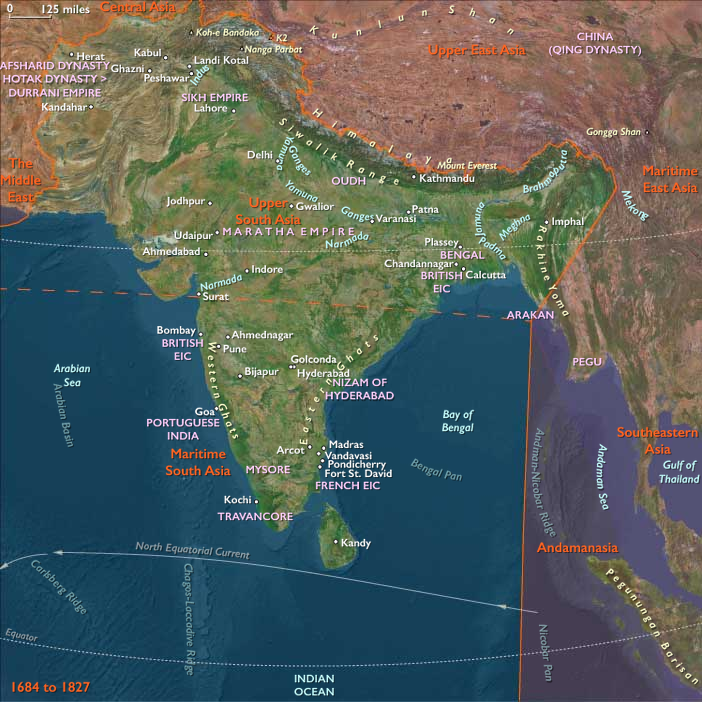
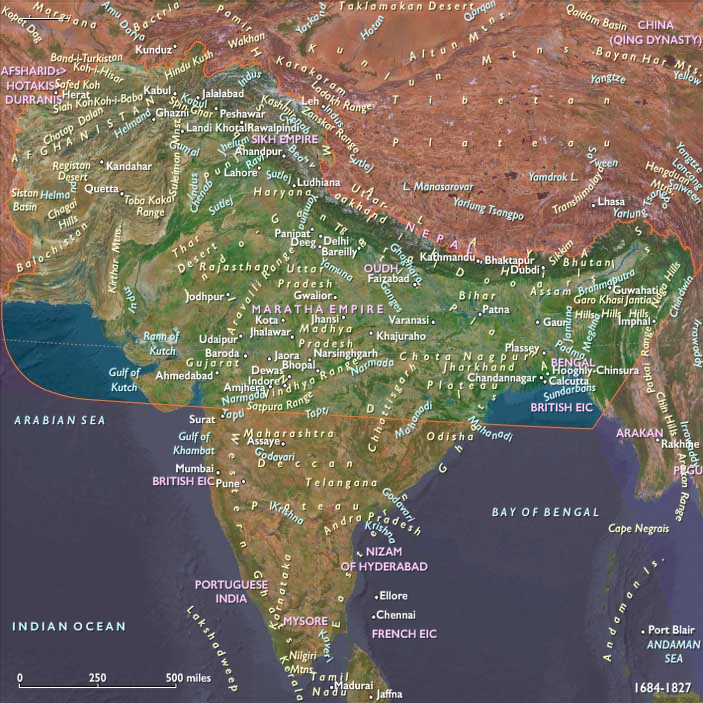
...the Afghan Rohillas, Pashtun Highlanders, make themselves …
Years: 1722 - 1722
...the Afghan Rohillas, Pashtun Highlanders, make themselves masters of the Rohilkhand (southeast of Delhi); ...
Locations
People
Groups
- Pashtun people (Pushtuns, Pakhtuns, or Pathans)
- Mysore, Kingdom of
- Rohilla (Pashtun tribe)
- Mughal Empire (Delhi)
- Maratha Empire
Topics
Commodoties
Subjects
Regions
Subregions
Related Events
Filter results
Showing 10 events out of 27970 total
Nanjing, or Nanking, porcelain, a Chinese blue-and-white porcelain made for export during the Qing dynasty (especially in the reign of Kangxi) at Jingdezhen, is shipped to Europe in great quantity from the port of Nanking (Nanjing); as a result, Western dealers in the nineteenth century will use the city's name when referring to the porcelain.
Though the porcelain is made for export, the shapes and decoration are mostly from Chinese traditions.
The porcelain varies in quality; the glaze can become very gray and the decoration is often rudimentary.
Much of the polychrome porcelain known as “Canton ware” is actually produced in white at Nanjing and sent to Canton for painting.
English potters extensively copy and adapted Nanjing decoration.
The Kangxi emperor, in particular, is a patron of the arts on a considerable scale.
With the Qing dynasty had come the beginning of the immense vogue for porcelain in Europe that is to reach its height during the first half of the eighteenth century.
The pottery industry had suffered severely in the chaotic middle decades of the seventeenth century, of which the typical products are “transitional wares,” chiefly blue-and-white.
The Imperial kilns at Ching-te-chen had been destroyed and not fully reestablished until 1682, when the Kangxi Emperor had appointed Ts'ang Ying-hsüan as director.
Under his control, Imperial porcelain has reached a level of excellence it has not seen for well over a century.
The finest pieces include small monochromes, which recapture the perfection of form and glaze of classic Sung wares.
New colors and glaze effects have been introduced, such as eel-skin yellow, snakeskin green, turquoise blue, and an exquisite soft red glaze shading to green (known as “peach-bloom”) that is used for small vessels made for the scholar's desk.
Also perfected is lang-yao (sang-de-boeuf, or oxblood, ware), which is covered with a rich copper-red glaze.
Kangxi period blue-and-white is particularly noted for a new precision in the drawing and the use of cobalt washes of vivid intensity.
Five-color (wu ts'ai) overglaze painted wares of the K'ang-hsi period become known in Europe as famille verte from the predominant green color in their floral decoration.
These wares also include expert imitations of overglaze painting of the Chenghua Emperor's reign (1464 - 1487).
Another variety has floral decoration painted directly on the biscuit (unglazed pottery body) against a rich black background (famille noire).
Toward the end of the Kangxi reign, a rose pink made from gold chloride is introduced from Europe and used with other colors in the decoration of porcelain (famille rose) and in cloisonné and overglaze painting.
Many varieties of Qing ware are common in the West.
Its wares differ, for the most part, from those of the Ming period in a fairly distinctive manner.
Potters have their medium under almost complete control, and their products are much more precisely finished.
Their finesse contrasts sharply with the struggles of potters in Europe, where porcelain manufacture is not to emerge from the purely empirical stage until the ninteenth century.
Letters written in 1712 and 1722 by a Jesuit missionary who has spent some years at Ching-te-chen record that some Qing pieces are handled by as many as seventy men, each contributing a small part to the total effect, and this is one of the reasons why many Qing wares are found to lack the freshness and the spontaneity of Ming decoration.
Sang de boeuf (French“oxblood”), also called flambé glaze, is a glossy, rich, blood-red glaze often slashed with streaks of purple or turquoise used to decorate pottery, particularly porcelain.
The effect is produced by a method of firing that incorporates copper, a method first discovered by the Chinese of the Ming dynasty, probably during the reign of Wanli (1573–1620).
Examples of this older work are now extremely rare.
The process was at first difficult to control, but it had been mastered by the time of Kangxi.
The Kangxi emperor at the Chinese New Year of 1722 celebrates his long and prosperous reign by inviting many elders to a great banquet at the court.
That winter he falls ill while staying at the imperial villa of Ch'ang ch'un yüan, in the northwestern outskirts of Peking, where on December 20 he dies.
Usually counted among the ablest monarchs ever to govern the vast Chinese empire, he had reigned for sixty-one years and laid the foundation for a long period of political stability and economic prosperity in China.
Yin-chen, as the fourth son of the previous emperor, is not immediately in line for the throne; but when the designated heir apparent became mentally deranged, the future Yongzheng emperor had seen an opportunity to seize the throne and began to intrigue against his brothers.
Several of the chronicles of the period allege that the Yongzheng emperor murdered his father.
In any case, he succeeds to the throne by having military support in Peking when his father dies.
Medieval and obsolescent forms of government have given place to effective autocracy in the course of Peter's reign.
He had in 1711 abolished the boyarskaya duma, or boyar council, and established by decree of the Senate as the supreme organ of state—to coordinate the action of the various central and local organs, to supervise the collection and expenditure of revenue, and to draft legislation in accordance with his edicts.
Martial discipline is extended to civil institutions, and an officer of the guards is always on duty in the Senate.
From 1722, moreover, there is a procurator general keeping watch over the daily work of the Senate and its chancellery and acting as “the eye of the sovereign.” When Peter had come to power, the central departments of state had been the prikazy, or offices, of which there were about eighty, functioning in a confused and fragmented way.
To replace most of this outmoded system, Peter in 1718 had instituted nine “colleges” (kollegy), or boards, the number of which is by 1722 expanded to thirteen.
Their activities are controlled, on the one hand, by the General Regulation and, on the other, by particular regulations for individual colleges, and indeed there are strict regulations for every branch of the state administration.
Crimes against the state come under the jurisdiction of the Preobrazhensky Office, responsible immediately to the tsar.
In 1722 also, Peter creates a new order of precedence, known as the Table of Ranks.
Formerly, precedence had been determined by birth.
In order to deprive the boyars of their high positions, Peter directs that precedence should be determined by merit and service to the Emperor.
This replaces the old system of promotion in the state services, which had been according to ancestry, by one of promotion according to services actually rendered.
It classifies all functionaries—military, naval, and civilian alike—in fourteen categories, the fourtenth being the lowest and the firsst the highest; and admission to the eighth category confers hereditary nobility. (The Table of Ranks will continue to remain in effect until the Russian monarchy is overthrown in 1917.)
Peter also introduces new taxes to fund improvements in Saint Petersburg.
He abolishes the land tax and household tax, and replaces them with a capitation.
The taxes on land on households are payable only by individuals who own property or maintain families; the new head taxes, however, are payable by serfs and paupers.
Despite Russia’s exhaustion after the Second or Great Northern War, Peter, who has long contemplated establishing a trade route to India via the countries east of the Caspian Sea, is apprehensive over the Turkish push toward the region.
Even during the second half of the Northern War, Peter had sent exploratory missions to the East—to the Central Asian steppes in 1714, to the Caspian region in 1715, and to Khiva in 1717.
The end of the war leaves him free to resume a more active policy on his southeastern frontier.
Losses suffered by some Russian merchants during one of the many tribal uprisings in the Persian realms, ongoing since 1709, provide Peter with the pretext for launching a war against a Persia weakened by the Afghan rebellions.

Bach’s Well-Tempered Clavier (in the original German: Das wohltemperierte Clavier), a collection of solo keyboard music, is a book of preludes and fugues in all 24 major and minor keys, appearing in 1722, composed "for the profit and use of musical youth desirous of learning, and especially for the pastime of those already skilled in this study".
The Pilgrimage Church of St. John of Nepomuk is the final work of Jan Santini Aichel, a Bohemian architect who combines the Borrominiesque Baroque with references to Gothic elements in both construction and decoration.
With many furnishings designed by Santini himself, the church is remarkable for its gothicizing features and complex symbolism, quite unusual for the time.
When the Roman Catholic Church in 1719 declared the tongue of John of Nepomuk to be "incorruptible", work began on a church in Zelená hora (meaning "Green Hill", German: Grünberg) where the future saint had received his early education. (The present Žďár nad Sázavou in the present Czech Republic, near the border between Bohemia and Moravia.)
It had been consecrated immediately after John's beatification in 1720, although construction work had continued until 1727.
The Jat caste, with plundering raids and the establishment of robber forts, had begun proclaiming their independence toward the end of the reign of Mughal emperor Aurangzeb's (1659–1707).
Churaman, Zamindar (tax collector) of Sinsini and the real founder of the Jat state of Bharatpur, had died on September 22, 1721, sparking family disputes between Churaman’s nephew, Mohkam Singh, and nephew nephew, Badan Singh, the latter having aligned with Jai Singh II of Amber (later Jaipur) to avoid the anger of Mohkam Singh.
A combined Rajput-Mughal army besieges the fort of Mohkam Singh at Thoon, taking it on November 18, 1722, and razing it.
After the fall of Thoon, Jatauli, and other forts, Badan Singh makes a formal submission five days later, as a samanta (vassal lord) of Jaipur Darbar.
Jai Singh honors him with the title of ‘Brijraj’ i.e., the king of Brij.
The Mughals recognize Bharatpur as an autonomous state.
Mahmud, the young son and successor of Mir Wais Hotak, is not content to hold only Qandahar.
He leads some twenty thousand men against Isfahan in 1722; the Safavid government surrenders after a six-month siege.
Saadat Khan becomes practically independent in Awadh (Oudh) from 1722; ...
...Bengal pays only an annual tribute to Delhi; and ...
Years: 1722 - 1722
Locations
People
Groups
- Pashtun people (Pushtuns, Pakhtuns, or Pathans)
- Mysore, Kingdom of
- Rohilla (Pashtun tribe)
- Mughal Empire (Delhi)
- Maratha Empire