
The Aesti (also Aestii or Aests) are …
Years: 98 - 98
The Aesti (also Aestii or Aests) are an ancient (most probably Baltic) people first described by the Roman historian Tacitus in his treatise Germania (circa 98 CE).
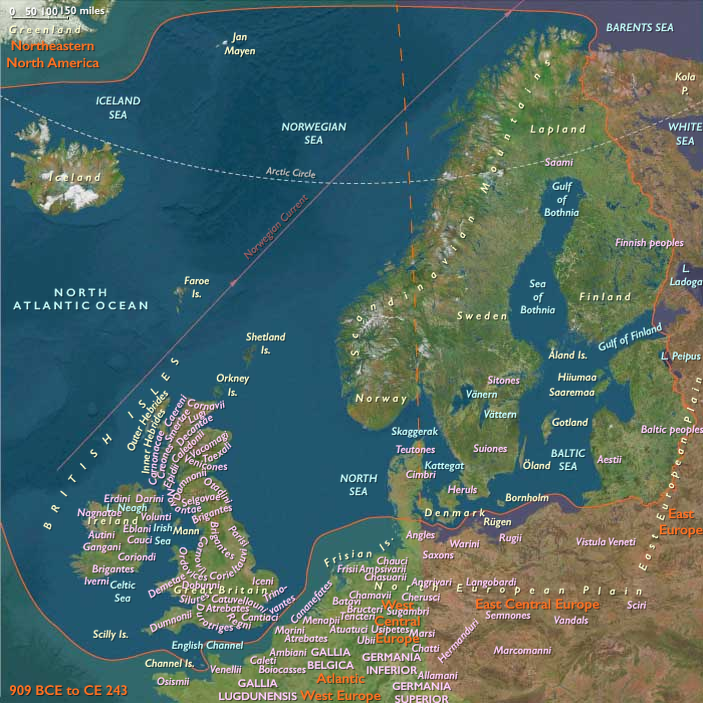
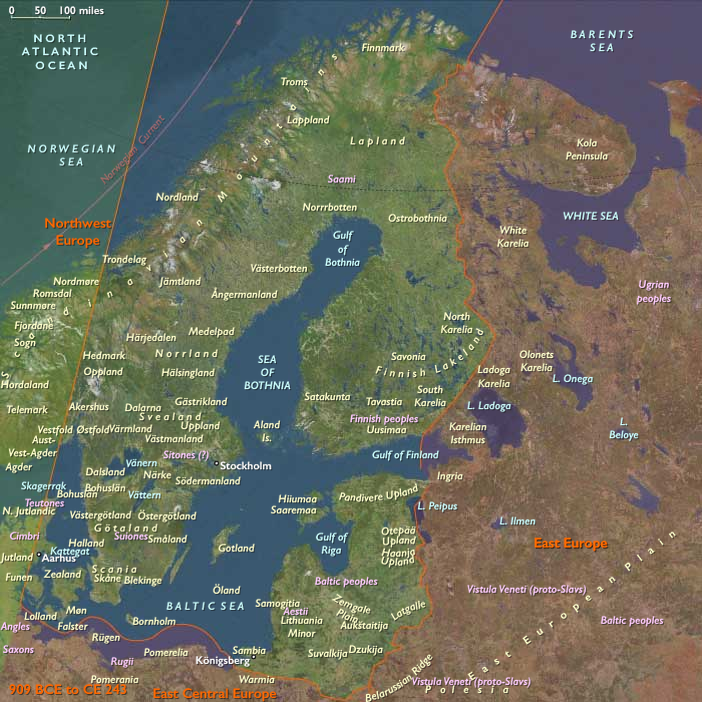
Aestui, the land of the Aesti, according to Tacitus was located somewhere east of the Suiones (Swedes) and west of the Sitones (possibly the Kvens), on the Suebian (Baltic) Sea.
This and other evidence suggests that Aestui was in a region around the later East Prussia (now Kaliningrad Oblast).
Geographical and linguistic evidence suggests that the Aesti were, ethnologically, a Baltic people and possibly synonymous with the Brus/Prūsa or Old Prussians (i.e., not a Germanic people such as the modern Prussians or a Finno-Ugric people, such as the Estonians).
Tacitus almost certainly erred in implying that the Aesti were a hybrid Celtic-Germanic culture: he claimed that while the "Aestian nations" followed the "same customs and attire" as "the Suebians" (at the time a collective term for eastern Germanic peoples), their speech resembled that of the Britons (i.e., a Celtic language rather than the Germanic languages of the Suebii).
The placement of the Tacitean Aestii is based primarily on their association with amber, a popular luxury item during the life of Tacitus, with known sources at the southeastern coast of the Baltic Sea.
The ancient writers, beginning with Tacitus, who is the first Roman author to mention the Aesti in his Germania, provide very little information on them.
Although Tacitus has never traveled to Magna Germania himself and only records information he had obtained from others, the short ethnographic excursus below is the most detailed ancient account of the Aestii that we have:
Upon the right of the Suebian Sea the Aestian nations reside, who use the same customs and attire with the Suebians; their language more resembles that of Britain.
They worship the Mother of the Gods.
As the characteristic of their national superstition, they wear the images of wild boars.
This alone serves them for arms, this is the safeguard of all, and by this every worshiper of the Goddess is secured even amidst his foes.
Rare among them is the use of weapons of iron, but frequent that of clubs.
In producing of grain and the other fruits of the earth, they labor with more assiduity and patience than is suitable to the usual laziness of Germans.
Nay, they even search the deep, and of all the rest are the only people who gather amber.
They call it glesum, and find it among the shallows and upon the very shore.
But, according to the ordinary incuriosity and ignorance of Barbarians, they have neither learned, nor do they inquire, what is its nature, or from what cause it is produced.
In truth it lay long neglected among the other gross discharges of the sea; till from our luxury, it gained a name and value.
To themselves it is of no use: they gather it rough, they expose it in pieces coarse and unpolished, and for it receive a price with wonder. (Germania, chapter XLV).
Tacitus' mention of a cult of the mother of the gods among the Aesti along the eastern Baltic coast does apply to the ancient Estonian and Baltic pagan religions.
He also refers to the Fenni living next to the Aesti—the Fenni being ancestors to the Finns or the Sámi would situate them closest to the Estonians.
Ultimately, Tacitus' use of Aesti could apply equally well to either a specific people or to a grouping of ethnically diverse peoples across a wider area.
Locations
People
Groups
- Finns
- Sami people
- Britons (historical)
- Estonians
- Germans
- Suebi (Suevi), Realms of the
- Roman Empire (Rome): Nerva-Antonine dynasty
Topics
Commodoties
Subjects
Regions
Subregions
Related Events
Showing 10 events out of 61437 total
Years: 98 - 98
Locations
People
Groups
- Finns
- Sami people
- Britons (historical)
- Estonians
- Germans
- Suebi (Suevi), Realms of the
- Roman Empire (Rome): Nerva-Antonine dynasty
Topics
Commodoties
Subjects
Regions
Subregions