The abbey known as Paisley Priory, dedicated …
Years: 1163 - 1163
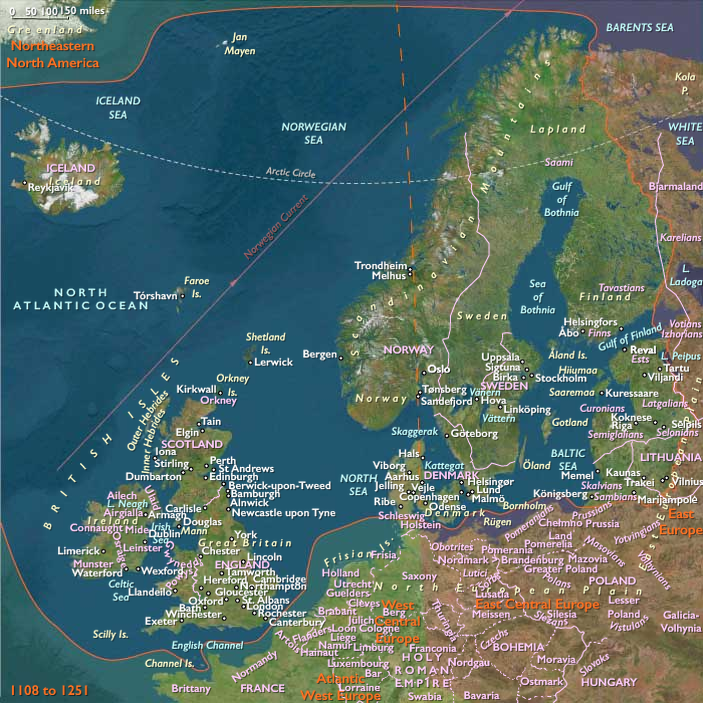
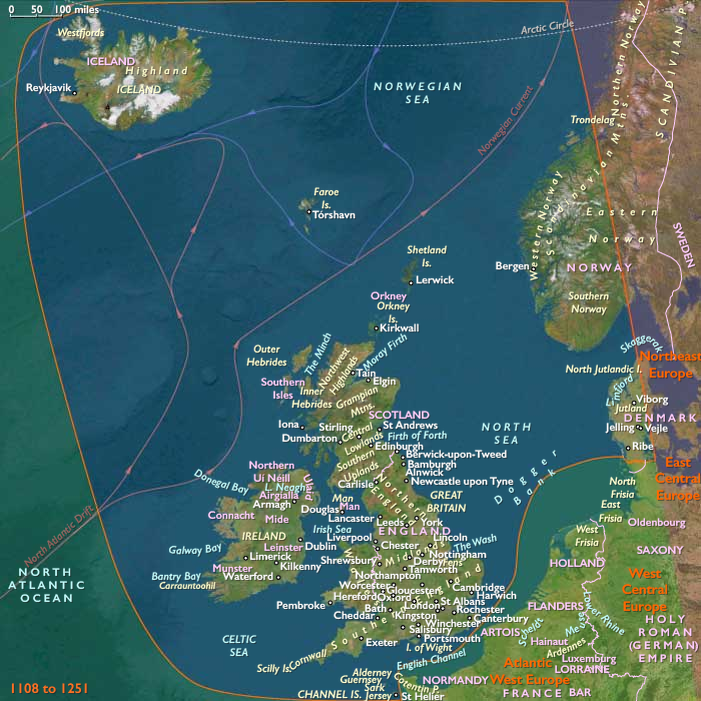
The abbey known as Paisley Priory, dedicated to Saints Mary, James, Mirin and Milburga, is founded in Scottish Strathclyde, seven miles (eleven kilometers) west of Glasgow on the White Cart Water, a stream, when, in 1163 Walter FitzAlan, the first High Steward of Scotland, issues a charter for a priory to be set up on land owned by him in Paisley.
Around thirteen monks come from the Cluniac priory at Much Wenlock in Shropshire to found the community.
Locations
Groups
Subjects
Regions
Subregions
Related Events
Filter results
Showing 10 events out of 48492 total
Benjamin of Tudela, in his ambitious journey to visit the Jewish communities of the diaspora, misses only that of Kaifeng, in China, where a colony from India or Persia had settled probably in about 1127, building a synagogue—the oldest known in China—in 1163.
(An extant stone tablet dated 1512 and found in K'ai-feng claims that Judaism entered China during the latter half of the Han dynasty, i.e., before CE 220, but the authenticity of the tablet is disputed.)
Ladislaus dies, possibly of poisoning, on January 14, 1163, and is buried in Székesfehérvár; his brother Stephen is proclaimed king.
In medieval times, Ladislaus is not counted as a king (being only an anti-king), so Ladislaus III will also be counted as Ladislaus II in the thirteenth century.
However, Lukas, Archbishop of Esztergom, who had been remaining loyal to Stephen III and had been arrested by Ladislaus II, denies Stephen’s coronation; therefore Stephen is crowned by Mikó, Archbishop of Kalocsa.
Archbishop Lukas does not want to accept Stephen's reign and excommunicates him; therefore Stephen prohibits any correspondence between the Hungarian bishops and the Holy See and he is accused of aspiring the Hungarian Church to be separated from Rome.
Stephen supports the claims of Constantinople without compromise, which results in growing indignation among the Hungarian barons.
In the beginning of 1163, the members of the Csák clan rebel against him, but they are defeated.
In the meantime, the young Stephen III seeks assistance of the Holy Roman Emperor, Frederick I, and, leading the troops sent to him by the emperor, he defeats his uncle on June 19, 1163 at Székesfehérvár.
During the battle, the elder Stephen is taken captive but the young king, following Archbishop Lukas' advice, sets him free.
After his release, Stephen flees again to Constantinople.
Nur ad-Din proves to be one of the most dangerous enemies the Frankish kingdom has ever faced.
Starting out as Emir of Aleppo, he had steadily increased his territory at the expense of his Muslim and Latin neighbors, until he gained the great city of Damascus in 1154.
He had seriously defeated the Crusaders at the Battle of Lake Huleh in 1157, but fell very ill immediately afterward, allowing the Franks to a chance to recover and, with the help of Thierry of Alsace and an army of pilgrims, to capture Harim castle later in the year.
However, an attack on Shaizar failed when Reynald of Châtillon, the Prince of Antioch, quarreled with the other Franks.
Consequently, Shaizar soon became the property of Nur ad-Din.
In 1158, Thierry and King Baldwin III had defeated Nur ad-Din at Butaiha, northeast of Tiberias.
The year 1160 had seen the capture of Reynald, who will spend the next sixteen years in Nur ad-Din's dungeons.
In December 1161, the Emperor Manuel I Comnenus had married Maria of Antioch and this event has given Antioch a strong protector in the emperor.
Amalric, count of Jaffa and Ascalon, succeeds his elder brother Baudouin III to the throne of Jerusalem in 1163.
Both Amalric and Nur ad-Din had soon become aware of the weakness of Fatimid Egypt, whose government has fallen into a state of decay.
After the assassination of Caliph al-Zafir and a series of palace coups, Shawar had seized power in 1162, was soon deposed, and appealed to Nur ad-Din for help.
Neither the Latin king nor the Muslim emir can afford to let the other capture the rich prize of Egypt.
Accordingly, Nur ad-Din had sent his lieutenant Shirkuh with an army to support the Egyptian vizier.
While Shirkuh campaigns in Egypt, Nur ad-Din mounts an offensive in Lebanon.
Following Latin policy, King Amalric takes an army to support his northern vassals, Bohemund III of Antioch and Raymond III of Tripoli.
Fortuitously, a large group of French pilgrims led by Hugh VIII of Lusignan and Geoffrey Martel, the brother of William IV of Angoulême, have joined the king of Jerusalem.
In addition, Constantine Kalamanos, the governor of Cilicia, has brought his Greek warriors to assist the Crusaders.
Nur ad-Din is no match for such a formidable combination of enemies and his army suffers a defeat.
Both Muslims and Franks are impressed by the fighting qualities of the imperial soldiers.
The negative result of al-Buqaia only makes Nur ad-Din more keen for revenge.

Bohemond III's father, Raymond of Poitiers, had been killed at the Battle of Inab in 1149, and his mother has ruled as regent until Bohemond is old enough to rule on his own.
Constance, however, had married a second time, to Raynald of Châtillon, who had ruled as Prince of Antioch until being taken captive in 1160 and imprisoned in Aleppo (where he will remain until 1176).
Bohemond was by this time of legal age to succeed, but Constance had refused; King Baldwin III of Jerusalem had intervened and declared Bohemond ruler of the principality.
In 1163, Constance asks the newly appointed imperial governor of Cilicia, Constantine Kalamanos, for aid in order to maintain her rule; the citizens of Antioch then riot and exile her.
She dies later this year, allowing Bohemond to take full control.
Constantine and Prince Bohemond III soon lead their troops together against Nur ad-Din Zengi's armies, which are besieging Krak des Chevaliers, a fortress in the County of Tripoli.
After a short battle, in which Constantine and his troops particularly distinguish themselves, Nur ad-Din flees in disorder to Homs.
Rabbi Benjamin of Tudela undertakes from 1160 to 1173 to survey the communities in the diaspora, traveling from Spain by way of Rome and Constantinople to the Near East, visiting most of the significant Jewish communities there.
In 1163, Benjamin finds forty thousand Jews residing in Baghdad, with twenty-eight synagogues and ten Torah academies.
In his Sefer Hamasot (Book of Travel), he describes the Jewish communities in Iran and India from the reports of eyewitnesses that he meets.
The Muslim Ghaznavids from Afghanistan move their imperial capital east from Ghazni to …
…Lahore in 1163.
The Gothic Innovation of Laon Cathedral (c. 1160 CE)
Around 1160 CE, construction began on Laon Cathedral, making it one of the earliest Gothic cathedrals, alongside Notre-Dame de Paris and Noyon Cathedral. Like these other pioneering structures, Laon Cathedral introduced new architectural elements that would define Gothic design.
Innovative Features of Laon Cathedral
-
Five-Tower Façade
- One of Laon’s most distinctive elements is its unprecedented five-tower façade, an early Gothic feature emphasizing monumentality and verticality.
- Although the planned central tower over the crossing was never completed, the façade’s twin towers and additional towers on the transepts give it a unique and commanding presence.
-
Four-Story Elevation: A New Architectural Experiment
- Like Notre-Dame de Paris, Laon Cathedral was an early experiment in four-story elevation, consisting of:
- An arcade (ground level).
- A gallery (above the arcade).
- A triforium (a decorative passage).
- A clerestory (with large windows to allow more light into the nave).
- This extra level contributed to greater height and openness, distinguishing it from earlier three-story Romanesque structures.
- Like Notre-Dame de Paris, Laon Cathedral was an early experiment in four-story elevation, consisting of:
-
Early Use of Rib Vaulting and Pointed Arches
- The cathedral employed rib vaults, allowing for taller, more flexible interiors.
- Pointed arches replaced earlier rounded Romanesque arches, improving structural efficiency while creating a sense of vertical aspiration.
Impact on Early Gothic Architecture
- Laon Cathedral’s experimental design influenced later Gothic cathedrals, particularly in northern France.
- The four-story elevation became a transitional step toward the fully developed High Gothic style seen in Chartres and Reims.
- Its innovative use of towers, rib vaulting, and pointed arches set a precedent for the structural and aesthetic evolution of Gothic architecture.
As one of the earliest Gothic cathedrals, Laon remains a crucial link between the Romanesque past and the soaring cathedrals of the High Middle Ages, helping to define the ambition and grandeur of the Gothic movement.
The 1163 Council of Tours and the Beginnings of the Albigensian Crusade
In 1163, during the papacy of Alexander III, a Council of Tours was convened, marking an important step in the Catholic Church’s efforts to suppress the Cathar heresy in southern France. The council’s decrees increased persecution against Cathars, setting the stage for the Albigensian Crusade in the early 13th century.
Key Decisions of the Council of Tours (1163)
-
Cathars to Be Deprived of Their Goods
- The council ordered that Cathars (and other heretics) should be stripped of their property, making them more vulnerable to secular authorities.
- This policy financially incentivized northern French lords, many of whom would later join the Albigensian Crusade (1209–1229), which sought not only to suppress heresy but also to seize the lands of the Cathar-supporting nobility in Languedoc.
-
One of the First Recorded Uses of "Albigenses"
- The council is one of the earliest recorded instances where the term "Albigenses" (referring to the city of Albi in southern France) was used to describe Cathars and their supporters.
- The term later became widely used to designate Cathar communities across Languedoc, particularly in Toulouse, Carcassonne, and Montségur.
-
Strengthening the Church’s Response to Heresy
- The bishops and clergy were instructed to actively combat heresy in their dioceses.
- Local secular rulers were encouraged to enforce anti-heretical measures, deepening the alliance between the French crown and the papacy in efforts to eradicate Catharism.
Impact and Long-Term Consequences
- The 1163 Council of Tours laid the groundwork for intensified persecution of Cathars, leading to greater pressure from both Church and secular authorities.
- By ordering the confiscation of Cathar goods, the Church made heretic-hunting profitable, fueling northern French ambitions in the south.
- The council’s rulings foreshadowed later Inquisitorial actions and provided a blueprint for the eventual Albigensian Crusade (1209–1229), which would result in the destruction of Cathar strongholds and the political annexation of Languedoc by the French crown.
The Council of Tours (1163) thus marked a pivotal moment in the Church’s war against heresy, as it combined religious condemnation with material punishment, making the suppression of Catharism an increasingly violent and expansionist campaign.