The Pact of Biak-na-bato, signed on December …
Years: 1897 - 1897
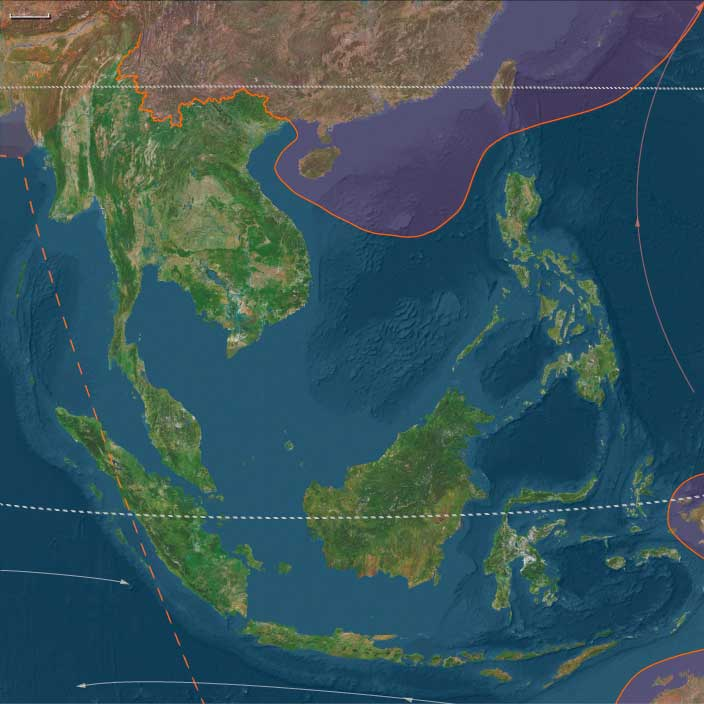
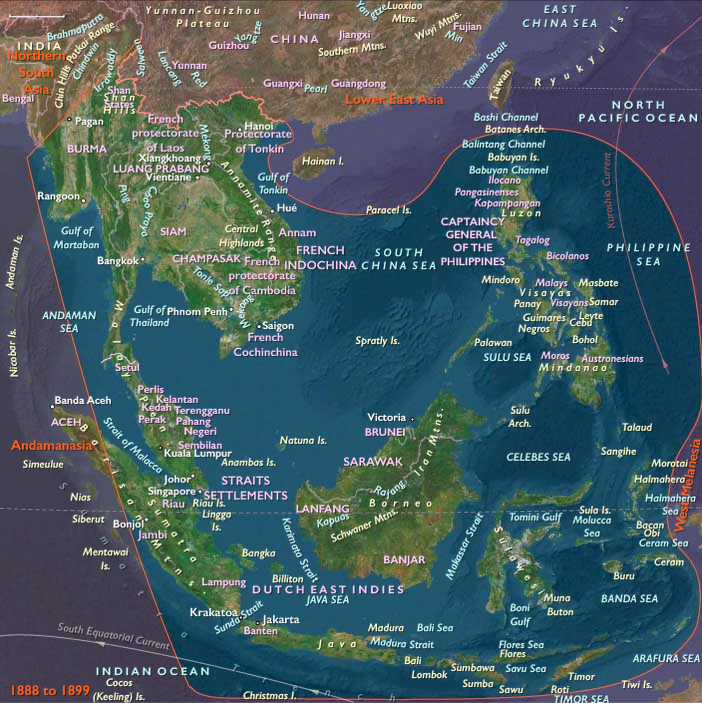
The Pact of Biak-na-bato, signed on December 15, 1897, temporarily suspends fighting in the Philippines.
Locations
Groups
Topics
Subjects
Regions
Subregions
Related Events
Filter results
Showing 10 events out of 9270 total
An enormous contemplation of life and death told through a series of figures, beginning with a baby and ending with a shriveled old woman, the work is surrounded by a dreamlike, poetic aura that is extraordinarily powerful.
Gauguin had flattened his imagery with sometimes unsuccessful results before the 1890s, but his "primitivism" has become less forced throughout this decade.
The influences of Jean-Auguste-Dominique Ingres and Pierre Puvis de Chavannes have led him to create increasingly rounded and modeled forms and a more sinuous line; as a result, Gauguin's images become more luxuriant and more naturally poetic as he develops marvelously orchestrated tonal harmonies.
France ends its use of New Caledonia as a penal colony in 1897.
New Caledonia had become a penal colony in 1864, and from the 1860s until the end of the transportations in 1897, France sent about twenty-two thousand criminals and political prisoners to New Caledonia.
The Bulletin de la Société générale des prisons for 1888 indicates that 10,428 convicts, including 2,329 freed ones, were on the island as of May 1, 1888, by far the largest number of convicts detained in French overseas penitentiaries.
The convicts included many Communards, arrested after the failed Paris Commune of 1871, including Henri de Rochefort and Louise Michel.
Between 1873 and 1876, 4,200 political prisoners were "relegated" to New Caledonia.
Only 40 of them settled in the colony; the rest returned to France after being granted amnesty in 1879 and 1880.
Catherine Helen Spence becomes the first female political candidate for political office in South Austrlalia, unsuccessfully standing for election as a delegate to the Federal Convention on Australian Federation.
The colony of South Australia's Constitutional Amendment Act 1894 had been the first legislation in the world permitting women also to stand for election to political office.
Kang’s Youwei ideas on reform spread despite repression by the Chinese government.
Deemed only a minor threat to the government, he is exiled to a peasant's hut in Shushenskoye, Minusinsky District, where he is kept under police surveillance; he is nevertheless able to correspond with other revolutionaries, many of whom visit him, and permitted to go on trips to swim in the Yenisei River and to hunt duck and snipe.
Russian policy has been extremely cautious in the crises that have arisen in connection with the Turkish Armenians and over Crete and Macedonia, but overall tends to support the Turkish government.
Russia and Austria agree in 1897 on spheres of influence in the Balkans.
The pogroms and the anti-Semitism of the new tsar not only means economic hardship and physical suffering but a deep spiritual malaise as well for many Jews, especially the maskalim (”enlightened”).
Before 1881, they had been abandoning the strict confines of the kehilot en masse and rebelling against religious orthodoxy, anxiously waiting for the expected emancipation to reach Russia.
The 1881 pogroms and their aftermath have shattered not only the faith of the maskalim in the inevitable liberalization of tsarist Russia but also their belief that the non-Jewish Russian intellectual will take an active role in opposing anti-Jewish policies.
Most of the Russian intelligentsia have either been silent during the pogroms or actually supported them.
Having lost their faith in God and in the inevitable spread of liberalism, large numbers of Russian Jews are forced to seek new solutions.
Many flock to the revolutionary socialist and communist movements opposing the tsar, while others become involved with the Bund, a cultural society organized in 1897 that seeks to establish a Yiddish cultural renaissance within Russia.
A smaller but growing number of Jews are attracted to the ancient but newly formulated notion of reconstituting a Jewish nation-state in Palestine.
Zionism as it evolves in Eastern Europe, unlike Zionism in the West, deals not only with the plight of Jews but also with the crisis of Judaism.
Thus, despite its secularism, East European Zionism remains attached to the Jewish biblical home in Palestine.
It also is imbued with the radical socialist fervor challenging the tsarist regime.

The rebellious and outspoken Lev Davidovitch Bronstein, now eighteen, takes the name Leon Trotsky and becomes a professional revolutionary in 1897.
Trotsky had became involved in revolutionary activities in 1896 after moving to the harbor town of Nikolayev (now Mykolaiv) on the Ukrainian coast of the Black Sea.
At first a narodnik (revolutionary agrarian socialist populist), he initially opposed Marxism but was won over to Marxism later that year by his future first wife, Aleksandra Sokolovskaya.
Instead of pursuing a mathematics degree, Trotsky helps organize the South Russian Workers' Union in Nikolayev in early 1897.
Using the name 'Lvov', he writes and prints leaflets and proclamations, distributes revolutionary pamphlets, and popularizes socialist ideas among industrial workers and revolutionary students.