
Ternate, in part as a result of …
Years: 1535 - 1535
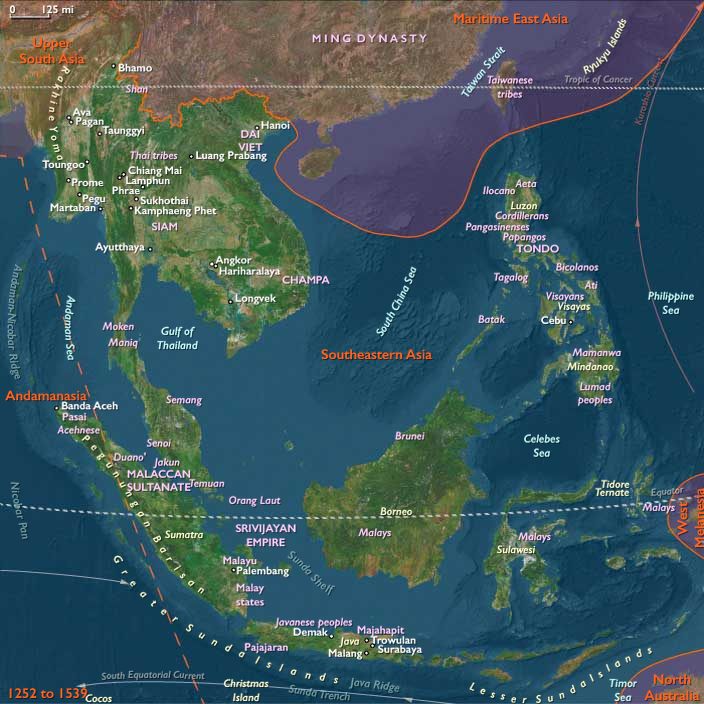
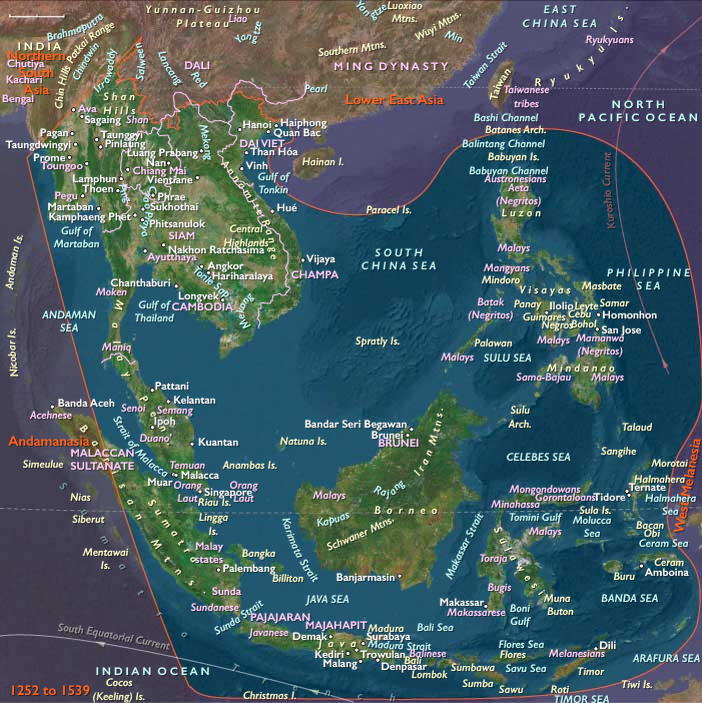
Ternate, in part as a result of its trade-dependent culture, was one of the earliest places in the region to which Islam spread, probably coming from Java in the late fifteenth century.
Initially restricted to Ternate's small ruling family, the new faith is spreading only slowly to the rest of the population.
The first Europeans to stay on Ternate were part of the Portuguese expedition of Francisco Serrão out of Malacca, which had been shipwrecked near Seram and rescued by local residents.
Sultan Abu Lais of Ternate heard of their stranding, and, seeing a chance to ally himself with a powerful foreign nation, brought them to Ternate in 1512.
The Portuguese had been permitted to build a fort (Kastella) on the island, construction of which began in 1522.
Relations between the Ternateans and Portuguese were strained from the start.
An outpost far from Europe generally only attracts the most desperate and avaricious, such that the generally poor behavior of the Portuguese, combined with feeble attempts at Christianization, have strained relations with Ternate's Muslim ruler, as have their efforts to monopolize the spice trade and dominate local politics.
The current ruler, Tabariji, is the son of Sultan Abulais and his first and primary wife, Nycili Boki Raja.
Nycili, the daughter of the king of Tidore, had inherited that realm from her father on his death in 1526.
Tabariji had been placed on the throne by his stepfather, Pati Serang, who then acted as regent.
In 1535, Tabariji is deposed by the Portuguese in favor of another brother and sent to Goa, where he soon converts to Christianity and takes as his baptismal name Dom Manuel.
Locations
People
Groups
- Islam
- Christians, Roman Catholic
- Tidore, Sultanate of
- Ternate, Sultanate of
- Portugal, Avizan (Joannine) Kingdom of
- India, Portuguese State of
- Portuguese Malacca
- Spain, Habsburg Kingdom of
- New Spain (Spanish colony)
Topics
- Age of Discovery
- Colonization of Asia, Spanish
- Colonization of Asia, Portuguese
- Portuguese Conquests in India and the East Indies
Commodoties
Subjects
- Commerce
- Engineering
- Labor and Service
- Conflict
- Exploration
- Faith
- Government
- Custom and Law
- Technology
- Finance
Regions
Subregions
Years: 1535 - 1535
Locations
People
Groups
- Islam
- Christians, Roman Catholic
- Tidore, Sultanate of
- Ternate, Sultanate of
- Portugal, Avizan (Joannine) Kingdom of
- India, Portuguese State of
- Portuguese Malacca
- Spain, Habsburg Kingdom of
- New Spain (Spanish colony)
Topics
- Age of Discovery
- Colonization of Asia, Spanish
- Colonization of Asia, Portuguese
- Portuguese Conquests in India and the East Indies
Commodoties
Subjects
- Commerce
- Engineering
- Labor and Service
- Conflict
- Exploration
- Faith
- Government
- Custom and Law
- Technology
- Finance
Regions
Subregions