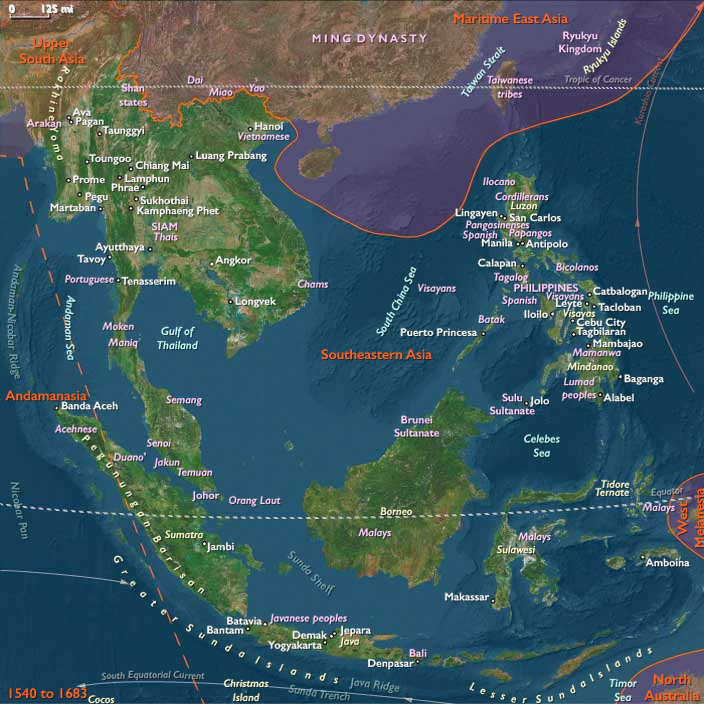
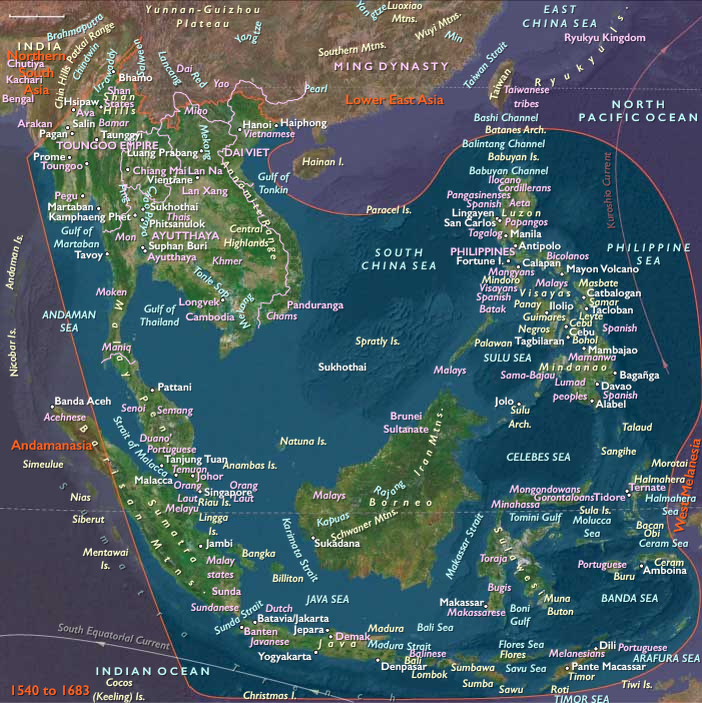
...Tenasserim in 1610, but is repelled by …
Years: 1610 - 1610
...Tenasserim in 1610, but is repelled by the Siamese defenders.
Locations
People
Groups
Subjects
Regions
Subregions
Related Events
Filter results
Showing 10 events out of 33443 total
Anaukpetlun invades Tavoy and ...
The VOC establishes the post of Governor General in 1610 to enable firmer control of their affairs in Asia.
To advise and control the risk of despotic Governors General, a Council of the Indies (Raad van Indië) is created.
The Governor General effectively becomes the main administrator of the VOC's activities in Asia, although the Heeren XVII (the Lords Seventeen, the Amsterdam-based regents of the VOC) will continue to officially have overall control.
VOC headquarters will be in Ambon from 1610 to 1619 for the tenures of the first three Governors General.
The Changdeokgung complex, also known as Changdeokgung Palace or Changdeok Palace, set within a large park in present Jongno-gu, Seoul, South Korea, is one of the "Five Grand Palaces" built by the kings of the Joseon Dynasty.
Like the other Five Grand Palaces in Seoul, Changdeokgung was heavily damaged in 1592 during the Japanese occupation of Korea.
Injeongjeon Hall, the throne hall of Changdeokgung, is used for major state affairs including the coronation of a new king and receiving foreign envoys.
Originally built in 1405, the badly burned structure is rebuilt in 1610.
The East India Company has managed in two years to build its first factory in the town of Machilipatnam on the Coromandel Coast of the Bay of Bengal.
Caravaggio’s last picture is The Martyrdom of Saint Ursula.
His style has continued to evolve — Saint Ursula is caught in a moment of highest action and drama, as the arrow fired by the king of the Huns strikes her in the breast, unlike earlier paintings which had all the immobility of the posed models.
The brushwork is much freer and more impressionistic.
Had Caravaggio lived, something new would have come.
In the chiaroscuro, a woman points two fingers at Peter while a soldier points a third.
Caravaggio tells the story of Peter denying Christ three times with this symbolism.
Chiaroscuro had been practiced long before Caravaggio came on the scene, but it is he who has made the technique definitive, darkening the shadows and transfixing the subject in a blinding shaft of light.
With this comes the acute observation of physical and psychological reality which forms the ground both for his immense popularity and for his frequent problems with his religious commissions.
He works at great speed, from live models, scoring basic guides directly onto the canvas with the end of the brush handle; very few of Caravaggio's drawings appear to have survived, and it is likely that he preferred to work directly on the canvas.
The approach is anathema to the skilled artists of his day, who decry his refusal to work from drawings and to idealize his figures.
Yet the models are basic to his realism.
Some have been identified, including Mario Minniti and Francesco Boneri, both fellow artists, Mario appearing as various figures in the early secular works, the young Francesco as a succession of angels, Baptists and Davids in the later canvasses.
His female models include Fillide Melandroni, Anna Bianchini, and Maddalena Antognetti (the "Lena" mentioned in court documents of the "artichoke" case as Caravaggio's concubine), all well-known prostitutes, who appear as female religious figures including the Virgin and various saints.
Caravaggio himself appears in several paintings, his final self-portrait being as the witness on the far right to the Martyrdom of Saint Ursula.

Caravaggio takes a boat northwards in the summer of 1610 to receive the pardon, which seems imminent thanks to his powerful Roman friends.
With him are three last paintings, gifts for Cardinal Scipione.
What happened next is the subject of much confusion and conjecture.
The bare facts are that on July 28 an anonymous avviso (private newsletter) from Rome to the ducal court of Urbino reported that Caravaggio was dead.
Three days later another avviso said that he had died of fever on his way from Naples to Rome.
A poet friend of the artist later gave July 18 as the date of death, and a recent researcher claims to have discovered a death notice showing that the artist died on that day of a fever in Porto Ercole, near Grosseto in Tuscany.
Human remains found in a church in Porto Ercole in 2010 are believed to almost certainly belong to Caravaggio.
The findings come after a yearlong investigation using DNA, carbon dating and other analysis.
Cesi visits Naples and meets the polymath Giambattista della Porta, who encourages Cesi to continue with his endeavors and joins Cesi's academy in 1610.
The painter Orazio Gentileschi had moved to Rome in the late 1570s or early 1580s and become associated with the landscape-painter Agostino Tassi, executing the figures for the landscape backgrounds of this artist in the Palazzo Rospigliosi, and it is said in the great hall of the Quirinal Palace, although by some authorities the figures in the last-named building are ascribed to Giovanni Lanfranco.
He had worked also in the churches of Santa Maria Maggiore, San Nicola in Carcere, Santa Maria della Pace and San Giovanni in Laterano.
However, Gentileschi's main influence starting from the early seventeenth century is Caravaggio, also in Rome at this time, whose style he is one of the best followers of.
Sharing with the former shadowy characteristics, he has taken part in several adventures in Rome's streets.
Giovanni Baglione had in late August of 1603 filed a suit for libel against Caravaggio, Gentileschi, Ottavio Leoni, and Filipo Trisegni in connection with some unflattering poems circulated among the artistic community of Rome over the preceding summer.
Caravaggio’s testimony during the trial as recorded in court documents is one of the few insights into his thoughts about the subject of art and his contemporaries.
Gentileschi's best works are Saints Cecilia and Valerian, in the Galleria Borghese of Rome; David after the death of Goliath (circa 1610), in the Palazzo Doria, Genoa; and some works in the royal palace, Turin, noticeable for vivid and uncommon coloring.
Rubens moves in 1610 into a new house and studio that he has designed.
Now the Rubenshuis Museum, the Italian-influenced villa in the center of Antwerp accommodates his workshop, where he and his apprentices make most of the paintings, and his personal art collection and library, both among the most extensive in Antwerp.
Altarpieces such as The Raising of the Cross (1610) and The Descent from the Cross (1611–1614) for the Cathedral of Our Lady are particularly important in establishing Rubens as Flanders' leading painter shortly after his return.
The Raising of the Cross, for example, demonstrates the artist's synthesis of Tintoretto's Crucifixion for the Scuola Grande di San Rocco in Venice, Michelangelo's dynamic figures, and Rubens's own personal style.
This painting has been held as a prime example of Baroque religious art.
The New Testament of the Douay-Rheims Bible (also known as the Rheims-Douai Bible or Douai Bible, and abbreviated as D-R), the translation of the Bible from the Latin Vulgate into English undertaken by members of the English College, Douai, had been published in Reims (France) in 1582, in one volume with extensive commentary and notes.
The Old Testament, which is published by the university of Douai, follows nearly thirty years later in two volumes; the first volume (Genesis to Job) in 1609, the second (Psalms to 2 Machabees plus the apocrypha of the Clementine Vulgate) in 1610.
Marginal notes take up the bulk of the volumes and have a strong polemical and patristic character.
They also offer insights on issues of translation, and on the Hebrew and Greek source texts of the Vulgate.
The purpose of the version, both the text and notes, is to uphold Catholic tradition in the face of the Protestant Reformation which up until the late sixteenth century had overwhelmingly dominated Elizabethan religion and academic debate.
As such it is an impressive effort by English Catholics to support the Counter-Reformation.