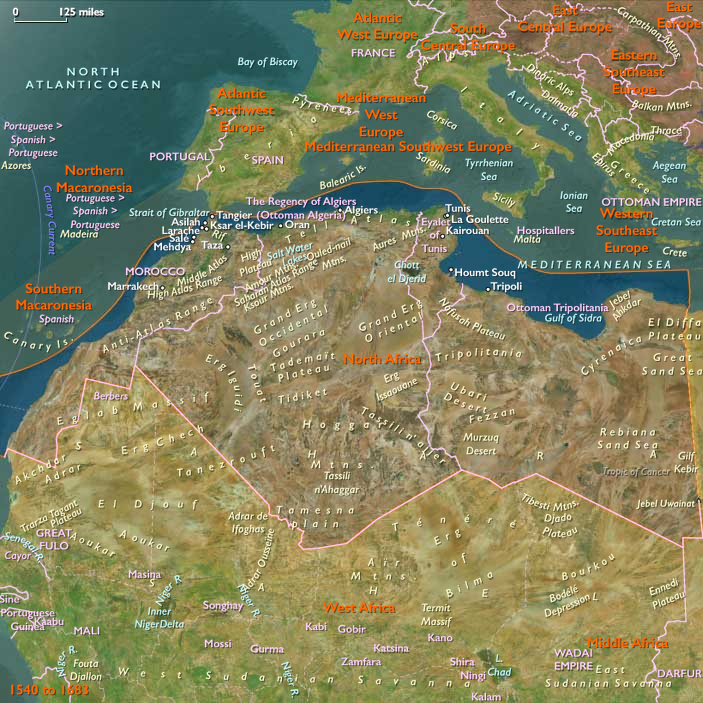
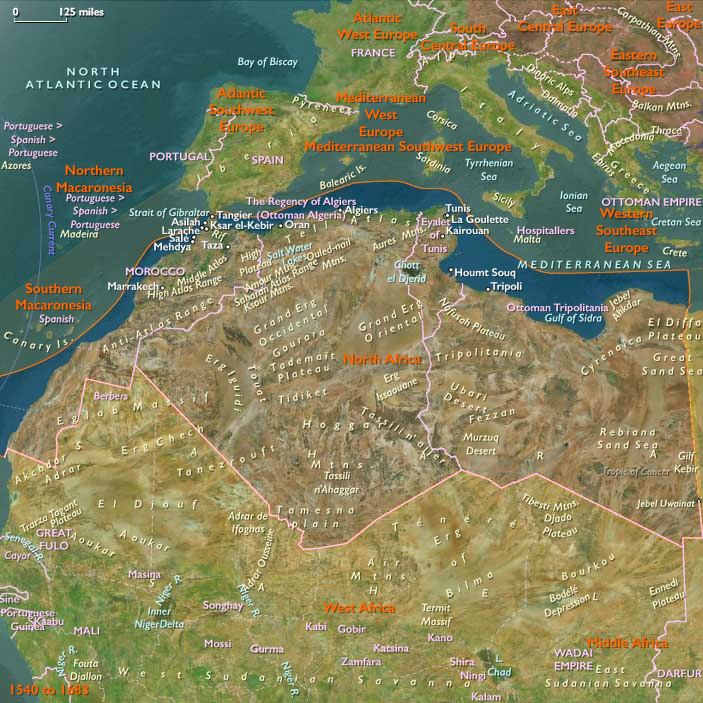
Taza.
Years: 1623 - 1623
Taza.
Locations
People
Groups
- Morocco, Sa'di Sharifate of
- Spain, Habsburg Kingdom of
- Portugal, Habsburg (Philippine) Kingdom of
- England, (Stuart) Kingdom of
Topics
Commodoties
Subjects
Regions
Subregions
Related Events
Filter results
Showing 10 events out of 32938 total
Dutch explorer Jan Carstenszoon, commissioned in 1623 by the Dutch East India Company to lead an expedition to the southern coast of New Guinea and beyond, to follow up the reports of land sighted further south in the 1606 voyages of Willem Janszoon in the Duyfken, had set sail from Amboyna in the Dutch East Indies with two ships, the Pera and Arnhem (captained by Willem Joosten Van Colster).
The ships travel along the south coast of New Guinea, then head south to Cape York Peninsula and the Gulf of Carpentaria.
Cape Keerweer is passed on April 14, 1623.
Landing in search of fresh water for his stores, Carstenszoon encounters a party of the local indigenous Australian inhabitants.
Carstenszoon describes them as "poor and miserable looking people" who have "no knowledge of precious metals or spices".
Carstenszoon and his crew fight a skirmish on May 8, 1623, with two hundred Aborigines at the mouth of a small river near Cape Duyfken (named after Janszoon's vessel which had earlier visited the region) and land at the Pennefather River.
Carstenszoon names the small river Carpentier River, and the Gulf of Carpentaria in honor of Pieter de Carpentier, at this time Governor-General of the Dutch East Indies.
Carstenszoon reaches the Staaten River before heading north again.
The Pera and Carstenszoon return to Ambon while the Arnhem crosses the Gulf of Carpentaria, sighting the the region between Roper and Victoria Rivers in present Australia’s Northern Territory and naming it Arnhem Land after the name of his ship.
Mustafa's brief reign, under the strong influence of his mother, witnesses continuous interference of the Janissaries in the administration and a revolt in Anatolia of Abaza Mehmed Pasa, who seeks to avenge Osman's death.
Mustafa is on September 10, 1623, deposed for a second time on the grounds of mental instability.
Eleven-year-old Murad IV, another son of Ahmed, succeeds on the deposition of his uncle.
The Safavid rulers of Persia had captured Baghdad in 1509 but lost it to the Ottomans a generation later.
The Ottoman pasha (governor) n Baghdad and the military have for some years vied for control of the city.
The struggle had become crucial in 1621, when a Janissary officer had formed a faction; he has for the past two years wielded more power than the pasha.
As he and the Janissaries are now masters of Baghdad, the officer applies to the Porte for recognition as the new pasha, but in vain.
He next turns to Shah 'Abbas for aid, gaining a small Persian relief force just as the Porte agrees to grant him recognition.
Renouncing 'Abbas, he finds himself attacked by the Persians and is killed in 1623 as they make the city again part of their empire.
Fakhr ad-Din, realizing the need for a strong and disciplined armed force, has channeled his financial resources into building a regular army.
This army proves itself in 1623, when Mustafa Pasha of Damascus, underestimating the capabilities of the Lebanese army, engages it in battle and is decisively defeated at Anjar in the Biqa Valley.
The Ottoman sultan, impressed by the victory of the Lebanese ruler, awards Fakhr ad-Din the title of Sultan al Barr (Sultan of Land).
France, Savoy, and Venice, agreeing to cooperate in removing Spanish forces from the strategic Alpine pass of Valtelline, a valley in the Lombardy region of northern Italy, sign the Treaty of Paris in February,
La Mulata or Kitchen Maid with the Supper of Emmaus is one of the first known works by Velázquez, possibly begun at the end of 1617 or the start of 1618 and completed around 1623 in Seville.
It shows a mulatto kitchen maid, with the supper at Emmaus in the left background.
It is now in the National Gallery of Ireland in Dublin.
Another version, without the religious scene, is in the Art Institute of Chicago.
Francisco de Zurbarán, born at Fuente de Cantos in Extremadura, the son of Luis Zurbarán, a haberdasher, and his wife, Isabel Márquez, had as a child set about imitating objects with charcoal.
His father had sent him to Seville in 1614 to apprentice for three years with Pedro Díaz de Villanueva, an artist of whom very little is known.
It is unknown whether Zurbarán had the opportunity to copy the paintings of Michelangelo da Caravaggio; at any rate, he has adopted Caravaggio's realistic use of chiaroscuro.
The painter who may have had the greatest influence on his characteristically severe compositions was Juan Sánchez Cotán.
Polychrome sculpture—which by the time of Zurbarán's apprenticeship had reached a level of sophistication in Seville that surpassed that of the local painters—had provided another important stylistic model for the young artist; the work of Juan Martínez Montañés is especially close to Zurbarán's in spirit.
Zurbarán paints directly from nature, and he makes great use of the lay-figure in the study of draperies, in which he is particularly proficient.
He has a special gift for white draperies; as a consequence, the houses of the white-robed Carthusians are abundant in his paintings.
To these rigid methods, Zurbarán is said to have adhered throughout his career, which is prosperous, wholly confined to Spain, and varied by few incidents beyond those of his daily labor.
His subjects are mostly severe and ascetic religious vigils, the spirit chastising the flesh into subjection, the compositions often reduced to a single figure.
The style is more reserved and chastened than Caravaggio's, the tone of color often quite bluish.
Exceptional effects are attained by the precisely finished foregrounds, massed out largely in light and shade; ...

The Portrait of Philip IV in Armour, a portrait of Philip IV of Spain by Velázquez now in the Museo del Prado in Madrid, is one of the artist's most realistic portraits of Philip IV and is one of the first he produces after being made painter to the king in 1623.
Its style corresponds to the artist's beginnings in Seville and shows its subject in a sculptural style like a portrait bust, with abrupt color contrasts.
Sidi al-Ayashi manages to briefly re-capture al-Mamura, and extends his power as far as
The Utrecht works made by Baburen between 1621 and 1624, the final years of his career, merge the visual characteristics learned from Caravaggio and Manfredi into genre, mythological and history painting.
Prometheus Being Chained by Vulcan (Rijksmuseum, Amsterdam), for example, adapts Caravaggio's upside-down figure of St. Paul from the Conversion of St. Paul (Santa Maria del Popolo, Rome) for the position of the fallen Prometheus, who was punished for stealing fire from the gods and giving it to mortals.
Years: 1623 - 1623
Locations
People
Groups
- Morocco, Sa'di Sharifate of
- Spain, Habsburg Kingdom of
- Portugal, Habsburg (Philippine) Kingdom of
- England, (Stuart) Kingdom of