
Taxila, or Takshashila, in the western Punjab …
Years: 180BCE - 180BCE
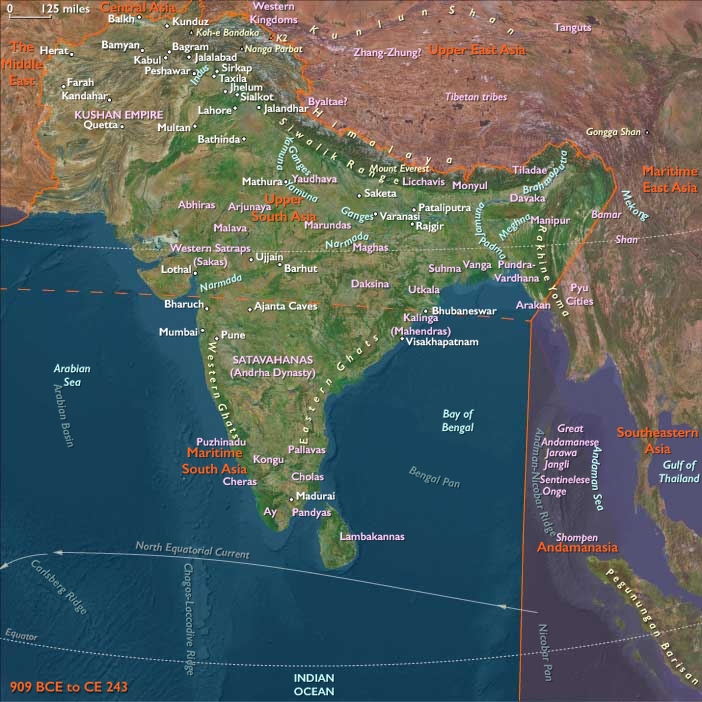
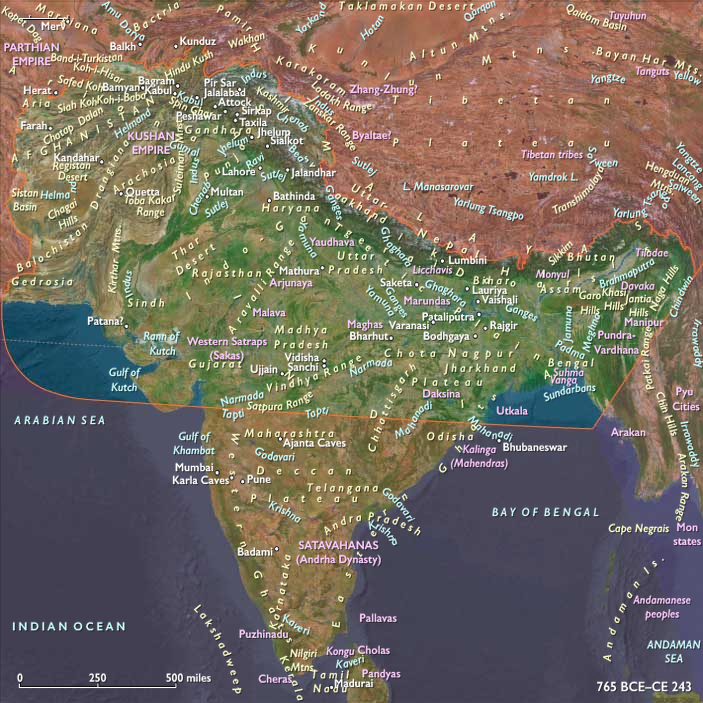
Taxila, or Takshashila, in the western Punjab (today represented by the remains in the present Bhir Mound) had become a great Buddhist center of learning during the reign of Ashoka, grandson of Chandragupta Maurya, founder of the Mauryan empire in eastern India.
Nonetheless, Taxila had briefly been the center of a minor local rebellion, subdued only a few years after its onset.
Two years after the assassination of the last Maurya emperor in 185, the Greco-Bactrian King Demetrius, who had succeeded his father Euthydemus around 200 BCE and conquered extensive areas in what now is eastern Iran and Afghanistan, led his troops across the Hindu Kush to conquer Gandhāra, the Punjab and the Indus valley, thus creating an Indo-Greek kingdom far from Hellenistic Greece.
It is generally considered that Demetrius ruled in Taxila (where many of his coins will be found in the archaeological site of Sirkap, on the opposite bank of the Tamranal River from Taxila.
The Indian records also describe Greek attacks on Saketa, Panchala, Mathura and Pataliputra.)
Demetrius I dies of unknown reasons, and the date 180 BCE is merely a suggestion aimed to allow suitable regnal periods for subsequent kings, of which there are to be several.
Even if some of them are co-regents, civil wars and temporary divisions of the empire are most likely.
The kings Pantaleon, Antimachus, Agathocles and possibly Euthydemus II rule after Demetrius I, and theories about their origin include all of them being relatives of Demetrius I, or only Antimachus.
Eventually, the kingdom of Bactria would fall to the able newcomer Eucratides, who in about 171 would uproot the Euthydemid dynasty of Greco-Bactrian kings and replace it with his own lineage.
Buddhism flourishes in the realms of the Bactrian kings.
The Sunga Empire's wars with the Indo-Greek Kingdom figure greatly in the history of this age, although the net result of these wars remains uncertain.
Locations
People
Groups
Topics
Commodoties
Subjects
Regions
Subregions
Years: 180BCE - 180BCE
Locations
People
Groups
Topics
Commodoties
Subjects
Regions
Subregions