Taranto, like Sparta, its mother city, had …
Years: 466BCE - 466BCE
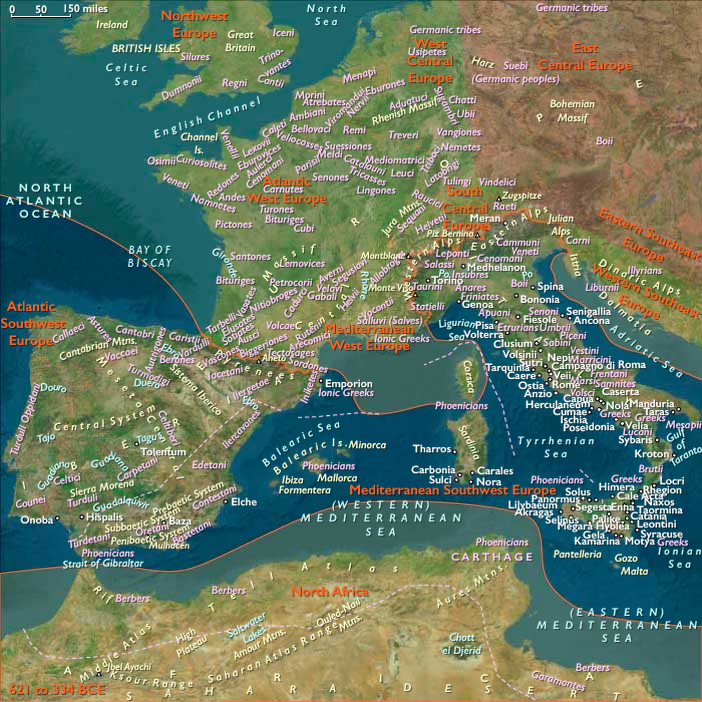
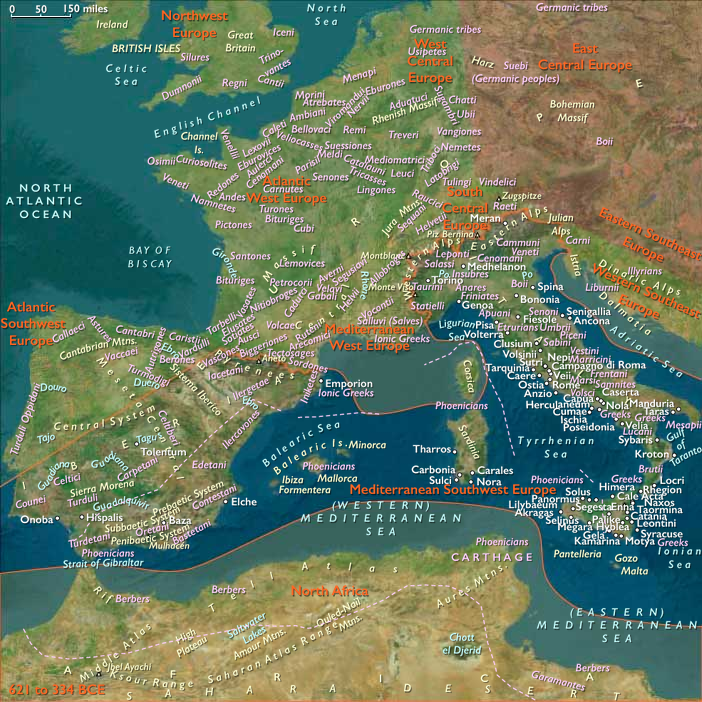
Taranto, like Sparta, its mother city, had begun as an aristocratic republic, but becomes democratic when the ancient nobility dwindles.
In 466 BCE, Taranto is again defeated by the Iapyges; according to Aristotle, who praises its government, there were so many aristocrats killed that the democratic party was able to get the power, to remove the monarchy, inaugurate a democracy, and expel the Pythagoreans.
Locations
Groups
- Messapii (Iapygian tribe)
- Greece, classical
- Italy, classical
- Sparta, Kingdom of
- Magna Graecia
- Taras (Dorian Greek) city-state of
Topics
Commodoties
Subjects
Regions
Subregions
Related Events
Filter results
Showing 10 events out of 65393 total
The tribes of Malis, a semi-indigenous Dorian people who contribute to the construction of a temple at Delphi, establish as their center Lamía, in the Sperkhiós River valley at the foot of the Óthris Mountains, near the Gulf of Euboea, in the fifth century BCE.
Egypt revolts against Persia, starting a six-year war.
An Athenian force sent to attack Cyprus is diverted to support this revolt.
Athens, in a failed attempt to aid the Egyptians, loses a fleet and possibly as many as fifty thousand men.
The Middle East: 465–454 BCE
Intrigue and Rebellion in the Persian Empire
Following the military setbacks in the Greek campaign, Xerxes I retreats to his palatial comforts, immersing himself in lavish architectural projects, notably at Persepolis. His reign, however, ends abruptly in 465 BCE when he is assassinated by Artabanus, his chief minister. This conspiracy also results in the murder of Xerxes’ elder son, Darius, leaving the throne to his younger son, who ascends as Artaxerxes I.
Known to the Greeks as Macrocheir ("Longhand"), Artaxerxes I establishes himself at Susa, the administrative heart of his vast empire. His early reign is fraught with palace intrigue and immediate challenges to his authority. Rebellions flare up in distant provinces, particularly in Bactria and Egypt, regions vital to the empire’s economic and strategic stability.
Suppressing these revolts demands significant military engagement, highlighting ongoing tensions between the Persian center and its peripheral territories. Despite these challenges, Artaxerxes manages to reassert Persian dominance, though at considerable cost, setting the stage for a period of uneasy stability marked by cautious governance and persistent regional discontent.
Xerxes, who had retired to his harem after the debacle in the west and devoted his energies to building palaces at Persepolis, is assassinated in 465 by Artabanus, his chief minister; his younger son succeeds him as Artaxerxes I (his elder brother, Darius, having been also murdered).
Artaxerxes, called by the Greeks Macrocheir (Longhand) spends most of his time at Susa.
Court intrigues at the beginning of Artaxerxes’ reign are followed by revolts in the provinces of Bactria and Egypt, which the Persians suppress after considerable fighting.
Near East (466–454 BCE): Egyptian Revolt, Judahite Resettlement, and Religious Reformation
Between 466 and 453 BCE, the Near East experiences notable political upheaval, strategic setbacks, and significant cultural developments. Central to the period is a major revolt by Egypt against Persian rule, sparking a prolonged six-year conflict. Initially hopeful, Egyptian resistance soon escalates into a broader international struggle when Athens diverts military resources originally intended for an assault on Cyprus to support the Egyptian insurgents. The Athenian decision results in disastrous losses, including a substantial portion of their naval fleet and possibly as many as fifty thousand soldiers, severely weakening their strategic capabilities in the eastern Mediterranean.
Meanwhile, in Palestine, returning Judahites from the Babylonian exile continue their intensive efforts at resettlement and reconstruction. Bethlehem is among the key towns repopulated during this period, symbolizing a broader renewal of Judahite communal and religious identity. Amidst these significant demographic shifts, the Persian court sends the influential scribe Ezra to Jerusalem in 458 BCE (though alternative chronologies place his arrival in either 428 or 397 BCE). Ezra's mission, as recorded in biblical tradition, is to reinforce adherence to religious law and to address controversial intermarriages with non-Judahites, an effort aimed at solidifying community cohesion and religious purity.
These developments collectively highlight a complex regional dynamic characterized by resistance to Persian authority, international entanglements, and a determined cultural and religious revival within Judahite society. The Near East thus continues to be shaped profoundly by the interplay of political power struggles and the assertion of local identities across Egypt, Palestine, and the broader eastern Mediterranean region.
Bethlehem is among the towns repopulated by the Judahites returning from Babylonia to Palestine.
The scribe Ezra, according to the Bible, is sent to Jerusalem from the Persian court in 458 BCE.
The purposes of his mission are (according to one view of the Book of Ezra) apparently to introduce stricter observance of the Law and to dissolve marriages with foreigners.
Other scholars date Ezra’s arrival at 428 BCE or 397 BCE.
Ezra, with the Book of Nehemiah, were originally one work in the Hebrew canon, and scholars disagree on whether the two books were written by the same hand.
Athens and the island of Thasos, a powerful naval state, come into conflict over control of gold deposits on the Thracian mainland, which Thasos has traditionally mined.
Thasos rebels against Athenian control, seeking to renounce its membership in the Delian League.
The rebellion is eventually crushed, after a long and difficult siege, but not before Sparta has secretly promised to invade Attica in support of the Thasians.
The Spartans are prevented from making good on this promise only by an earthquake in Laconia, which triggers a helot rebellion.
The uprising of the helots against their Spartan overlords in the Peloponnese, coincident with the earthquake of 464 BCE, is soundly attested in contemporary or near-contemporary writings, although Greek historians do not agree on the interpretation of this event.
This appears in any case to lead to strained relations between Sparta and Athens, one of the factors that leads to the Peloponnesian War.
Fought between Sparta as the leaders of the Peloponnesian League and Sparta's other allies, most notably Thebes, and the Delian League led by Athens with support from Argos, the First Peloponnesian War consists of a series of conflicts and minor wars, such as the Second Sacred War.
There are several causes for the war, including the building of the Athenian Long Walls, Megara's defection and the envy felt by Sparta at the growth of the Athenian Empire.
The Suppliant Women, written by Aeschylus in about 463 BCE as the first play in a trilogy, dramatizes the decision of the king of Argos to shelter fifty Egyptian women—the Danaids—who seek escape from marriage to their cousins.
He premieres in Athens another trilogy, one of enormous scope and power, the Oresteia, in 458 BCE.
The only one of the playwright’s trilogies, or any other from this age, to survive intact, the Oresteia is a dramatization of the legendary curse on the House of Atreus.
The play features the violent Agamemnon, the even more violent Choephoroe, or Libation Bearers, and the spectacular Eumenides.
The Oriesteia explores ambiguous and paradoxical relationship between humans and the cosmos, in which people must answer for actions determined by the gods.
A skene, or stage building, (originally of wood), had been added about 460 BCE at the rear of the Greek theater at Athens, consisting until now only of the large circle known as the orchestra ("dancing place").
The actors make their entrances and exits through this new structure, although the chorus continues to enter from the sides and the action is still restricted to the flat orchestra.
Additional scenery, painted on panels attached to the skene, may be in use by now.
Several special effects and machines are available to the dramatists.
These include the eccyclema, or "wheeling out" machine, a wagon (or perhaps a turntable) on which bloody tableaux are displayed after a murder takes place in the palace, represented by the skene; and a crane by which actors portraying gods can be flown above the stage.
According to the ancient, anonymous Life of Aeschylus, "boys fainted and women miscarried" at the appearance of the Furies hounding the protagonist Orestes in the Eumenides.
This is a tribute to the true showmanship of Aeschylus, whose striking visual effects combine elaborate machinery with exotic robes, painted scenery, daring costumes and masks, and high boots (kothornoi) that magnify the height of the actors.
Aeschylus after 458 BCE returns to Sicily, allegedly dissatisfied with the Athenian public.
Euripides, a thirty-year old Athenian playwright (possibly born on Salamis) enters his first competition in 455; the Attic drama festival of 454 sees the first performance of his plays.

Greek mathematicians use the theorem of Pythagoras to make the discovery that in a square with sides of length one, the length of its diagonal d is a number whose square is two (d(2) = 2).
The Greeks initially try to find a rational number whose square is 2, but, about 460 BCE, they finally prove that d = the square root of 2 is not rational.
Mathematicians have, therefore, to expand their concept of a number to include these irrational numbers, or surds.
Theorists of the time are unable to determine as rational or irrational another mysterious number which arose naturally, the Greek letter pi—the ratio of the circumference of a circle to its diameter.
Years: 466BCE - 466BCE
Locations
Groups
- Messapii (Iapygian tribe)
- Greece, classical
- Italy, classical
- Sparta, Kingdom of
- Magna Graecia
- Taras (Dorian Greek) city-state of