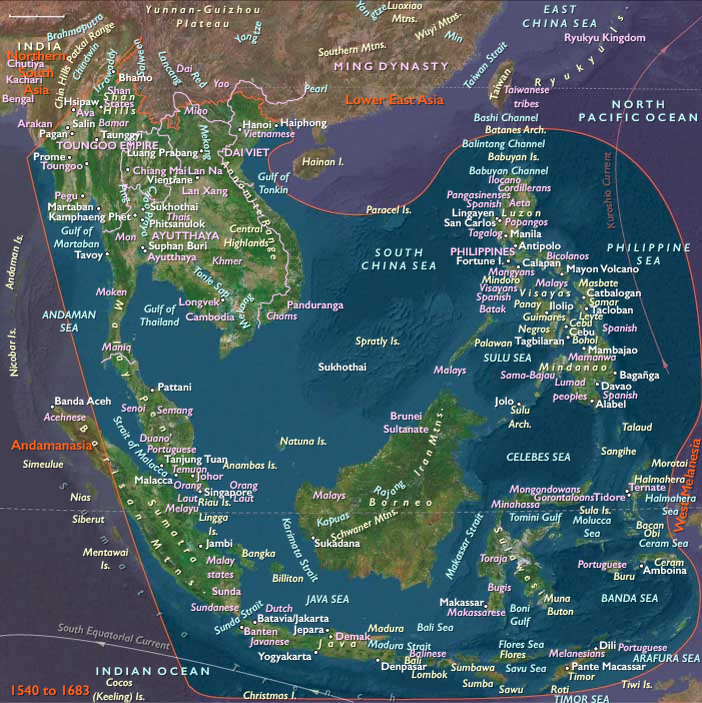
Tabinshwehti takes the Mon town of Moulmein …
Years: 1541 - 1541
Tabinshwehti takes the Mon town of Moulmein in 1541, and ...
Locations
People
Groups
Topics
Commodoties
Subjects
Regions
Subregions
Related Events
Filter results
Showing 10 events out of 36788 total
Tabinshwehti, following a coronation ceremony and religious donations at the Shwedagon Paya, where he is crowned “king of all Burma” in 1541, ...
...the newly installed monarch leads an expedition to the north to subjugate Prome, but the initial assaults against the city walls fail.
Prome requests aid from Shan Ava and Arakan.
Thai forces arrive first, but Bayinnaung meets them in advance before they can arrive at the city and defeats them.
The siege drags on and when the rainy season arrives, Tabinshwehti orders his troops to plant rice and gather labor and provisions from Lower Burma.
Bayinnaung ambushes the overland contingent of forces sent by Arakan, causing caused both the Arakanese land and river forces to return home.
After five months of siege, starvation leads to defections and enable the Burmese to easily overcome the weakened defenses.
(The Portuguese writer Fernão Mendes, purportedly an eyewitness, describes in detail the sack of Prome and the punishments that were supposedly meted out to the inhabitants.)
Tabinshwehti now controls Lower Burma; most of the Mon princes become his vassals.
...the coastal areas south to Tavoy.
Martaban, a thriving Mon port town, will be difficult for Tabinshwehti to subdue, supported as it is by Portuguese soldiers and arms and defended on the land side by strong fortifications backed with earthwork and on the water side by seven Portuguese ships under Paulo Seixas.
Martaban tries to negotiate surrender when supplies run out, but Tabinshwehti will accept only a complete surrender.
Martaban tries without success to lure away Tabinshwehti’s Portuguese mercenary commander Joano Cayeyro.
Finally, Tabinshwehti uses fire rafts to burn and drive away the ships guarding the water side of the fortifications, then maneuvers a high fortress raft armed with guns and cannons to a position in front of the river side fortifications.
The attackers clear the walls of defenders and launch a final assault on the town.
(Pinto records in detail the pillaging and executions that supposedly took place in the wake of the defeat after seven months of siege.)
Olaus Petri (Olof Persson), a clergyman, writer and a main character of the Protestant reformation in Sweden, had in 1539 been ordained as a priest.
Shortly thereafter, however, he and King Gustav Vasa had had a falling out, probably because they were both dominant persons who had ideas in opposition.
Olaus also fearlessly criticized the King's ideas as he thought appropriate but the main reason was that Olaus had gained knowledge of a conspiracy against the King during confession, which he did not reveal.
A trial court had on January 2, 1540, sentenced him and Laurentius Andreae, a renowned clergyman and scholar, to death.
The sentences had been reduced after much pleading to severe fines and both men had been released.
Olaus in 1541 produces a second Swedish Bible translation.
Pataliputra, once the political and cultural center of India, has remained deserted since the Gupta decline in the mid-seventh century.
Sher Shah Sur, also known as Sher Khan or Lion King, the founder of the Sur Dynasty, has established his empire after conquering a huge swathe of territory that is now most of Afghanistan, Pakistan and northern India.
Refounding Pataliputra in 1541 as Patna, he envisions a fort and a town on the banks of the Ganga.
(Sher Shah's fort in Patna does not survive, but the mosque built in Afghan architectural style does.)
One of the oldest continuously inhabited places in the world, Patana is today a bustling city of 1,800,00 people, the capital of the Indian state of Bihar.
The Buddhist and Jain pilgrim centers of Vaishali, Rajgir or Rajgriha, Nalanda, Bodhgaya, and Pawapuri are all nearby.
Patna is a sacred city for Sikhs also, being the birthplace of the tenth and last "human" guru, Guru Gobind Singh.
Major hostilities between Portugal and the Ottoman Empire had begun in 1538 when the Turks, with fifty-four ships, laid siege to Diu, which had been built by the Portuguese in 1535.
The Ottoman fleet had been led by Suleiman I's emissary Hussein Paşa, however the attack had not been not successful and the siege was lifted.
The Portuguese under Estêvão da Gama, having left Goa on December 31, 1540 and reaching Aden on January 27, 1541, attacks the Ottoman fleet near Suez Harbor.
The fleet had reached Massawa (February 12), where Gama had left a number of ships and continued north.
Reaching Suez, he discovers that the Ottoman naval base has long known of his impending raid, and foils his attempt to burn the beached ships.
Gama is forced to retrace his steps to Massawa, although he pauses to attack the port of El-Tor on the Sinai Peninsula.
Jean Calvin, aiming to provide a coherent theology and disciplined organization for his Francophone followers, explains his complex doctrines in a simple style in The Institutes of the Christian Religion.
This groundbreaking tract conquers for the French language the ability to discuss religious subjects that have previously been reserved for Latin.
Calvin's seminal work, which will alter the course of Western history as much as any other book, is still read by theological students today.
Friends of Calvin gain control of the Geneva city council in 1541, and Calvin, now thirty-two and recently married, reluctantly accepts their invitation to return from three years of pleasant exile in Strasbourg as pastor of that city’s French congregation.
In Calvin’s Ordinances of 1541, he gives a new organization to the Protestant church consisting of pastors, doctors, elders, and deacons.
His reforms meet stiff resistance, however, among some Genevans who regard Calvin's morality as absurdly severe, with its banning of plays and its attempt to introduce religious pamphlets and psalm singing into Geneva's taverns.
Later deemed a mistake, Andrea Doria grants Dragut his freedom in the hope of winning favor if one of his nephews should fall into Ottoman hands.
Taking advantage of Dragut's defeat, Andrea Doria sails from Messina in the summer at the head of fifty-one galleys and more than thirty galliots and fustas, aboard which are fourteen companies of Spanish infantry led by García de Toledo, Spanish Viceroy of Sicily.
They attack the Ottoman positions at Tunis, seizing the strongholds of Monastir, Sousse, Hammamet and Kelibia, which they return to the Hafsid King Muhammad V.
Barbarossa's privateering campaign is further checked when, on October 1, the Turkish privateers are defeated again by Christian ships at the Battle of Alborán, in the waters east of the Strait of Gibraltar.
The tolerance of Jews in the Venetian Republic had come to an end following the 1509 influx of Sephardic Jews expelled from the Iberian Peninsula in 1492, and some public figures had talked of deporting or isolating the Venetian Jews.
The Jews of Venice had not been expelled, as had been the case in many European countries, but the Venetian Ghetto had been instituted in 1516 to contain them.
Surrounded by canals, the area is only linked to the rest of the city by two bridges, which are closed from midnight until dawn and during certain Christian festivals, when all Jews are required to stay in the Ghetto.
The area has such a dense population that – uniquely in Venice – buildings rise to six or more stories.
There are numerous benevolent institutions (today, the Jewish Ghetto is still home to five synagogues.
They are known for their interiors, the oldest, the Scuola Grande Tedesca, dating from 1528.
The Scola Levantina had been established in 1538.)
Despite the restrictions on movement and terribly cramped conditions, the Jewish population grows, and in 1541, the quarter is enlarged to cover the neighboring Ghetto Vecchio.
Because of the increased participation of Sephardic Jews in Balkan commerce, the Venetian Senate in 1541 grants Levantine Jews permission to reside in Venice.
This is an attempt by Italian princes to enrich themselves at the expense of local interests rather than to improve the lot of Jews.