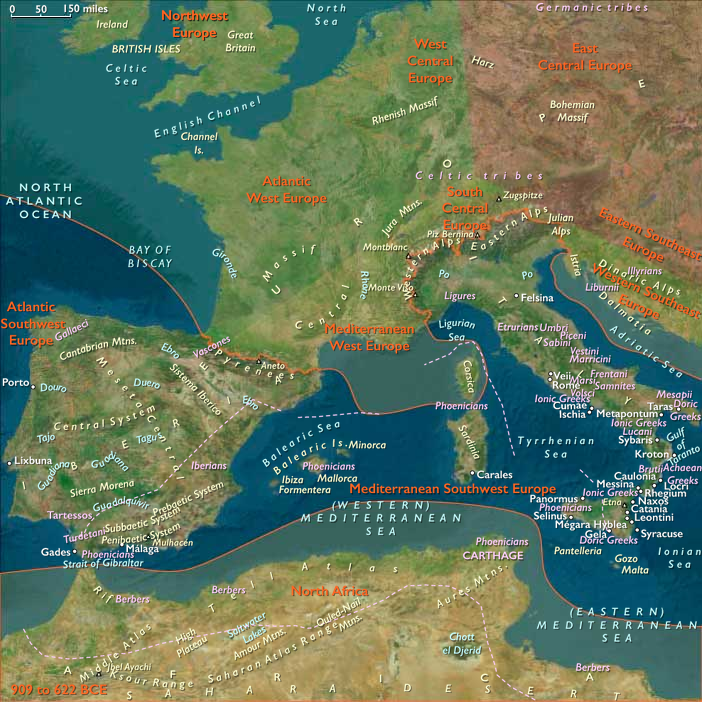
Syracusan exiles and Chalcidian inhabitants of Zancle …
Years: 657BCE - 646BCE
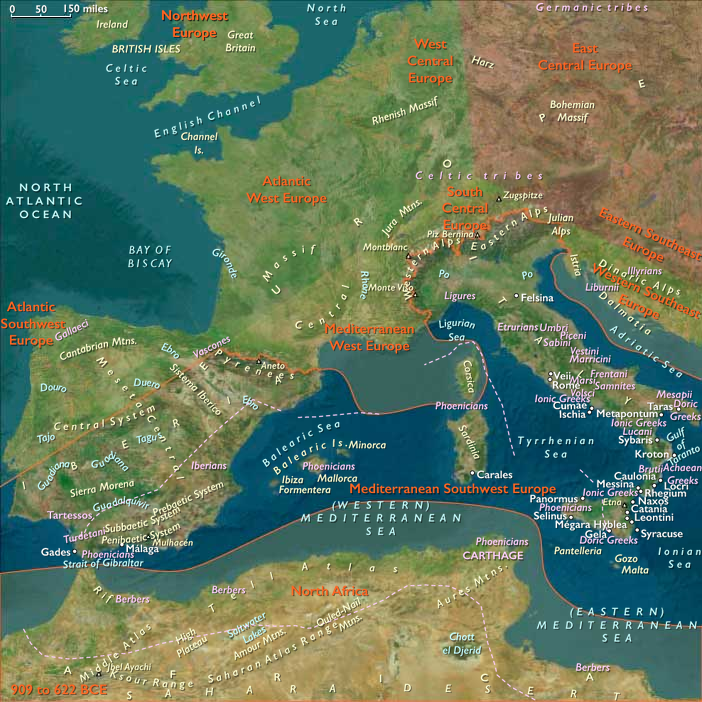
Syracusan exiles and Chalcidian inhabitants of Zancle (Messana) establish Himera, on the northern Himeras (modern Grande) River, on the northern coast of Sicily in about 649 BCE.
Locations
Groups
- Ionians
- Greece, classical
- Sicily, classical
- Italy, classical
- Chalcis, City-State of
- Magna Graecia
- Zancle (Dorian Greek) city-state of
- Syracuse, Corinthian city-state of
- Himera, (Dorian-Ionian Greek) city-state of
Topics
Commodoties
Subjects
Regions
Subregions
Related Events
Filter results
Showing 10 events out of 66210 total
The Middle East: 657–646 BCE
Ashurbanipal's Dominance and Babylonian Revolt
During this period, Ashurbanipal firmly consolidates Assyrian dominance, securing his empire through forceful diplomacy and relentless military campaigns. His reign sees the Assyrian Empire at its greatest territorial extent, stretching from Persia to Egypt and encompassing key regions of Anatolia and the Levant. However, underlying tensions within the empire, particularly in Babylonia, threaten stability.
The Revolt of Shamash-shum-ukin
In 652 BCE, Ashurbanipal’s brother Shamash-shum-ukin, king of Babylon, openly revolts, seeking autonomy and rallying a coalition of Elamites, Arameans, Arabs, and several Babylonian cities against Assyrian rule. Ashurbanipal responds decisively, launching a prolonged siege of Babylon that lasts until 648 BCE. The siege devastates the city, leading to severe famine and suffering. In desperation, Shamash-shum-ukin reportedly perishes in a fire as Babylon falls back under direct Assyrian control. Ashurbanipal then installs a puppet ruler, Kandalanu, to govern Babylon, ensuring its compliance with Assyrian dominance.
Assyrian Campaigns against Elam
Ashurbanipal next turns his attention to Elam, which had supported the Babylonian revolt. In a series of brutal campaigns between 647 and 646 BCE, Ashurbanipal devastates Elam, capturing its cities and razing its capital, Susa, in 646 BCE. Elamite temples and royal tombs are looted, and the statues of Elamite deities are taken to Nineveh. These acts decisively weaken Elam, effectively ending its status as a significant power.
Cultural and Artistic Achievements
Despite the ongoing military conflicts, Ashurbanipal fosters considerable cultural and intellectual achievements in Assyria. He expands the renowned Library of Ashurbanipal in Nineveh, meticulously collecting thousands of clay tablets covering literature, history, science, medicine, and divination. This vast library becomes an invaluable cultural repository, preserving significant Mesopotamian literature, including the Epic of Gilgamesh.
Internal Stability and External Influence
Ashurbanipal’s decisive actions against Babylon and Elam restore internal stability and reinforce Assyrian supremacy. Meanwhile, his continued diplomatic and military successes ensure external dominance, with kingdoms across Anatolia, the Levant, and even as far west as Lydia recognizing Assyrian influence. The empire's advanced military techniques—particularly its cavalry—continue to evolve, solidifying Assyria’s reputation as the region’s paramount military power.
Thus, between 657 and 646 BCE, Ashurbanipal’s reign is characterized by the aggressive suppression of rebellion, significant territorial consolidation, cultural flourishing, and relentless expansion of Assyrian influence, reaffirming the empire's place at the apex of ancient Near Eastern power.

The chief Megaran colony is Astacus (modern Izmit) in northwestern Asia Minor.
Phocaeans, lacking arable land on the Greek mainland, establish colonies in the Crimea and in the Dardanelles, founding Lampsacus (654), a city with a fine harbor on the Asiatic shore of the Hellespont, and …
…Amisus, a city on the southern coast of the Black Sea, lying between the deltas of the Kizil and Yesil rivers on a promontory (just northwest of the modern city center of Samsun, Turkey).
The Elamite ambassadors in Nineveh lose control when they see the head of Teumman; one tears out his beard and the other commits suicide.
As further humiliation, the head of the Elamite king is put on display at the port of Nineveh.
The death and head of Teumman is depicted multiple times in the reliefs of Ashurbanipal's palace.
Ashurbanipal, a scholar as well as a warrior, is collecting an enormous library of Babylonian, Assyrian, and Sumerian cuneiform literature at Nineveh.
Babylonian king Shamash-shum-ukin rises in rebellion against his brother in May 652.
The reasons for this are completely unknown, as no Babylonian sources have been preserved.
He forms a powerful coalition including Nabu-bel-shumate, king of the Mesopotamian Sealands, the Elamites, the Chaldean tribes of the south under Merodach Baladan, the kings of Guti, Amurru and Meluhha and the Arabs from Arabia.
According to a later Aramaic tale on Papyrus 63, Shamash-shum-ukin formally declared war on Ashurbanipal in a letter where he claims that his brother is only the governor of Nineveh and his subject.
Again the Assyrians delayed an answer, this time due to unfavorable omens.
It's not certain how the rebellion affected the Assyrian heartlands but some unrest in the cities indicates that there were problems.
When Babylon finally is attacked, the Assyrians prove to be more powerful.
Civil war prevents further military aid, and in 648 BCE, Borsippa and Babylon are besieged.
Without aid, the situation is hopeless.
The sources describe cases of cannibalism.
After two years Shamash-shum-ukin meets his end in his burning palace just before the city surrenders in June 648, to be remembered by the Greeks in the story of Sardanapal (Ashurbanipal).
This time Babylon is not destroyed, as under Sennacherib, but a terrible massacre of the rebels takes place, according to the king's inscriptions.
Ashurbanipal allows Babylon to keep its semiautonomous position, but it becomes even more formalized than before.
The next king Kandalanu leaves no official inscription, probably as his function is only ritual.
During the four-year civil conflict between Assyria and Babylonia, Egypt has become independent, the alliance with Lydia has ended, and Elam and Media cease to be tributary to Assyria.
The Scythians under Madea (Madius, or Madya) oust Median king Phraortes in 652 during Media’s first war with Assyria, ending the First Median Dynasty.
Assyria and Elam clash again in 658/657 BCE, the reason being an action against the Assyrians in 664 by the treasonous province of Gambulu, for which Ashurbanipal had finally decided to punish them.
On the other hand, Teumman sees his authority threatened by the Elamite princes at the Assyrian court and has demanded their extradition.
When the Assyrian forces invade Elam, a battle follows at the Ulaya river.
Elam is defeated in the battle in which, according to Assyrian reliefs, Teumman committed suicide.
Ashurbanipal installs Humban-nikash as king of Madaktu and another prince, Tammaritu, as king of the city Hidalu.
Elam is considered a new vassal of Assyria and tribute was imposed on it.
With the Elamite problem solved, the Assyrians can finally punish Gambulu and seizes its capital.
The victorious army then marches home, taking with them the head of Teumman.
Ashurbanipal launched a devastating attack on Elam in 653. A text, written in 649, among the annals of Ashurbanipal, records Ashurbanipal's justifications for the war and its conclusion.
The first of these two reliefs depicts the death of the Elamite king, Teumman (also Teumann), and his son, Tammaritu, during the battle of Til-Tuba (River Ulai) in c. 653 BCE. Teumman had been waging war against Ashurbanipal, but during the battle, which Ashurbanipal decisively won, Teumman met his end.
The second relief depicts Ashurbanipal and his queen relaxing at a banquet while the head of Teumman hangs from a tree (far left). Ashurbanipal described his victory and the fate of his enemy:
"Like the onset of a terrible hurricane, I overwhelmed Elam in its entirety. I cut off the head of Teumann, their king, – the haughty one, who plotted evil. Countless of his warriors I slew. Alive, with my hands, I seized his fighters. With their corpses I filled the plain about Susa as with baltu and ashagu. Their blood I let run down the Ulai; its water I dyed red like wool."
Ashurbanipal also went on to destroy the Kingdom of Elam:
"I had the sanctuaries of the land Elam utterly destroyed and I counted its gods and its goddesses as ghosts… I destroyed and devastated the tombs of their earlier and later kings… I took their bones to Assyria. I prevented their ghosts from sleeping and deprived them of funerary-offerings and libations… On a march of one month and twenty-five days, I devastated the districts of the land Elam and scattered salt and cress over them."
Near East (657–646 BCE): Realignments, Religious Syncretism, and Egypt’s Resurgence
Judah under Manasseh: Submission and Religious Pluralism
Throughout this era, Judah continues as a compliant ally of Assyria during the stable and prosperous reign of King Manasseh. His loyalty to Assyrian kings Esarhaddon and Ashurbanipal ensures Judah’s participation in imperial building projects and military operations, contributing to increased economic prosperity.
Manasseh’s reign is marked by notable religious pluralism and syncretism, likely reflecting the cosmopolitan influence resulting from extensive Near Eastern commerce and interactions. The Temple in Jerusalem houses not only the worship of Yahweh (YHWH) but also foreign cults—including solar deities, astral gods, and Asherah, a prominent Canaanite fertility goddess. Similarly, the rural regions of Judah see a resurgence of local altars to Yahweh alongside numerous pagan shrines and foreign rituals. The Hebrew scriptures later condemn this religious diversity, highlighting Manasseh’s violent persecution of Yahwist devotees as part of his effort to consolidate religious practice under his rule.
Psamtik I and Egypt’s Reunification and Revival
With Assyrian attention occupied by unrest elsewhere, the Egyptian ruler Psamtik I seizes the opportunity to assert greater independence and consolidate power over Egypt. Psamtik strategically employs Greek mercenaries, successfully taking control of northern Egypt around 656 BCE. He quickly moves to reunify the divided nation by dispatching a powerful naval force to Thebes in March 656 BCE, compelling the Nubian-appointed God’s Wife of Amun, Shepenupet II, to adopt his daughter Nitocris I as her successor. Recorded on the so-called Adoption Stela, this diplomatic maneuver effectively ends the remaining influence of the Nubian Twenty-fifth Dynasty in Upper Egypt.
Psamtik actively encourages the growth of Greek settlements, deepening Hellenic influence in Egyptian military and commercial activities. His vigorous military campaigns—especially against Libyan raiders in Egypt’s Dakhla Oasis—demonstrate his resolve in reestablishing centralized Egyptian authority.
Kushite Consolidation at Meroë
Expelled definitively from Egypt, the Kushite dynasty relocates its political center further southward to Meroë around 656 BCE, strategically positioned along vital caravan trade routes connecting the Nile to the Red Sea. After King Tantamani’s death in 653 BCE, he is succeeded by Atlanersa, son of Taharqa, who continues to rule from this newly established Kushite heartland, marking the start of Meroë’s long ascendancy as the primary cultural and political hub of Nubia. Atlanersa is interred in the royal cemetery at El-Kurru, preserving dynastic continuity and heritage.
Gyges and the Fall of Lydian Ambitions
In Asia Minor, the once formidable Lydian king Gyges encounters severe setbacks due to shifting regional alliances. His decision to support Psamtik’s Egyptian revolt against Assyria in 654 or 652 BCE causes the Assyrians to withdraw their previously crucial military backing. Exposed and vulnerable, Lydia faces another invasion by the Cimmerians, who decisively defeat Gyges. The exact date remains unclear, but Gyges’ death during this invasion significantly weakens Lydia’s standing as a regional power.
Legacy of the Era
This period (657–646 BCE) is characterized by shifting political and military realignments across the Near East. Judah under Manasseh balances between religious syncretism, political submission, and economic growth. Meanwhile, Egypt’s reunification under Psamtik I ends decades of foreign domination, reasserting native Egyptian power augmented by Greek military and commercial partnerships. Simultaneously, Kush repositions itself at Meroë, initiating a new chapter in its dynastic history, while Lydia experiences a sharp reversal, illustrating the volatility of power dynamics in the region.
Years: 657BCE - 646BCE
Locations
Groups
- Ionians
- Greece, classical
- Sicily, classical
- Italy, classical
- Chalcis, City-State of
- Magna Graecia
- Zancle (Dorian Greek) city-state of
- Syracuse, Corinthian city-state of
- Himera, (Dorian-Ionian Greek) city-state of