
Swietopolks's army suffers a great defeat at …
Years: 1245 - 1245
November
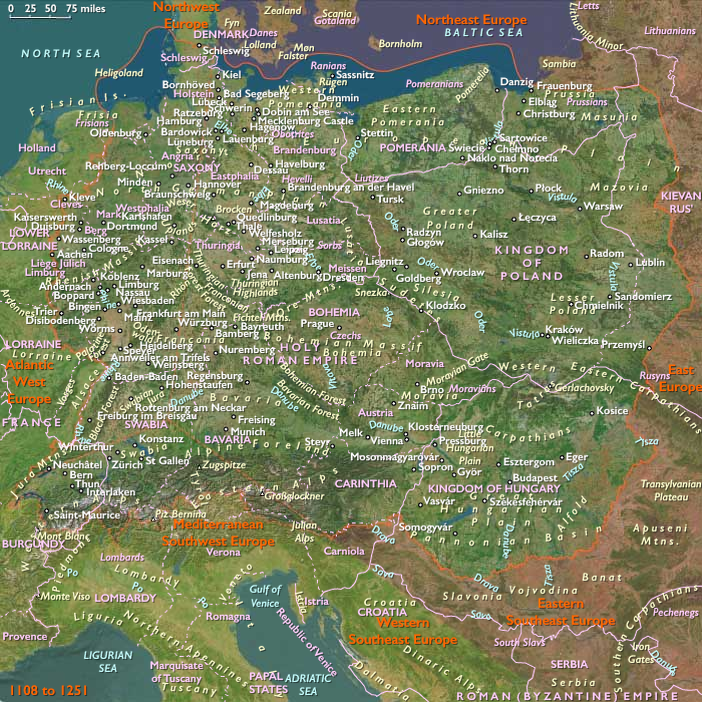
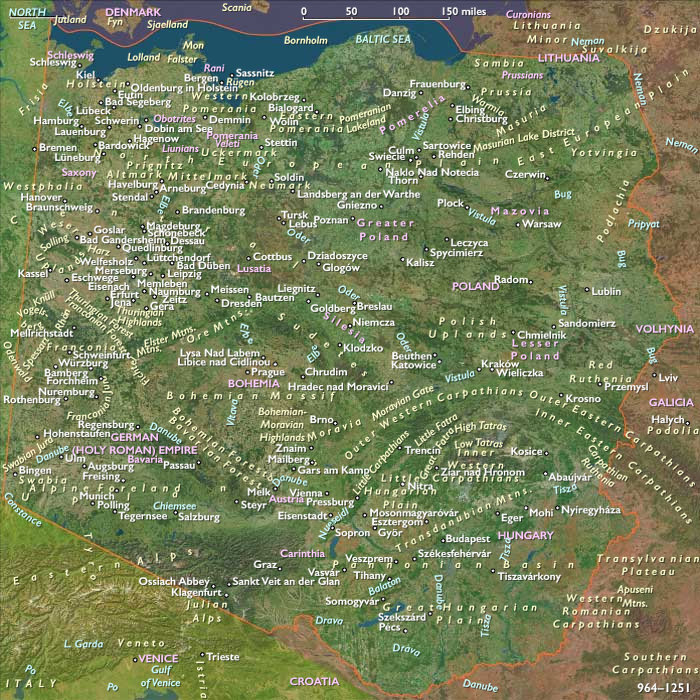
Swietopolks's army suffers a great defeat at Świecie in late 1245.
Locations
People
Groups
- Polytheism (“paganism”)
- Prussians, Old, or Baltic (Western Balts)
- Germans
- Poles (West Slavs)
- Christians, Roman Catholic
- Pomerania, Polish Duchy of
- Mazovia, Duchy of
- Poland during the period of fragmentation, Kingdom of
- Teutonic Knights of Acre (House of the Hospitalers of Saint Mary of the Teutons in Jerusalem)
Topics
- Crusades, The
- Poland, Fragmentation of
- Northern Crusades, or Baltic Crusades
- Teutonic Knights' Conquest of Prussia
- Prussian Uprising, First
Commodoties
Subjects
Regions
Subregions
Related Events
Filter results
Showing 10 events out of 46736 total
Giovanni da Pian del Carpine appears to have been a native of Umbria, in modern-day Italy, where a place formerly called Pian del Carpine, but now Magione, stands near Perugia, on the road to Cortona.
He was one of the companions and disciples of his countryman Saint Francis of Assisi.
Giovanni bears a high repute in the Franciscan order, and had taken a prominent part in disseminating its teaching in northern Europe, holding successively the offices of warden (custos) in Saxony, and of provincial (minister) of Germany, and afterwards of Spain, perhaps of Barbary, and of Cologne.
He had been in the last post at the time of the great Mongol invasion of eastern Europe and of the disastrous Battle of Legnica, which threatened to cast European Christendom under the leadership of the Great Khan of the Mongol Empire, Ögedei Khan.
The dread of the Tatars was, however, still on people's mind four years later, when Pope Innocent IV dispatched the first formal Catholic mission to the Mongols, partly to protest against the latter's invasion of Christian lands, partly to gain trustworthy information regarding Mongol armies and their purposes.
Behind these there may have lurked the beginnings of a policy much developed later—of opening diplomatic intercourse with a power whose alliance might be valuable against Islam.
Pope Innocent IV has chosen Giovanni to head this mission.
Giovanni is around sixty-five at the time, and apparently is in charge of nearly everything in the mission.
As a papal legate, he bears a letter from the Pope to the Great Khan, Cum non solum.
Giovanni had started from Lyon, where the Pope is in residence, on April 16, 1245, accompanied by another friar, Stephen of Bohemia, who breaks down at Kaniv near Kiev and is left behind.
Béla IV welcomes back tens of thousands of Kun (Cumans) who had fled the country before the invasion, recalling them to Hungary in 1245 to repopulate settlements devastated by war.
The nomadic Cumans subsequently settle throughout the Great Hungarian Plain.
The Cumans can be violent against local people and their nomadic lifestyle is hurtful for the Hungarian peasants, but the king favors them.
Duke Konrad of Mazovia, failing to grasp the danger of the Knights’ presence, had at first supported the Knights against Pomerania, but eventually shifts his alliance.
Circumstances have hindered Baldwin from accomplishing anything with the aid from Europe: by 1245, his treasury is empty, and he is forced to break up parts of the imperial palace for firewood.
He travels again to the West, first to Italy and then to France, where he will spend two years.
The empress Marie and Philip of Toucy govern during his absence.
Imperial forces attack Piacenza in 1245.
Baldwin II’s Second Journey to Western Europe (1245): The Sale of Relics to Louis IX
In 1245, Baldwin II, the struggling Latin Emperor of Constantinople, embarked on a second journey to Western Europe, seeking financial and military aid to support his weakening empire, which was under constant threat from the resurgent Byzantine forces of Nicaea. Lacking funds and desperate to secure support, Baldwin resorted to selling sacred relics that had been preserved in Constantinople, including some of the most revered objects in Christian tradition.
The Sale of Relics to Louis IX
-
Baldwin II sold a large collection of alleged relics, including:
- The Crown of Thorns, believed to have been worn by Jesus Christ during His Crucifixion.
- A large portion of the True Cross, supposedly the actual cross upon which Jesus was crucified.
- Several other Holy Relics from Constantinople, which had been preserved in the Byzantine imperial treasury for centuries.
-
The buyer was King Louis IX of France, who was deeply pious and a dedicated crusader. He saw the acquisition of these relics as an extraordinary opportunity to enhance France’s spiritual prestige.
The Relics and the Sainte-Chapelle in Paris
- Upon acquiring the relics, Louis IX built the Sainte-Chapelle in Paris (consecrated in 1248) as a magnificent reliquary to house them.
- The Sainte-Chapelle was designed as a masterpiece of Rayonnant Gothic architecture, emphasizing light, height, and intricate stained glass to create a divine, ethereal atmosphere.
- The relics were enshrined with great ceremony, and Paris became one of the most important pilgrimage sites in medieval Christendom.
Impact and Legacy of Baldwin II’s Actions
-
Temporary Aid for the Latin Empire
- The sale of relics provided Baldwin II with some immediate financial relief, but it was not enough to save the crumbling Latin Empire.
- In 1261, the Byzantines recaptured Constantinople, marking the end of the Latin Empire.
-
Elevating Paris as a Religious Center
- The acquisition of the Crown of Thorns and other relics made Paris a new center of Christian devotion, rivaling Rome and Jerusalem.
- The Sainte-Chapelle remains one of the greatest medieval Gothic monuments today.
-
The Decline of the Latin Empire
- The sale of Constantinople’s sacred relics symbolized the empire’s desperate decline.
- It also weakened the Latin Church’s standing in the East, as Byzantine Christians viewed the Latin rulers as plunderers rather than protectors of Orthodoxy.
Baldwin II’s sale of relics in 1245 was a desperate financial maneuver that provided short-term aid but ultimately did little to save the Latin Empire, while simultaneously enhancing France’s religious and cultural prestige under Louis IX.
Haarlem Receives Its First City Charter (1245 CE)
In 1245, Haarlem, a settlement located on the Spaarne River near the North Sea, west of modern-day Amsterdam, was granted its first city charter. This marked the official recognition of Haarlem as a city, establishing its political and economic autonomy within the County of Holland.
Significance of the Charter
- The city charter was granted by Count William II of Holland, who later became King of the Romans (elected 1247).
- The charter provided Haarlem with legal rights, including:
- Self-governance under local laws.
- Market privileges to stimulate trade.
- Fortification rights, allowing the construction of walls and defenses.
Haarlem’s Growth and Importance
- Due to its strategic location near major trade routes, Haarlem became an important commercial and administrative center.
- The city played a key role in the textile and brewing industries, which later contributed to its economic prosperity in the Dutch Golden Age.
- Haarlem would later become known for its contributions to Dutch art and culture, particularly in the 17th century.
The granting of Haarlem’s city charter in 1245 was a pivotal moment in its history, laying the foundation for its development as one of the most significant cities in Holland.
Reconstruction begins in 1245 on the site of the Collegiate Church of Saint Peter in Westminster, popularly called Westminster Abbey, under the patronage of Henry III, after the demolition of a Norman church built in the mid-eleventh century in Westminster by Edward the Confessor.
The architect is Henry of Reims, who brings to the project a first hand knowledge of French High Gothic architecture.
The design, although modified by the Parisian Rayonnant style, closely follows the French Gothic plan first established a half-century before at Chartres Cathedral and later used at the cathedrals of Reims and Amiens.
Key to this plan are the four-part rib vaults, the three-story elevation, the round piers with attached colonnettes, and the tall, narrow proportions of the main spaces.
Innocent IV and Frederick II continue the struggle between the Papacy and the Empire.
The pope, forced by the emperor to flee Rome for France in 1244, establishes a papal court-in-exile at the powerful archbishopric of Lyon.
Innocent condemns the emperor in April 1245, and summons him to appear before the Council of Lyon, which convenes successfully despite Frederick’s blocking of the Alpine passes to France; he has captured and imprisoned clerics on their way to the Council.
When Frederick refuses to appear, Innocent induces the council to convict him in absentia and declare him deposed on a triple charge: constant violation of the peace, sacrilege, and heresy.
The pope then attempts to secure the election of a new emperor.
, and in April 1245, he was formally deposed by Innocent IV.
Pope Gregory IX had also earlier offered King Louis' brother, count Robert of Artois, the German throne, but Louis had refused.
The ecumenical council also attempts to assist the Christian forces fighting in the Holy Land and to organize a defense against the Mongol invasion of Europe.
The capture of Jerusalem by the Khwarezmians, recently displaced by the advance of the Mongols, on their way to ally with Egypt, has returned Jerusalem to Muslim control, but European Christians have seen the city pass from Christian to Muslim control numerous times in the past two centuries.
This time, despite calls from the Pope, there is no popular enthusiasm for a new crusade.
The only man interested in beginning one is Louis IX, who declares his intent to go East in 1245.
The Holy Roman Emperor is in no position to crusade.
Béla IV of Hungary is rebooting his devastated kingdom after the Mongol invasion of 1241.
Henry III of England is still struggling with Simon de Montfort, among other his other problems.
Henry and Louis, engaged as they are in the Capetian-Plantagenet struggle, are not on good terms.
A new papal council had been held in Lyon beginning on June 24, 1245.
One month later, Innocent IV had declared Frederick to be deposed as emperor, characterizing him as a "friend of Babylon's sultan", "of Saracen customs", "provided with a harem guarded by eunuchs" like the schismatic emperor of Constantinople, and, in sum, a "heretic".
The Pope backs Henry Raspe, landgrave of Thuringia as his rival for the imperial crown and sets in motion a plot to kill Frederick and Enzio, supported by another friend of Frederick's, Orlando de Rossi, the pope's brother-in-law.
The count of Caserta unmasked the plotters, and the vengeance is terrible: the city of Altavilla Silentina, where they had found shelter, and which had sided with the town of Capaccio and other local barons against the emperor Frederick II, is razed to the ground, and the guilty are blinded, mutilated and burned alive or hanged.
Years: 1245 - 1245
November
Locations
People
Groups
- Polytheism (“paganism”)
- Prussians, Old, or Baltic (Western Balts)
- Germans
- Poles (West Slavs)
- Christians, Roman Catholic
- Pomerania, Polish Duchy of
- Mazovia, Duchy of
- Poland during the period of fragmentation, Kingdom of
- Teutonic Knights of Acre (House of the Hospitalers of Saint Mary of the Teutons in Jerusalem)
Topics
- Crusades, The
- Poland, Fragmentation of
- Northern Crusades, or Baltic Crusades
- Teutonic Knights' Conquest of Prussia
- Prussian Uprising, First
