Sweyn had returned in 1006 to raid …
Years: 1007 - 1007
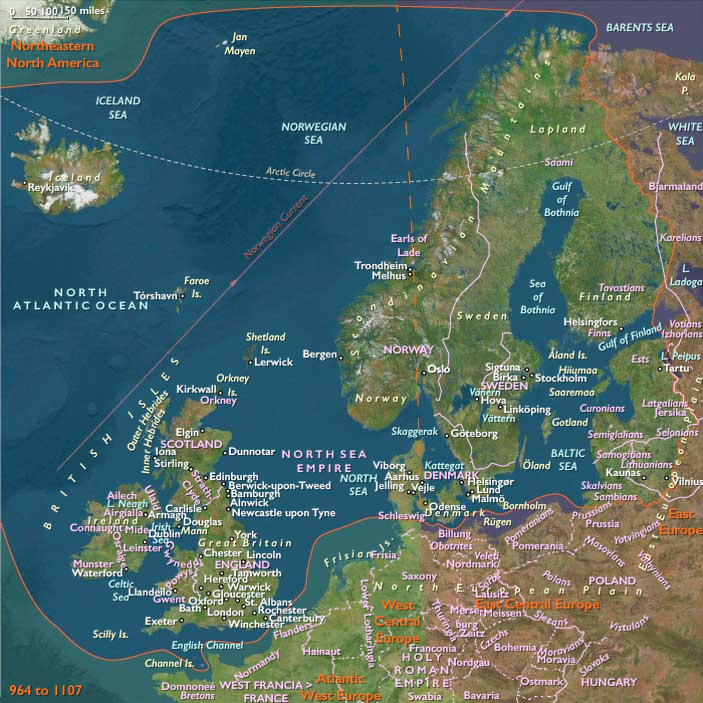
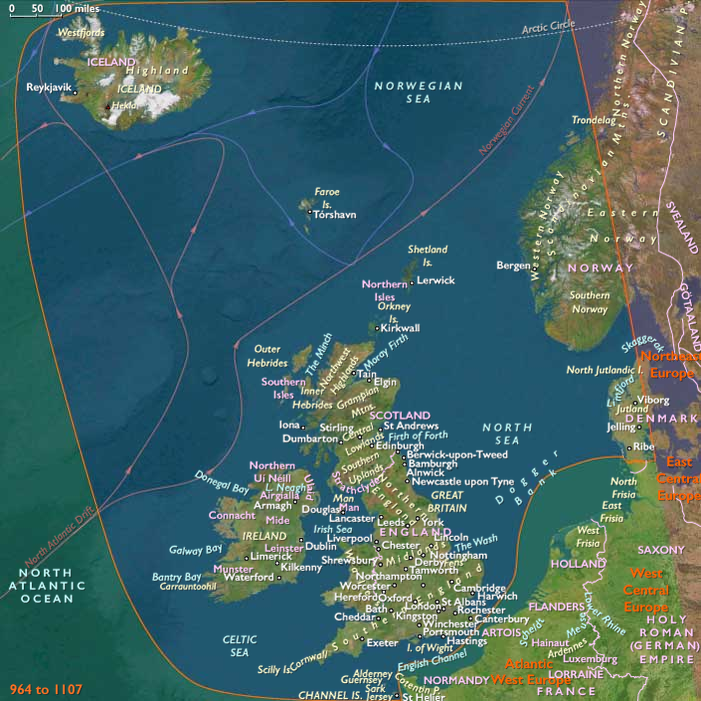
Sweyn had returned in 1006 to raid England, and departs in 1007 with thirty-six thousand pounds of Danegeld, which buys Æthelred two years of peace.
Locations
People
Groups
Topics
Commodoties
Subjects
Regions
Subregions
Related Events
Filter results
Showing 10 events out of 51894 total
The German Bishop Bruno of Querfurt, following his diplomatic failure in the Banat, goes to Kiev, where Vladimir I authorizes him to make Christian converts among the Pechenegs, semi-nomadic Turkic peoples living between the Danube and the Don rivers.
Bruno spends five months there and baptizes some thirty adults.
He helps to bring about a peace treaty between them and the ruler of Kiev.
Before leaving for Poland, Bruno consecrates a bishop for the Pechenegs.
Henry’s denunciation of the Peace of Poznań in 1007 causes Boleslaw's attack on the Archbishopric of Magdeburg as well as …
…the reoccupation of marches of Lusatia and …
…Meissen, including …
…the city of Bautzen.
Raja Raja captures Udagai in the western hill country of the Cheras in a battle fought sometime before 1008 CE.
Kalingattuparani, a war poem written during the reign of Kulothunga Chola I, hints at a slight on the Chola ambassador to the Chera court as the reason for this sacking of Udagai.
Raja Raja's son Rajendra is the Chola general leading the army in this battle.
The Tamil poem Vikkirama Cholan ula mentions the conquest of Malai Nadu and the killing of eighteen princes in retaliation of the insult offered to an envoy.
Fulk III "Nerra" of Anjou: The Ruthless Founder of Angevin Power
Fulk III of Anjou ("Nerra"—"the Black"), who would later be remembered as the true architect of Angevin power, was a ruler of contradictions—a ruthless warrior and cunning strategist, yet also deeply pious and prone to acts of penitence. His reign was marked by relentless expansion, political intrigue, and extreme displays of both cruelty and devotion.
The Infamous Execution of Elisabeth of Vendôme (999)
One of the most infamous episodes of his life occurred in December 999, when he discovered his first wife, Elisabeth of Vendôme, guilty of adultery with a lowly goatherd. In response, Fulk III enacted a brutal punishment:
- Elisabeth, his cousin and noble consort, was burned alive at the stake, wearing her wedding dress—an act designed to publicly humiliate her and emphasize the dishonor she had brought upon him.
- The severity of the execution demonstrated Fulk’s uncompromising sense of honor, a characteristic that defined his rule.
- His decision to carry out the punishment personally—rather than leaving it to church or feudal authorities—underscored his authoritarian control over Anjou.
Fulk’s Reputation: Ruthlessness and Piety
- Despite his extreme cruelty, Fulk III was also known for his religious devotion and acts of penitence.
- He embarked on multiple pilgrimages to the Holy Land, possibly as atonement for his violent deeds.
- He was a great patron of monastic institutions, helping to establish or support religious centers, including the Abbey of Beaulieu-lès-Loches.
Legacy
- Fulk III’s rule laid the foundations for Angevin power, shaping the dynasty that would later produce Henry II of England and the Plantagenets.
- His blend of brutality and religious fervor became a hallmark of Angevin rulers, who often combined ruthless ambition with deep religious convictions.
- His actions, though shocking even by medieval standards, reinforced his authority and cemented his legacy as one of the most formidable feudal lords of his time.
Fulk III embodied the raw power struggles of early medieval Europe, where violence and faith coexisted in a world governed by honor, vengeance, and divine retribution.

Emperor Henry II’s Campaign Against Baldwin IV of Flanders (1007)
In 1007, Emperor Henry II launched a decisive military campaign against Baldwin IV of Flanders, seeking to reassert imperial control over the strategically vital County of Valenciennes, which Baldwin had seized in 1006 in violation of the imperial border along the Scheldt River.
The Imperial Retaliation
- Acting without allied support, Henry II led a large imperial army to the Scheldt River, advancing deep into Flemish-held territory.
- The imperial forces ravaged the countryside, depriving Baldwin of supplies and local support, placing him on the defensive.
- Unable to resist the imperial advance, Baldwin IV was forced to surrender Valenciennes to Henry.
Henry II’s Political Maneuvering: Forgiveness and Reward
- Rather than punishing Baldwin IV harshly, Henry II forgave him, transforming an enemy into a loyal vassal.
- As part of the reconciliation, Henry officially granted Baldwin control of Ghent, ensuring Baldwin’s continued loyalty to the empire while maintaining imperial influence in Flanders.
- This move reinforced Henry II’s diplomatic acumen, as Baldwin IV now owed his restored position to the emperor, making him a valuable ally rather than a persistent adversary.
Aftermath and Significance
- The recovery of Valenciennes restored imperial authority in the Scheldt region, reaffirming Henry II’s role as protector of imperial borders.
- Baldwin IV, having gained Ghent, solidified his power base in Flanders, further expanding his influence in northern France and the Low Countries.
- The resolution of the conflict between Flanders and the empire allowed Henry II to focus on his internal consolidation and religious policies, while Baldwin IV continued to strengthen Flanders' economic and military position.
Legacy
This campaign exemplified Henry II’s strategic blend of military force and political reconciliation, ensuring both imperial dominance and feudal stability in the region. Baldwin IV, now an imperial vassal, would continue to play a key role in the power dynamics of northern Europe, setting the stage for Flanders’ continued rise as a major political and economic power.
The Turbulent Marriage of Robert II and Constance of Arles: Intrigue and Murder (1007)
The marriage between Robert II of France ("the Pious") and Constance of Arles, finalized in 1001, quickly became a source of conflict at the French court. While it provided the Capetian dynasty with southern French connections, it also created deep resentment among the northern nobility, who despised Constance’s Provençal customs and kinfolk.
Court Tensions and Political Intrigue
- Constance of Arles, the daughter of William I of Provence, introduced southern influences into the Parisian court, which were viewed with suspicion and hostility by the established Frankish nobility.
- Many of Robert II’s courtiers, still loyal to his former wife, Bertha of Burgundy, openly opposed Constance, creating factions within the royal court.
- Among Constance’s most outspoken opponents was Hugh of Beauvais, one of Robert’s closest advisors, who resented the influence of her Provençal relatives.
The Assassination of Hugh of Beauvais (1007)
- In 1007, Hugh of Beauvais attempted to persuade Robert II to repudiate Constance, possibly hoping to reinstate Bertha of Burgundy or secure a new political marriage for the king.
- Shortly after, twelve knights—all reportedly linked to Fulk III, Count of Anjou, a powerful ally of Constance’s family—murdered Hugh of Beauvais, likely at Constance’s instigation.
- The brutal assassination shocked the French court and further deepened the divisions between the northern nobles and Constance’s Provençal allies.
Aftermath and Political Consequences
- Robert II did not repudiate Constance, but tensions between them persisted for years.
- The murder weakened Robert’s control over his court, as many of his traditional allies saw him as being manipulated by his wife and her southern kin.
- The House of Anjou’s role in the assassination signaled a growing rivalry between northern and southern noble factions, which would continue to destabilize the Capetian court in the following years.
Legacy
The marital discord between Robert II and Constance of Arles, combined with political murders and court rivalries, highlighted the fragile authority of the early Capetian monarchy. Constance’s assertive influence, though controversial, helped shape the future of Capetian rule, demonstrating the power struggles between the king, his noble advisors, and an ambitious queen determined to protect her family’s interests.
The Fatimid-era Egyptian sea captain Domiyat travels to a Buddhist site of pilgrimage in Shandong in 1008, where he presents the Chinese Emperor Zhenzong of Song with gifts from his ruling Imam Al-Hakim bi-Amr Allah, establishing diplomatic relations between Egypt and China that had been lost during the collapse of the Tang Dynasty in 907 (the Fatimid state had been established a few years later, in 910).