
Toll succeeds in winning the fortress of …
Years: 1772 - 1772
August
Locations
People
- Adolf Frederick, King of Sweden
- Charles Gravier, Count of Vergennes
- Charles XIII of Sweden
- Frederick the Great
- Gustaf Philip Creutz
- Gustav III of Sweden
- Jacob Magnus Sprengtporten
- Johan Christopher Toll
- Louisa Ulrika of Prussia, Queen consort of Sweden
- Nicolas Beaujon
- Nikita Ivanovich Panin
- Étienne-François, comte de Stainville, duc de Choiseul
Groups
- Sweden, (second) Kingdom of
- Denmark-Norway, Kingdom of
- France, (Bourbon) Kingdom of
- Prussia, Kingdom of
- Russian Empire
Topics
Subjects
Regions
Subregions
Related Events
Filter results
Showing 10 events out of 25898 total
Catherine of Russia is also very satisfied by this "diplomatic document", as Russia now comes into possession of that section of Livonia which had still remained in Commonwealth control, and of Belarus, which embraces the counties of Vitebsk, Polotsk and Mstislavl.
Long-smoldering opposition to the Hasidim from Orthodox rabbis called Mitnaggedim (Opponents) reaches a climax in 1772 when Elijah ben Solomon, the gaon (spiritual leader) of Vilna, excommunicates the Hasidim for their practical repudiation of traditional Judaism, for pantheistic tendencies, for the adoption of esoteric Kabbalistic teachings, and for excessive veneration of the tzaddiqim.
Elimelech of Lizhensk had, in fact, established Hasidic dynasties by claiming that charismatic qualities were transmitted by heredity from a father to his son.
The movement continues unabated despite such opposition.
Both the ascending Russian Empire and pre-revolutionary France aspire to have Sweden as a client state.
Parliamentarians and others with influence are susceptible to taking bribes that they did their best to increase.
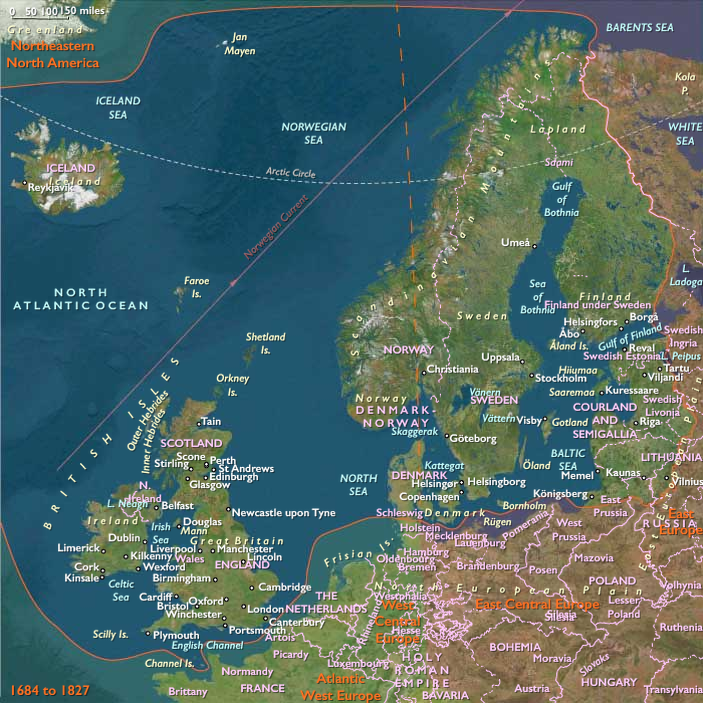
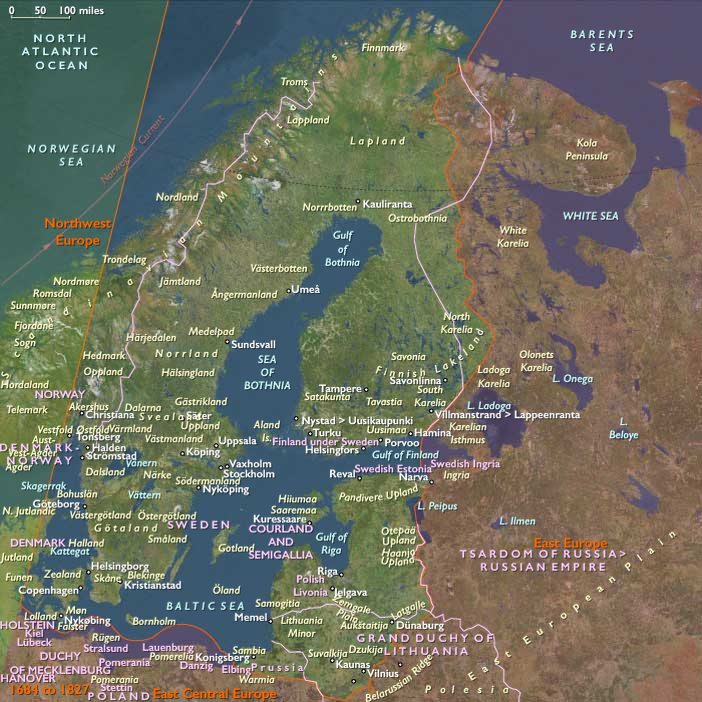
The integrity and the credibility of the political system wanes, and in 1772 the young and charismatic king Gustav III staged a coup d'état, abolished parliamentarism and reinstated royal power in Sweden—more or less with the support of the parliament.
A new Constitution is read to the estates and unanimously accepted by them.
The diet is then dissolved, and Gustav begins his rule as an enlightened despot.
Gustav III's coup d'état thus ends Sweden's Age of Liberty, the half-century long experiment with a parliamentary system and increasing civil rights in the period from Charles XII's death in 1718.
Many alchemists, such as Cornelius Drebbel, the Dutch inventor who in 1608 had suggested production of oxygen by heating saltpeter, had noted the existence and properties of oxygen before Scheele, investigating the air in 1772, demonstrates that air is a mixture of two gases.
He calls one of these “fire air” because it supports combustion, and the other “foul air”, because it is left after the fire air has been used up.
Scheele obtains the “fire air” by heating potassium nitrate, mercury dioxide, and many other substances.
Christian VII, the son of Frederick V, King of Denmark, and his first consort Louisa, daughter of George II of Great Britain, had become King of Denmark and Norway, and Duke of Schleswig and Holstein, on his father’s death on January 14, 1766.
Although possessed of a winning personality and considerable talent, he has been badly educated, systematically terrorized by a brutal governor, Detlev Greve zu Reventlow, and hopelessly debauched by corrupt pages, and is apparently intelligent and certainly has periods of clarity, Christian suffers from severe mental problems, possibly schizophrenia.
After his marriage at Christiansborg on November 8, 1766, to his cousin Princess Caroline Matilda (known in Denmark as Queen Caroline Mathilde), a sister of King George III of Great Britain, he has abandoned himself to the worst excesses, especially debauchery.
He had in 1767 entered in to a relationship with the courtesan Støvlet-Cathrine, publicly declaring that he cannot love Caroline Mathilde, because it is "unfashionable to love one's wife".
He ultimately sinks into a condition of mental stupor.
Symptoms during this time include paranoia, self-mutilation and hallucinations.
He becomes submissive to upstart Johann Friedrich Struensee, who has risen steadily in power in the late 1760s.
The neglected and lonely Caroline Mathilde has drifted into an affair with Struensee.
The king’s marriage with Caroline Mathilde is in 1772 dissolved by divorce.
Struensee is arrested and executed in this same year.
Christian had signed Struensee's arrest warrant with indifference, and under pressure from his stepmother, Juliana Maria of Brunswick-Wolfenbüttel, who had led the movement to have the marriage dissolved.
Caroline Mathilde, retaining her title but not her children, will eventually leave Denmark in exile and pass her remaining days in neighboring Celle, where on May 11, 1775, she will die of scarlet fever.
The marriage had produced two children, the future Frederick VI and Princess Louise Auguste.
However, it is widely believed that Louise was the daughter of Struensee—portrait comparisons have supported this.
Christian is only nominally king from 1772 onward.
Denmark is now ruled by Christian's stepmother, his physically disabled half-brother Frederick, and the Danish politician Ove Høegh-Guldberg.
The territory of the Kingdom of Poland includes all of present Lithuania and Belarus and half of contemporary Ukraine.
Catholics of Polish ethnic background represent most of the inhabitants of he western and central regions of the Kingdom.
Roman Catholic Poles and Lithuanians live in its northwestern section, which is today Lithuania.
Eastern Catholics of Ruthenian (which is now Belarussian and Ukrainian) background and a small but important Catholic Polish minority inhabit the eastern regions.
Jews (about ten percent of the whole population) who live mostly in shtetls, i.e., small towns, also inhabit all parts of the Polish Kingdom.
Other ethnic groups, such as Germans, Armenians, Tartars, Scots, Dutchmen, etc., are represented.
Russia in the Seven Years War had been first on Austria’s side, then on Prussia’s, but the main loser in this contest is Poland, which Russia, Prussia and Austria partition in 1772: it is to be the first of three such partitions.
Russia is to annex most of Poland’s eastern regions, Austria is to take the Polish Southwest, and Prussia is to take the Northwest.
The Polish-Lithuanian Commonwealth loses about thirty percent of its territory by this partition, together with a population of four million people (one-third of its population).
Prussia, by seizing northwestern Poland, instantly gains control over eighty percent of the Commonwealth's total foreign trade and, through the levy of enormous custom duties, accelerates the Commonwealth's inevitable collapse.
The partition treaty is ratified by its signatories on September 22, 1772.
Frederick II of Prussia is elated with his success; Prussia takes most of the Polish Royal Prussia that stands between its possessions in the Kingdom of Prussia and the Margraviate of Brandenburg, taking Ermland (Warmia), Royal Prussia without the city of Danzig (Gdańsk) (which in 1773 is to become a new province called West Prussia), northern areas of Greater Poland along the Noteć River (the Netze District), and parts of Kuyavia, (also the Prussian city of Thorn [Toruń]).
To Austria falls Zator and Auschwitz (Oświęcim), part of Little Poland embracing parts of the counties of Kraków and Sandomir and the whole of Galicia, less the City of Kraków.
Austrian diplomat Wenzel Anton, Prince of Kaunitz-Rietberg, is proud of wresting as large a share as he has, with the rich salt mines of Bochnia and Wieliczka, despite token criticism of the partition from Austrian Empress Maria Theresa.
The agreement of partition had been signed in Vienna in February 1772.
The Russian, Prussian and Austrian troops had simultaneously entered the Commonwealth early in August and occupied the provinces agreed upon among themselves.
The occupation manifesto had been issued on August 5, 1772, much to the consternation of a country too exhausted by the endeavors of the Confederation of Bar to offer successful resistance.
Several battles and sieges have taken place place nonetheless, as Polish troops refused to lay down their arms (most notably, in Tyniec, Kraków, and Częstochowa).
Many Frankists have established themselves near Częstochowa, and kept up constant communication with their "holy master"
Frank has inspired his followers through mystical speeches and epistles, in which he states that salvation can be gained only through the "religion of Edom," or dat ("law"), a mixture of Christian and Sabbateanism
Frank is released, after the first partition of Poland, by the Russian general Aleksandr Bibikov, who had occupied Częstochowa in August 1772.
Years: 1772 - 1772
August
Locations
People
- Adolf Frederick, King of Sweden
- Charles Gravier, Count of Vergennes
- Charles XIII of Sweden
- Frederick the Great
- Gustaf Philip Creutz
- Gustav III of Sweden
- Jacob Magnus Sprengtporten
- Johan Christopher Toll
- Louisa Ulrika of Prussia, Queen consort of Sweden
- Nicolas Beaujon
- Nikita Ivanovich Panin
- Étienne-François, comte de Stainville, duc de Choiseul
Groups
- Sweden, (second) Kingdom of
- Denmark-Norway, Kingdom of
- France, (Bourbon) Kingdom of
- Prussia, Kingdom of
- Russian Empire
