Swedes consumes an average of twelve pounds …
Years: 1880 - 1880
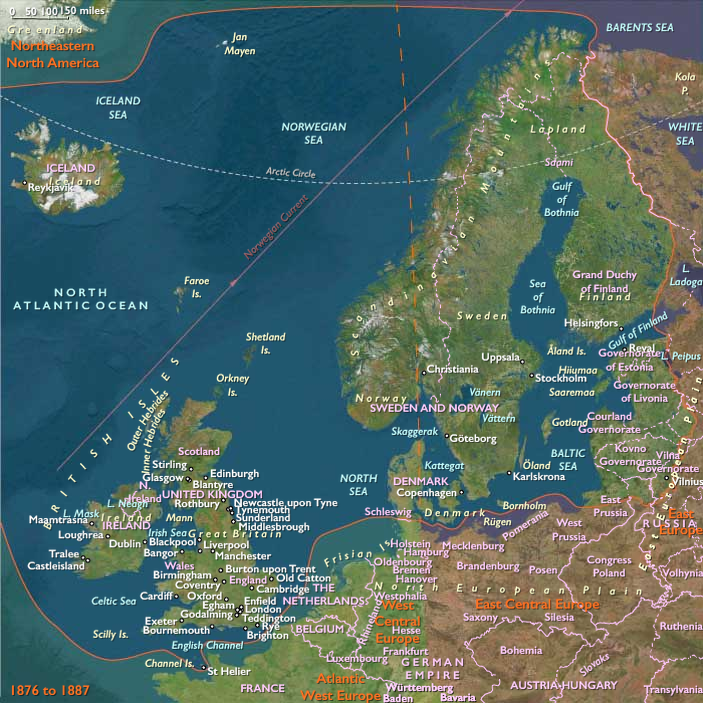
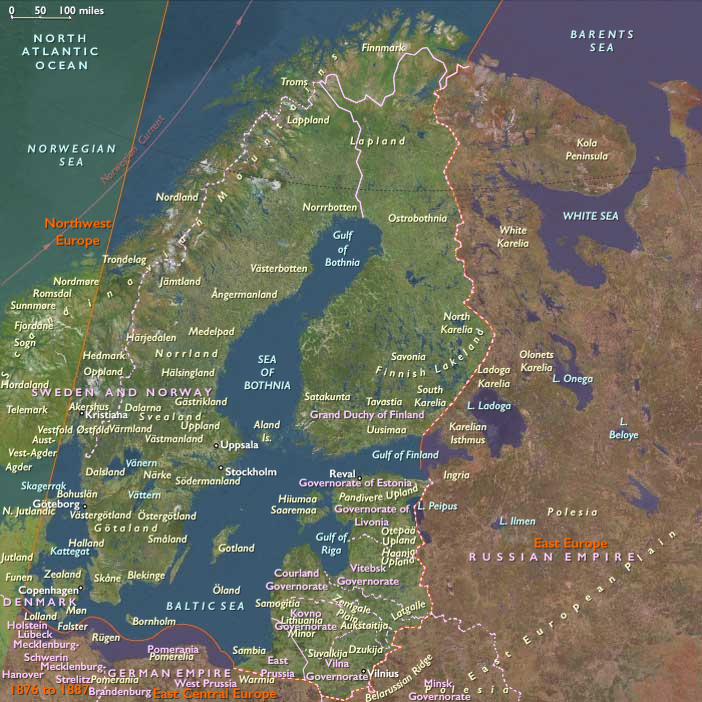
Swedes consumes an average of twelve pounds of refined sugar annually by 1880.
Locations
Groups
Commodoties
Subjects
Regions
Subregions
Related Events
Filter results
Showing 10 events out of 11486 total
The island of Tahiti and most of its satellites remain a French protectorate until June 29, 1880, when Pomare V is forced to cede the sovereignty of Tahiti and its dependencies to France.
Pomare is given a pension by French government and the titular position of Officer of the Orders of the Legion of Honor and Agricultural Merit of France.
The London Missionary Society, which had sent missionaries and teachers such as John Williams in 1816 and John Paton in 1858, endeavored to provide stability in the islands of Tahiti through sustainable relief and development work, providing a written language, and ending traditional cannibalism and child sacrifice practices.
Tahiti’s Queen Pomare IV, who had died from natural causes on September 17, 1877, had been succeeded by her son, who has ruled from September 24, 1877, as King Pōmare V. Born as Teri'i Tari'a Te-rā-tane, he had become Heir Apparent and Crown Prince (Ari'i-aue) upon the death of his elder brother on May 13, 1855.
He has married twice, first on November 11, 1857 to Te-mā-ri'i-Ma'i-hara Te-uhe-a-Te-uru-ra'i, princess of Huahine, whom he had divorced on August 5, 1861.
His second marriage is to Joanna Mara'u-Ta'aroa Te-pa'u Salmon (now known as Her Majesty The Queen Marau of Tahiti), at Pape'ete on January 28, 1875.
Pomare V has one son and two daughters.
The increasing push of settlement in Australia, increased police efficiency, improvements in rail transport and communications technology, such as telegraphy, have made it increasingly difficult for bushrangers to evade capture.
Among the last bushrangers are the Kelly Gang, led by Ned Kelly, who are captured at Glenrowan in 1880, two years after they are outlawed.
Kelly was born in Victoria to an Irish convict father, and as a young man he had clashed with the Victoria Police.
Following an incident at his home in 1878, police parties had searched for him in the bush.
After he had killed three policemen, the colony had proclaimed Kelly and his gang—his two brothers and two friends—wanted outlaws.
Their subsequent seizure of a sheep station, robbery of two banks and capture of a hotel, ends in a final violent confrontation with police place at Glenrowan on June 28, 1880.
All but Ned die in the battle; dressed in homemade plate metal armor and helmet, he is captured, sent to jail, and hanged for murder at Old Melbourne Gaol in November 1880.
His daring and notoriety make him an iconic figure in Australian history, folklore, literature, art and film.
Some bushrangers, most notably Ned Kelly in his Jerilderie Letter, and in his final raid on Glenrowan, explicitly represent themselves as political rebels.
Attitudes to Kelly, by far the most well-known bushranger, exemplify the ambivalent views of Australians regarding bushranging.

Britain imports 105,538 chests of opium into China in 1880.
Chinese officials had begun encouraging local production of opium in the aftermath of legalization in 1860, and poppy cultivation has spread beyond the country's southwest.
As addiction rises throughout China, imports of Indian opium increase from forty-eight hundrd tons in 1859 to sixty-seven hundred tons in 1880.
Despite the growth of Indian imports after 1858, most of the higher demand is supplied by Chinese domestic production.
China is in the midst of a major opium boom by the 1880s, particularly in the rugged southwestern provinces of Yunnan and ...
...Sichuan, China's leading opium-producing province, which observers claim is harvesting ten thousand tons of raw opium annually.
Electric trams (known as streetcars or trolleys in North America) are first experimentally installed in Saint Petersburg, Russia, invented and tested by Fyodor Pirotsky as early as 1880.
These trams, like virtually all other electric trams to be developed, use either a trolley pole or a pantograph, to feed power from electric wires strung above the tram route.
The Russian realist novel reaches new heights with The Brothers Karamazov, Fyodor Dostoyevsky’s final novel.
Serialized in The Russian Messenger on February 1, 1880, the last parts are published in November.
At nearly eight hundred pages, The Brothers Karamazov is Dostoyevsky's largest literary work and his largest contribution to literature; it is often cited as his greatest work, his magnum opus.
Apart from being successful with the critics, the book is popular generally.
Dostoyevsky is chosen as the vice president of the Slavic Benevolent Society on February 3, 1880, and invited to speak at the unveiling of the Pushkin memorial in Moscow.
Initially scheduled for May 26, the date of the unveiling is rescheduled to June 6 because of the death of Empress Maria Alexandrovna.
Dostoyevsky delivers his speech from memory two days later, inside a large room, giving such an impressive and hypnotizing performance that many people cry or are in other ways emotionally overwhelmed.
His speech is met with thunderous applause, and even his longtime rival Ivan Turgenev embraces him.
Dostoyevsky's delivery is, however, later attacked by several people, among them the liberal political scientist Alexander Gradovsky and conservative thinker Konstantin Leontiev; Gradovsky thought that he would have idolized the people in his speech, while Leontiev compares his delivery with French Utopian socialism rather than Christianity in his essay "On Universal Love".
However, the latter praises his last work, stating that it features no "rosy Christianity".
These attacks lead to a further deterioration in Dostoyevsky's health.
The recorded death rate from diabetes in Denmark is 1.8 per 100,000 in 1880.
The citizens of Denmark each consume an average of twenty-nine pounds of sugar annually by 1880.
Adolf Erik Nordenskiöld leaves Karlskrona on a voyage that will make him the first to navigate the Northern Sea Route, a shipping lane from the Atlantic Ocean to the Pacific Ocean along the Siberian coast, on June 22, 1878.