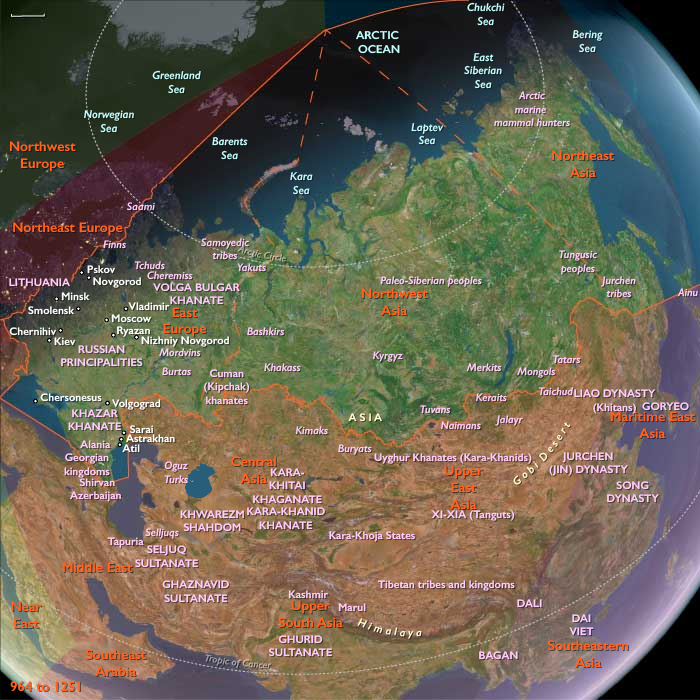
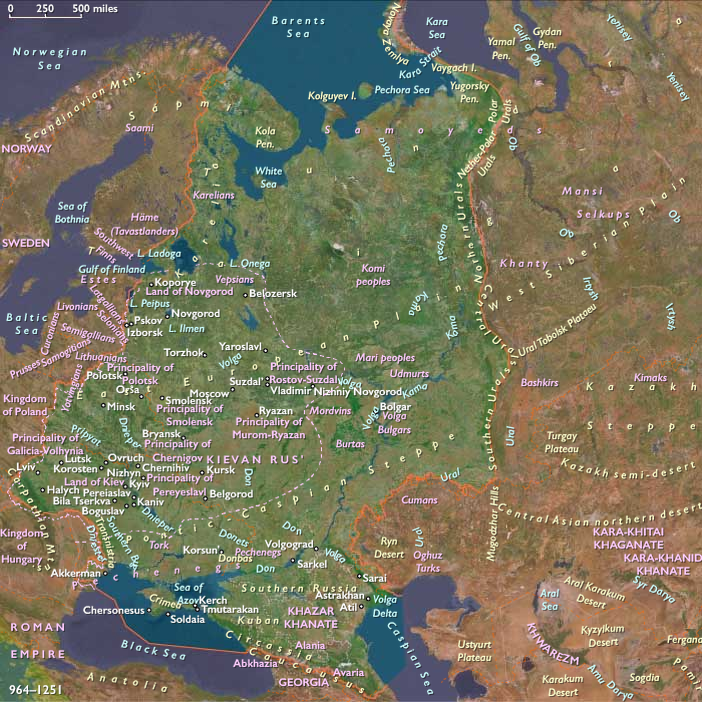
Sviatopolk is the son of Iziaslav Iaroslavich …
Years: 1088 - 1088
Sviatopolk is the son of Iziaslav Iaroslavich by his wife Gertrude of Poland.
During his brother Yaropolk's life, Sviatopolk had not been not regarded as a potential claimant to the Kievan throne.
In 1069 he had been sent to Polotsk, a city briefly taken by his father from the local ruler Vseslav.
He has spent the past ten years (1078–88) ruling Novgorod.
Upon his brother's death, he succeeds him in Turov, which will remain in possession of his descendants until the seventeenth century.
Locations
People
Groups
Commodoties
Subjects
Regions
Subregions
Related Events
Filter results
Showing 10 events out of 561 total
Indian opium has become a major global commodity under the British, who dominate the trade.
Opium's peculiar properties make it the ideal trade good during this age, combining the reliable demand of a basic food with the logistics of a luxury good.
As an addictive drug, opium requires a daily dose, giving it the inelastic demand of a basic foodstuff.
Long distance sea-trade in bulk foods is beyond the capacity of current maritime technology, but opium has the low weight and high markup of a luxury good like cloves or pepper.
Compounding its extraordinary profitability, China's Yongzheng emperor reacts to the rise of mass addiction by banning opium in 1729 and thus denying China the opportunity to produce opium locally to undercut the high price of Indian imports.
A syndicate of Indian merchants up the Ganges River at Patna holds a monopoly over the Bengal opium trade, making cash advances to peasant farmers and selling the processed opium to Dutch, British and French merchants.
Forces of the British East India Company in 1764 march inland from their port at Calcutta to conquer Bengal.
They soon discover the financial potential of India's richest opium zone.
The Company assumes control of a well-established opium industry involving peasant producers, merchants, and long-distance traders.
British exports of Indian opium to China increase from fifteen tons in 1720 to seventy-five tons in 1773, in which year the British governor-general of Bengal abolishes the Indian opium syndicate at Patna and establishes a colonial monopoly on the sale of opium.
Opium not only solves the fiscal crisis that accompanied the British conquest of Bengal; it remains a staple of colonial finances, providing from six to fifteen percent of British India's tax revenues throughout the nineteenth Century.
More important, opium exports are an essential component of a triangular trade that is the foundation of Britain's status as a world power.

Trade figures for the 1820s show that the triangular trade is large and well balanced: twenty-two million pounds sterling worth of Indian opium and cotton to China; next, twenty million pounds worth of Chinese tea to Britain; then, twenty-four million pounds of British textiles and machinery back to India.
The British East India Company, prizing stability above profit, has for over two decades maintained India's opium exports at four thousand chests—or two hundred and eighty tons tons, just enough to finance its purchase of China's tea crop.
Moreover, the vast profits of Britain's opium trade soon attract competitors.The premature death of Pratap Singh Shah (reigned 1775-77), the eldest son of Prithvi Narayan Shah, leaves a huge power vacuum that remains unfilled for decades, seriously debilitating the emerging Nepalese state.
Pratap Singh Shah's successor is his son, Rana Bahadur Shah (reigned 1777-99), aged two and one-half years at his accession.
The acting regent until 1785 is Queen Rajendralakshmi, followed by Bahadur Shah (reigned 1785-94), the second son of Prithvi Narayan Shah.
Court life is consumed by rivalry centered on alignments with these two regents rather than on issues of national administration.
In 1794 the king comes of age, and in 1797 he begins to exercise power on his own.
Rana Bahadur's youth has been spent in pampered luxury amid deadly intrigue and has made him incapable of running either his own life or the country.
He becomes infatuated with a Maithili Brahman widow, Kantavati, and clears the way to the throne for their illegitimate son, Girvan Yuddha Shah.
Disconsolate after the death of his mistress in 1799, Rana Bahadur begins to engage in such irrational behavior that leading citizens demand his abdication.
He is forced to turn his throne over to Girvan Yuddha Shah, aged one and one-half years, and retires to Banaras.
There has been little direct contact with the lands controlled by the British East India Company or its clients, but by the early 1800s a confrontation is becoming more likely.
Just as Nepal had been expanding toward the west throughout the late eighteenth century, so the company has steadily added to its annexed or dependent territories all the way to the Punjab.
Amar Singh Thapa claims lowland areas of Kumaon and Garhwal as part of his conquests, but David Ochterlony, the British East India Company's representative in the west, keeps up constant diplomatic resistance against such claims, which are not pressed.
In 1804 Palpa is finally annexed by Gurkha and along with it comes claims to parts of the Butawal area in the Tarai.
As Nepalese troops slowly occupy these tracts, local landlords complain to the company that their rights are being violated.
Similar claims to Saran District lead to armed clashes between Nepalese troops and the forces of local landlords.
During these proceedings, there is constant diplomatic intercourse between the government of Nepal and the British East India Company and little desire on either side for open hostilities.
The Gurkha generals, however, are quite confident in their ability to wage warfare in the mountains, and the company, with its far greater resources, have little reason to give in to this aggressive state, which blocks commerce in the hills.
After retreating before a reoccupation by company troops, Nepalese forces counterattack against police outposts in Butawal, killing eighteen police officers on April 22, 1814.
The fragile state of Nepal is at war with the British Empire.
The kingdom of Garhwal to the west is mostly hill country but includes the rich vale of Dehra Dun.
During the late eighteenth century, the kingdom had been devastated by conquerors as varied as Afghans, Sikhs from the Punjab, and Marathas from western India.
The armies of Nepal had been poised to attack Garhwal in 1790, but the affair with Tibet had shifted their attention.
In 1803 after Garhwal is devastated by an earthquake, the Nepalese armies move in, defeat and kill the raja of Garhwal in battle, and annex a ruined land.
General Amar Singh Thapa moves farther west and during a three-year campaign defeats or buys off local princes as far as Kangra, the strongest fort in the hills.
The Nepalese lay siege to Kangra until 1809, when Ranjit Singh, ruler of the Sikh state in the Punjab, intervenes and drives the Nepalese army east of the Sutlej River.
Amar Singh Thapa spends several years putting down rebellions in Garhwal and Kumaon, towns that submit to military occupations but are never fully integrated into the Gurkha state.
The Nepalese are being checked in the west.
The Chinese forces easily force the Nepalese out of Tibet in 1792 and pursue them to within thirty-five kilometers of Kathmandu.
The Nepalese are forced to sign a humiliating treaty that takes away their trading privileges in Tibet.
It makes them subordinate to the Qing Empire and requires them to pay tribute to Beijing every five years.
Thus, Nepal is enclosed on the north, and the British have again shown themselves to be untrustworthy.
The Gurkha state has its greatest success in expanding to the east and west, but it also presses northward toward Tibet.
There is a longstanding dispute with the government of Tibet over trade issues, notably the status of Nepalese merchants in Lhasa and other settlements and the increasing debasement of coinage used in Tibet.
There also is a dispute over control of the mountain passes into Tibet, including the Kuti and Kairang passes north of Kathmandu.
In the 1780s, Nepal demands that Tibet surrender territory around the passes.
When the Tibetans refuse, the Nepalese close trade routes between Lhasa and Kathmandu.
In 1788 the Nepalese overrun Sikkim, send a punitive raid into Tibet, and threaten Shigatse, seat of the Panchen Lama, the second highest-ranking lama in Tibet.
They received secret assurances of an annual payment from the Tibetan and local Chinese authorities, but when the agreement is not honored they invade again in 1791, pillaging the monastery at Shigatse before withdrawing to Nepal.
These acts finally move the emperor in Beijing to send a huge army to Tibet.
Alarmed, the government in Kathmandu concludes a trade agreement with the British East India Company, hoping for aid in their struggle.
They are to be disappointed because the British have no intention of confronting China, where there are so many potential trading opportunities.
Five leading Gurkha families contend for power in Nepal during this period—the Shahs, Choutariyas, Thapas, Basnyats, and Pandes.
Working for these families and their factions are hill Brahmans, who act as religious preceptors or astrologers, and Newars, who occupy secondary administrative positions.
No one else in the country has any influence on the central government.
When a family or faction achieves power, it kills, exiles, or demotes members of opposing alliances.
Under these circumstances, there is little opportunity for either public political life or coordinated economic development.
The struggle for power at the Gurkha court has unfortunate consequences for both Nepal's foreign affairs and for internal administration.
All parties try to satisfy the army in order to avoid interference in court affairs by leading commanders, and the military is given a free hand to pursue ever larger conquests.
As long as the Gurkhas are invading disunited hill states, this policy—or lack of policy—is adequate. Inevitably, continued aggression will lead Nepal into disastrous collisions with the Chinese, then with the British.
At home, because power struggles center on control of the king, there is little progress in sorting out procedures for sharing power or expanding representative institutions.
A consultative body of nobles, a royal court called the Assembly of Lords (Bharadari Sabha), is in place after 1770 and it has substantial involvement in mayor policy issues.
The assembly consists of high government officials and leading courtiers, all heads of important Gurkha families.
In the intense atmosphere surrounding the monarch, however, the Assembly of Lords breaks into factions that fight for access to the prime minister or regent, and alliances develop around patron/client relationships.
Damodar Pande takes over the administration during the minority of the Nepalese king as mukhtiyar, or prime minister (1799-1804), with complete control over administration and the power to conduct foreign affairs.
He sets a significant precedent for later Nepalese history, which has seen a recurring struggle for effective power between king and prime minister.
The main policy of Damodar Pande is to protect the young king by keeping his unpredictable father in Banaras and to play off against each other the schemes of the retired king's wives.
By 1804 this policy has failed.
The former king engineers his return and takes over as mukhtiyar.
Damodar Pande is executed and replaced by Bhimsen Thapa as chief administrator (kaji).
In a bizarre turn of events on April 25, 1806, Rana Bahadur Shah quarrels in open court with his half-brother, Sher Bahadur.
The latter draws his sword and kills
Rana Bahadur Shah before being cut down by a nearby courtier. Taking advantage of this opportunity, Bhimsen Thapa becomes prime minister (1806-37), and the junior queen, Tripurasundari, becomes regent (1806-32).
They cooperated to liquidate ninety-three of their enemies.
The death of Girvan Yuddha Shah in 1816 and the accession of his infant son mean the retention of the regency.