Sverre, an illegitimate son of Norway’s King …
Years: 1177 - 1177
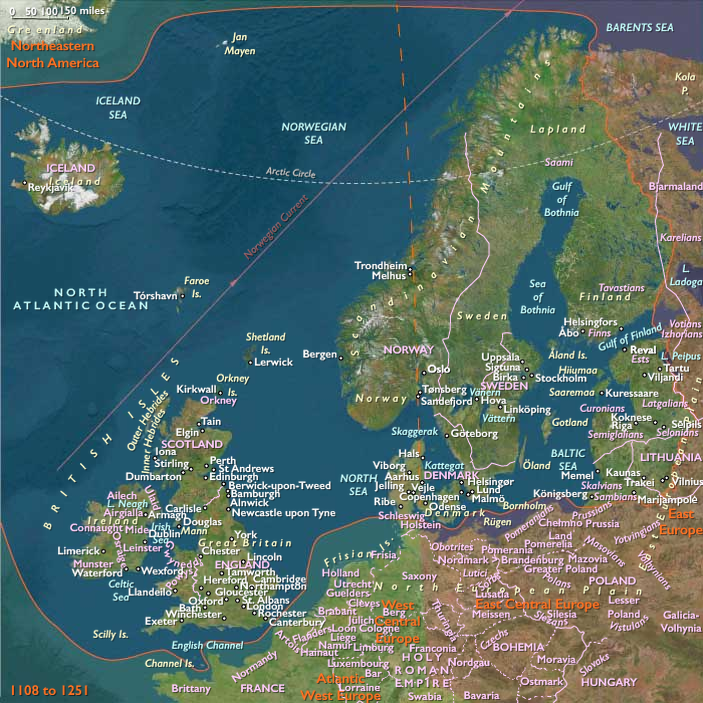
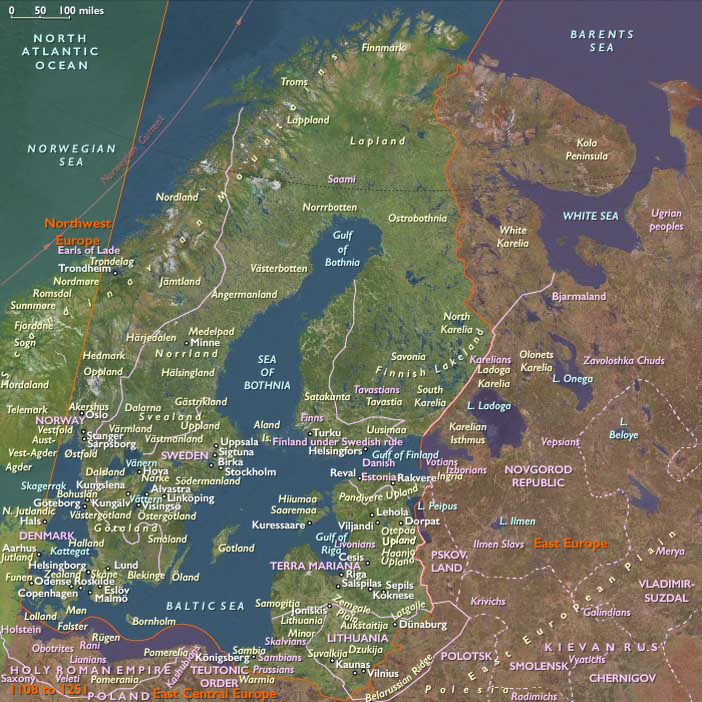
Sverre, an illegitimate son of Norway’s King Sigurd born in mid-century in a time of civil war, is raised as a commoner and educated for the priesthood.
When told of his true heritage, he goes to Norway in 1174 and fights for the throne, with the support of a populist faction called the Birkebeiners.
Sverre in June 1177 first leads his men to Trøndelag, where he is proclaimed as king.
Locations
People
Groups
Topics
Commodoties
Subjects
Regions
Subregions
Related Events
Filter results
Showing 10 events out of 48240 total
Jaya Indravarman dispatches a trading expedition to acquire horses in China’s Kwangtung and Henan provinces for use in the next full-scale assault, but the expedition fails to obtain the animals.
Lacking sufficient horses, the Chams attack by sea in 1177, sailing up the Tonle Sap (the “Great Lake“ in the region of present central Cambodia) and the Siemreab river to capture the undefended capital, Yasodharapura (Angkor).
The Chams burn the city’s wooden structures, kill the Khmer rebel king Tribhuvanadityavarman, and loot Angkor Wat, the greatest of Angkor's temple complexes.
Tangut Emperor Renzong had discovered an assassination plot in 1170 and executed the generals who were behind it.
As a result, Renzong distrusts his army generals and the army has begun to fall into incompetence.
During his later years, Western Xia begins to fight wars against various enemies.
Renzong's reign is the peak of Western Xia Dynasty.
Many tribes to the north and west have become vassal states of Western Xia, and Renzong's focus on internal politics has allowed the central government to be more efficient.
His reign coincides with the peak of the Southern Song and the Jin Dynasties, and there are relatively few conflicts between these three countries.
The nobles of the Georgian realm rise against King George III in 1177 and declare Prince Demna (Demetrius), who, being a son of George III's late elder brother David V, Demna is considered by many as a legitimate pretender to the Georgian throne.
Approximately thirty thousand rebel forces under Demna's father-in-law Ioane Orbeli strengthen their positions at the citadel of Lore.
The fortress is besieged by the royal army.
Throwing himself and his followers on the mercy of his uncle, he is blinded and castrated and most of his in-laws murdered.
Demna does not survive the punishment and soon dies.
Myriokephalon, although a significant defeat for the Empire, has not materially affected the capabilities of the imperial army.
This is underlined by the notable victory the imperial forces win over the Seljuqs at Hyelion and Leimocheir on the Meander River the following year.
Following Emperor Manuel Komnenos's defeat at the Battle of Myriokephalon, the Empire fails to implement all the conditions, particularly the destruction of border fortresses, demanded by the Seljuq sultan Kilij Arslan II as a prerequisite for a cessation of hostilities.
A substantial Seljuq cavalry army, including Turkmen nomad auxiliaries, is dispatched into imperial territory, in the Meander Valley in western Anatolia, on a retaliatory raid.
An imperial army under the general John Komnenos Vatatzes, the emperor's nephew, sets out from Constantinople with instructions to intercept the Seljuq raiders.
Vatatzes is given two other generals as his subordinates, Constantine Doukas and Michael Aspietes, and is able to pick up reinforcements as his army moved through imperial territory.
The Turks, who have orders to ravage the Meander Valley as far as the seacoast, sack the imperial settlements of Tralles, …
…Chonae, Lampe,…
…Antioch, Louma and Pantacheir.
As a result of these successes, they are loaded with plunder, including, rather poetically, water from the sea, an oar and shore sand.
These burdens will have drastically slowed their progress and lessened their tactical mobility.
The Seljuq army is returning towards Turkish territory when it approaches a "choke point" in its journey, where the great eastern highway crosses the Meander River by way of a bridge (probably ruined or semi-derelict), near the villages, or forts, of Hyelion and Leimocheir.
The imperial troops have concealed themselves and are divided into two corps, separated by the river.
They catch the Seljuq army in an ambush when it has partially crossed over the river, destroying it as a fighting force.
The imperial light troops play a prominent role in the battle; posted on high ground they are described as raining missiles down onto the near helpless Seljuqs.
Many of the Seljuq soldiers tumble into the river and are drowned.
The Seljuq commander, known as "Atapakos" in Greek sources—evidently a bearer of the title of Atabeg—tries to help his forces cross the river by rallying the most heavily armed of his cavalry and attacking the imperial forces.
This attack having failed, he tries to save himself by swimming across the river with his horse.
When he reaches the opposite shore, however, he is killed by an Alan soldier of the imperial force.
Following the death of their commander, the Seljuq troops flee in disorder, with a great number of them being drowned in the river; Choniates stating that only a few out of many thousands were able to save themselves.
On the imperial side, the general Michael Aspietes falls; he is drowned in the Meander when thrown by his wounded horse.
The imperial victory is followed up by punitive expeditions against the Turkmen nomads settled around the upper Meander Valley.
The imperial strategy at this battle, ambushing a raiding army on its return journey when it is slowed by plunder and captives, is exactly what is prescribed in much earlier imperial military treatises, such as the Tactica of Leo VI (886–912).
This points to a retention by imperial commanders of knowledge of the successful military strategies of the past.
Construction of the outstanding Pont Saint-Bénezet at Avignon on the Rhône begins in 1177.
The bridge at this time may have consisted of a wooden superstructure supported by stone piers.
Pistoria (in Latin other possible spellings are Pistorium or Pistoriae), situated on the Ombrone River about twenty miles (thirty-two kilometers) northwest of Florence, had been a center of Gallic, Ligurian and Etruscan habitations before becoming a Roman colony in the sixth century BCE, along the important road Via Cassia: in 62 BCE, the demagogue Catiline and his fellow conspirators had been slain nearby.
From the fifth century, the city has been a bishopric, and during the Lombardic kingdom, it was a royal city and had several privileges.
Pistoia's most splendid age begins in 1177 when it proclaims itself a free commune: in the following years it will became an important political center, erecting walls and several public and religious buildings.
Cuenca had been captured by the King of Seville, Al-Mu'tamid ibn Abbad, after the defeat of Alfonso VI of León and Castile in the battle of Sagrajas (1086), .
However, when his lands were attacked by the Almoravids, he had sent his daughter-in-law Zaida to Alfonso, offering him Cuenca in exchange of military support.
The first Christian troops had entered the city in 1093.
However, the Almoravids had captured it in 1108.
Their governor in the city had declared himself independent in 1144, followed by the whole of Murcia the following year.
Muhammad ibn Mardanis, elected King of Cuenca, Murcia and Valencia in 1147, had had to defend his lands from the Almohad invasion until his death 1172, after which his son had to sign a pact of tributes with the newcomers.
The seventeen-year old Alfonso VIII of Castile had tried to conquer the city, but after five months of siege, had had to retreat after the arrival of troops sent by the Almohad caliph Abu Yaqub Yusuf.
Alfonso had signed a seven-years truce but when, in 1176, the Cuencans occupied some Christian lands in Huete and Uclés, Alfonso had intervened at the head of a coalition including also Ferdinand II of León, Alfonso II of Aragon and the Military Orders of Calatrava, Santiago and Montegaudio, besieging Cuenca for months starting from 1177's Epiphany.
The city's commander, Abu Bakr, sued again the support of Yaqub Yusuf, but the latter was in Africa and did not send any help.
After an unsuccessful Cuenca sortie against the Christian camp on July 27, the besieged city is conquered by Alfonso's troops on September 21, 1177, while the Muslim garrison takes refuge in the citadel.
The latter falls in October, putting an end to the Arab domination in Cuenca.
Alfonso VIII grants the city a title, and it is considered to be "Muy noble y muy leal" (Very noble and very loyal).
It is given a set of laws, the Fuero, written in Latin, that rule Cuenca's citizens, and it is considered one of the most perfectly written law codes in this period.