
Svalbard had been discovered in 1596 by …
Years: 1613 - 1613
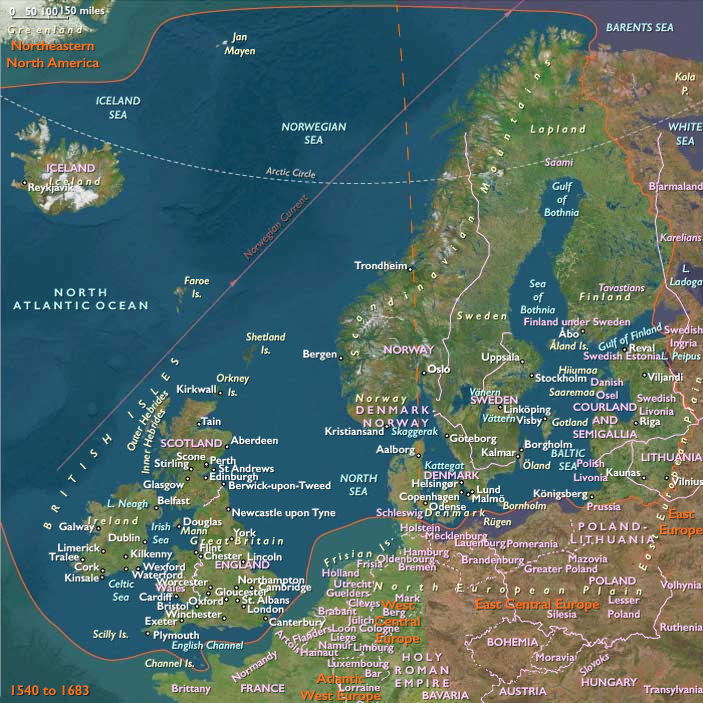
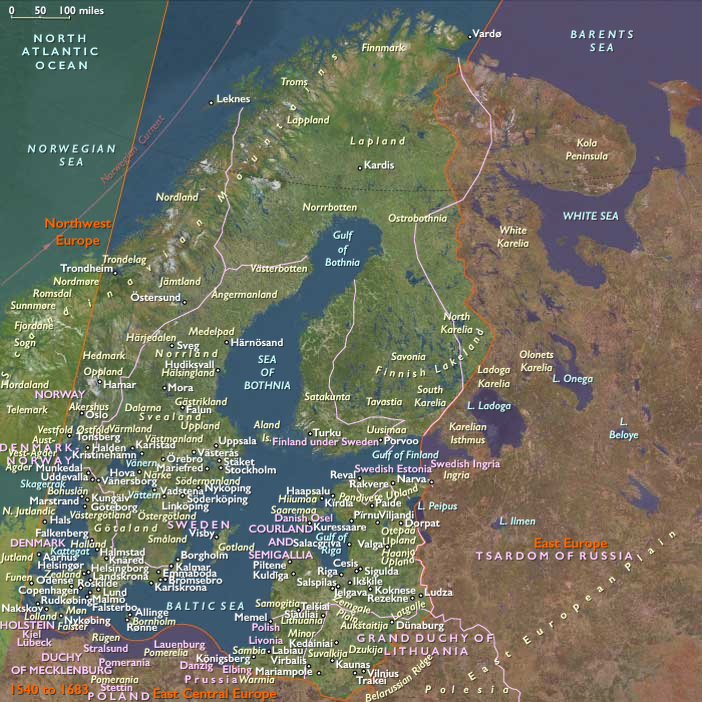
Svalbard had been discovered in 1596 by the Dutch navigator Willem Barentsz.
The English Muscovy Company, encouraged by reports of whales off the coast of Spitsbergen in 1610,had sent a whaling expedition there the following year.
The expedition was a disaster, with both ships sent being lost.
The crews returned to England in a ship from Hull.
The following year two more ships were sent.
Other countries followed suit, with Amsterdam and San Sebastian each sending a ship north.
The latter ship returned to Spain with a full cargo of oil.
Such a fabulous return resulted in a fleet of whaleships being sent to Spitsbergen in 1613.
The Muscovy Company sends seven, backed by a monopoly charter granted by King James I.
They meet with twenty other whaleships (eleven-twelve Basque, five French, and three Dutch), as well as a London interloper, which are either ordered away or forced to pay a fine of some sort.
The United Provinces, France, and Spain all protest against this treatment, but James I holds fast to his claim of sovereignty over Spitsbergen.
The company's royal charter of 1613 grants a monopoly on whaling in Spitsbergen, based on the (erroneous) claim that Hugh Willoughby had discovered the land in 1553.
Not only had they wrongly assumed a 1553 English voyage had reached the area, but on June 27, 1607, during his first voyage in search of a "northeast passage" on behalf of the company, Henry Hudson had sighted "Newland" (i.e., Spitsbergen), near the mouth of the great bay Hudson later simply named the Great Indraught (Isfjorden).
The English hope in this way to head off expansion by the Dutch in the region, at this time their major rival.
The following three and a half decades are to witness numerous clashes between the various nations (as well as infighting among the English), often merely posturing, but sometimes resulting in bloodshed.
This jealousy stems as much from the mechanics of early whaling as from straightforward international animosities.
In the first years of the fishery, England, France, the United Provinces and later Denmark-Norway ship expert Basque whalemen for their expeditions.
At this time Basque whaling relies on the utilization of stations ashore where blubber could be processed into oil.
In order to allow a rapid transference of this technique to Spitsbergen, suitable anchorages have to be selected, of which there are only a limited number, in particular on the west coast of the island.
Locations
People
Groups
- Basque people
- Muscovy Company (also called Russian Company or Muscovy Trading Company)
- Spain, Habsburg Kingdom of
- Netherlands, United Provinces of the (Dutch Republic)
- France, (Bourbon) Kingdom of
- England, (Stuart) Kingdom of
Topics
Commodoties
Subjects
Regions
Subregions
Years: 1613 - 1613
Locations
People
Groups
- Basque people
- Muscovy Company (also called Russian Company or Muscovy Trading Company)
- Spain, Habsburg Kingdom of
- Netherlands, United Provinces of the (Dutch Republic)
- France, (Bourbon) Kingdom of
- England, (Stuart) Kingdom of
Topics
Commodoties
Subjects
Regions
Subregions