
Susenyos becomes Emperor following the defeat of …
Years: 1606 - 1606
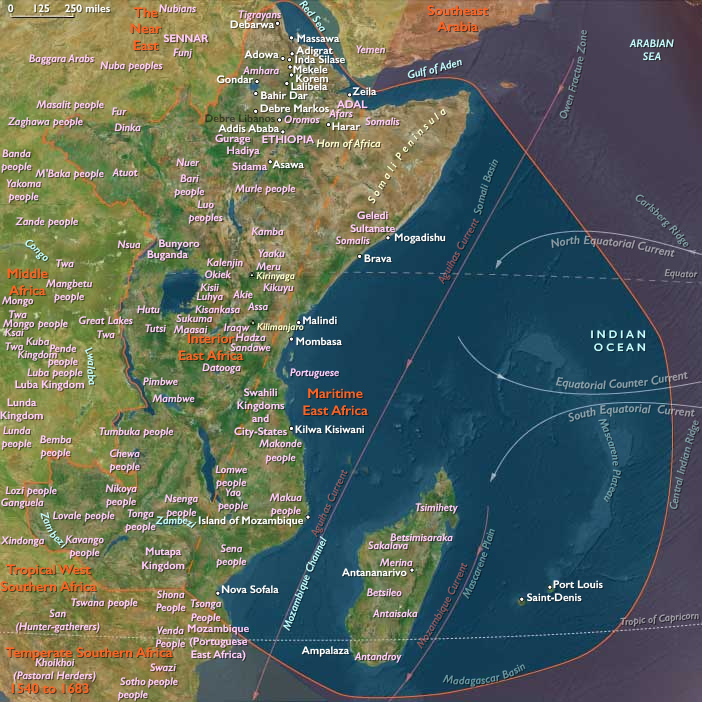
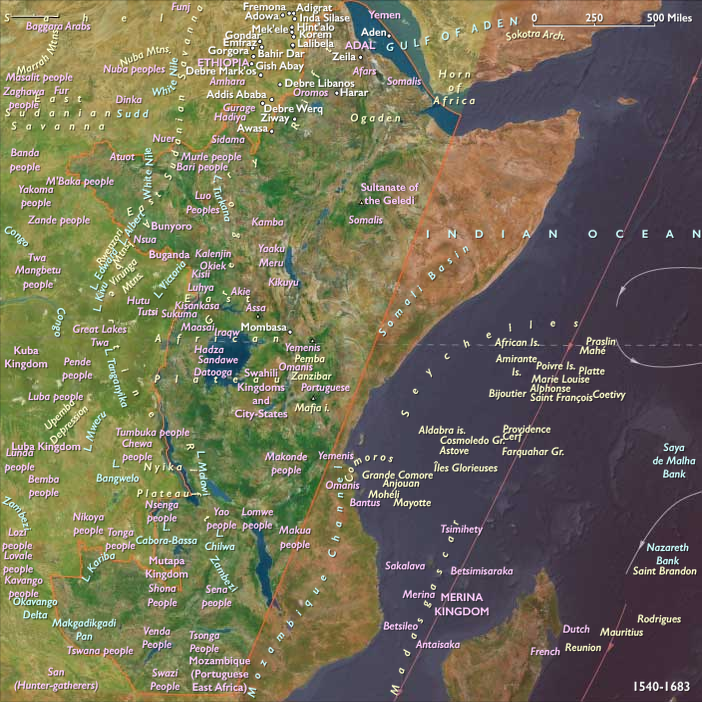
Susenyos becomes Emperor following the defeat of first Za Sellase, then Yaqob at the Battle of Gol in 1606, which is in southern Gojjam.
Locations
People
Groups
- Coptic Orthodox Church of Alexandria
- Christians, Roman Catholic
- Jesuits, or Order of the Society of Jesus
- Spain, Habsburg Kingdom of
- Portugal, Habsburg (Philippine) Kingdom of
- Ethiopia, Solomonid Dynasty of
Subjects
Regions
Subregions
Related Events
Filter results
Showing 10 events out of 33661 total
Pedro Fernandez de Queirós, a Portuguese-born navigator who had been a pilot on Mendana’s ill-fated 1595 expedition, had proposed an expedition to the Pacific in search of Terra Australis.
Queirós commands a party of three Spanish ships, San Pedro y San Pablo (one hundred and fifty tons tons), San Pedro (one hundred and twenty tons) and the tender (patache) Los Tres Reyes, which had left Callao in Spanish Peru on December 21, 1605, with Luís Vaz de Torres in command of the San Pedro.
Anchoring in a bay of the New Hebrides group on May 3, 1606, and assuming the islands to be outliers of the Great Southern Continent he seeks for his king, he names the yet-unseen continent “La Austrialia (sic) del Espiritu Santo,” a reference to the House of Austria, to which the king of Spain belongs, and a pun on “tierra austral,” ( “the south land”).
Queirós’ ships after six weeks put to sea again to explore the coastline.
Queirós in the San Pedro y San Pablo on the night of June 11, 1606, becomes separated from the other ships in bad weather and is unable (or so he will later say) to return to safe anchorage at Espiritu Santo.
He then sails to Acapulco in Mexico, where he will arrive in November 1606.
In the account by Prado, which is highly critical of Queirós, mutiny and poor leadership are given as the reason for Queirós’ disappearance.
Torres will remain silent on the subject other than to write his “condition was different to that of Captain Queirós.”
The Ryūkyū Kingdom and the Shimazu clan of Satsuma have been engaged in trade for at least several centuries and possibly for far longer than that; in addition, Ryukyu at times had paid tribute to the Muromachi shogunate (1336–1573) of Japan as it has to China since 1372.
One of the chief events which spurs Satsuma to aggression had occurred when Hideyoshi launched the first of two invasions of Korea in 1592.
Through messengers from Satsuma, he had ordered that Ryukyu contribute warriors to the invasion efforts, and was refused; he had also commanded that Ryukyu temporarily suspend its official missions to China.
The mission had traveled to Beijing anyway, on business relating to Shō Nei's formal investiture, and related Hideyoshi's plans to Chinese Court officials there.
Shimazu Yoshihisa, lord of Satsuma, had then suggested that Ryukyu be allowed to supply food and other supplies instead of manpower; Hideyoshi had agreed, but Shō Nei had ignored the related missives.
Following Hideyoshi's death in 1598, and Tokugawa Ieyasu's subsequent rise to power, Shō Nei had been asked by Satsuma to formally submit to the new shogunate, a request which was also ignored.
The Shimazu now requests to launch a punitive mission against Ryukyu and, in 1606, is granted permission by the shogunate.
The peace of Zsitvatörök that Ahmed has signed with Austria is a blow to Ottoman prestige, and he is compelled to extend commercial privileges to France, Venice, and the Netherlands within his domains.
Reverses in the ongoing Turko-Persian war, together with incidents in Egypt, Lebanon, the eastern Mediterranean, and the Cossack-harried Black Sea area, cause Ahmed to be somewhat deferential at the signing.
The Porte, in fifteen years of war, has gained only the fortresses of Erlau and Kanizsa and has indicated its inability to expand farther into Europe.
Ahmed, angered by the Persian conquests, is now free to move against his enemies in the east.
Ahmed leads a large army against a smaller Persian force commanded by 'Abbas near Lake Urmia but suffers defeat with heavy losses.
'Abbas afterward takes control of Mosul, and ...
...Diyarbakir.
Abbas is generally tolerant of Christianity.
The Italian traveler Pietro della Valle, who will visit Persia in 1626, is to profess astonishment at the shah's knowledge of Christian history and theology and establishing diplomatic links with European Christian states is to be a vital part of the shah's foreign policy.
Christian Armenia is a key province on the border between Abbas' realm and the Ottoman Empire.
From 1604 Abbas has implemented a "scorched earth" policy in the region to protect his northwestern frontier against any invading Ottoman forces, a policy which involves the forced resettlement of many Armenians from their homelands.
Many are transferred in 1606 to New Julfa, a town the shah had built for the Armenians near his capital Isfahan.
Thousands of Armenians die on the journey, but hose who survive enjoyed considerable religious freedom in New Julfa, where the shah builds them a new cathedral, one of the first churches to be established in the district.
Abbas' aim is to boost the Iranian economy by encouraging the Armenian merchants who have moved to New Julfa.
As well as religious liberties, he also offers them interest-free loans and allows the town to elect its own mayor (kalantar).
Other Armenians, transferred to the provinces of ...
...Gilan and ...
...Mazandaran, are less lucky.
Abbas is fond of the province of Mazandaran, the birthplace of his mother Khayr al-Nisa Begum, and wants to establish a second capital in Mazandaran, Farahabad, but the climate is unhealthy and malarial.
Built on a site formerly known as Tahan and linked to the town of Sari, seventeen miles away, by a stone causeway, the shah intends the city as his winter capital.
Many of the Armenian settlers die and others will gradually abandon the city.
Susenyos manages to first surprise and decimate the forces of Za Sellase at Manta Dafar in Begemder; when Za Sellase escapes to Yaqob's camp, the Emperor's derision causes Za Sellase to defect to Susenyos.
For several days, the armies of the two rival emperors maneuver in the mountains of Gojjam, to at last meet in the Battle of Gol on March 10, 1606, where Yaqob and Abuna Petros II are killed in battle, and his troops slaughtered.
Years: 1606 - 1606
Locations
People
Groups
- Coptic Orthodox Church of Alexandria
- Christians, Roman Catholic
- Jesuits, or Order of the Society of Jesus
- Spain, Habsburg Kingdom of
- Portugal, Habsburg (Philippine) Kingdom of
- Ethiopia, Solomonid Dynasty of
