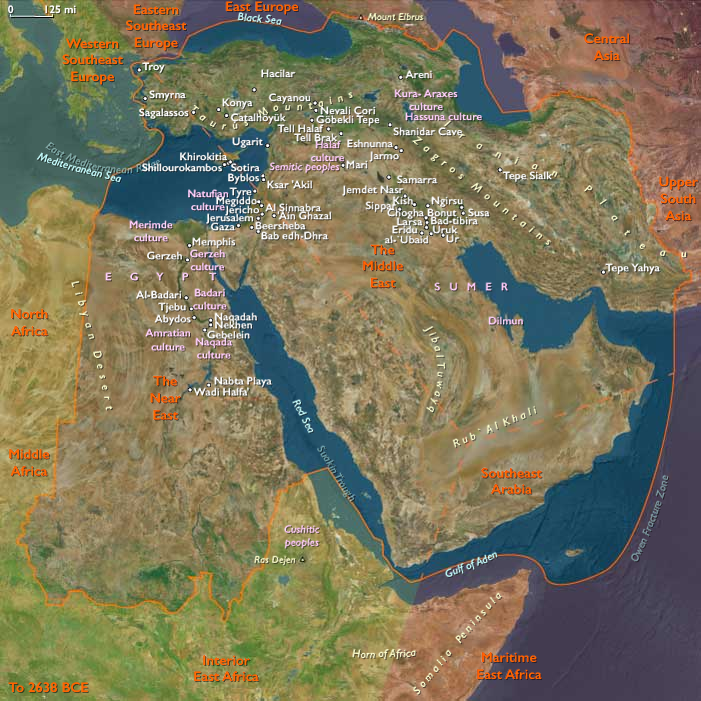
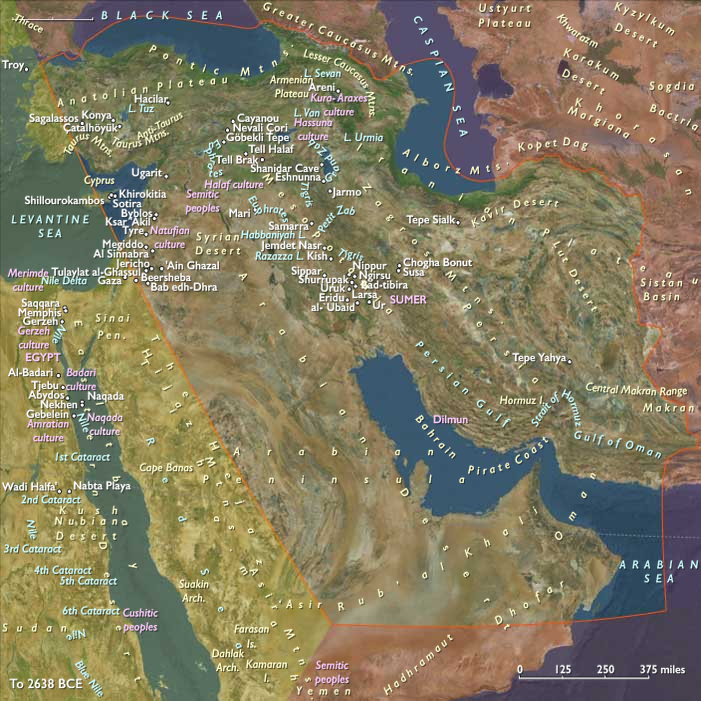
The region around Susa in the southwest …
Years: 4077BCE - 3934BCE
Locations
Groups
Topics
Commodoties
Subjects
Regions
Subregions
Related Events
Filter results
Showing 10 events out of 68829 total
The Older and Younger Peron Transgressions: Climatic and Coastal Transformations in the Mid-Holocene
By 4100 BCE, the effects of the Older Peron Transgression had subsided, restoring climatic conditions in Europe to those of the Atlantic Period—the warmest and most humid phase of the Holocene. This stabilization allowed for the continued expansion of Neolithic farming communities, as well as cultural and technological advancements across the continent.
The Younger Peron Transgression (4000–3400 BCE)
- Occurring within the Neolithic Subpluvial, the Younger Peron Transgression was a significant sea-level riseevent.
- By its peak, sea levels stood at approximately three meters above 20th-century levels, dramatically reshaping coastal landscapes.
- This transgression transformed river valleys, estuaries, and coastal settlements, influencing human adaptation strategies.
Impact on Human Settlements and Societies
- Low-lying coastal settlements were inundated, forcing early farming and fishing communities to migrate inland or adapt to wetter environments.
- The formation of new estuaries, lagoons, and coastal wetlands may have encouraged fishing, shellfish gathering, and early maritime trade.
- Some cultures responded by constructing stilt houses and wooden trackways to navigate changing landscapes.
- The reworking of coastlines influenced cultural exchange networks, as communities adjusted to new trade routes.
A Climate of Transformation
- The Neolithic Subpluvial (also called the Holocene Climatic Optimum) was a warm and wet period, particularly affecting North Africa, where the Sahara remained fertile.
- These changing climatic and environmental conditions shaped the development of late Neolithic societies, as they adapted to fluctuating landscapes and resources.
The Younger Peron Transgression (4000–3400 BCE) thus played a critical role in shaping prehistoric coastal environments, influencing migration patterns, settlement strategies, and economic activities during the Neolithic expansion.
More than one hundred dwellings surrounding a community center, a cemetery and a kiln are built around 4000 in Jiangzhai, a Banpo phase Yangshao culture village site to the east of Xi'an, where modern archaeologists have excavated the earliest copper artifacts in China.
The horse is domesticated around 4000 (though possibly earlier) in several locations on the Eurasian steppe.
Bone bits and horse remains in human graves found in the Eneolithic (fifth millennium) Samara culture at the middle Volga, a culture suggested as corresponding to the Proto-Indo-Europeans in the Kurgan hypothesis championed by twentieth century Lithuanian-American archeologist Marija Gimbutas, represent the earliest archaeological evidence of horse domestication.
It cannot yet be determined decisively if these horses were ridden or not, but they were certainly used as a meat-animal.
Recent discoveries concerning Botai culture suggest that Botai culture settlements in the Aqmola Province of Kazakhstan are the location of the earliest domestication of the horse.
However, an increasing amount of evidence supports the hypothesis that horses were domesticated in the Eurasian Steppe (Dereivka, centered in Ukraine) approximately 4000-3500 BCE.
The date of 4000 BCE is based on evidence that includes the appearance of dental pathologies associated with biting, changes in butchering practices, changes in human economies and settlement patterns, the depiction of horses as symbols of power in artifacts, and the appearance of horse bones in human graves.
The Funnelbeaker culture, named for its characteristic pottery, emerges around 4000 BCE as the earliest Neolithic culture in northern Europe and Scandinavia.
Older traditions of hunting and fishing survive alongside agriculture in some areas, such as the Mesolithic Ertebolle culture of Denmark.
The Funnelbeaker culture ranges from the Elbe catchment in Germany and Bohemia with a western extension into the Netherlands, to southern Scandinavia (Denmark up to Uppland in Sweden and the Oslofjord in Norway) to the Vistula catchment in Poland.
Variants of the Funnelbeaker culture in or near the Elbe catchment area include the Tiefstich pottery group in northern Germany as well as the cultures of the Baalberge group (TRB-MES II and III; MES = Mittelelbe-Saale), the Salzmünde and Walternienburg and Bernburg (all TRB-MES IV) whose centers are in Saxony-Anhalt.
With the exception of some inland settlements such as Alvastra pile dwelling, the settlements are located near those of the previous Ertebølle culture on the coast.
The culture is characterized by single-family daubed houses of about twelve meters by six meters.
It is dominated by animal husbandry of sheep, cattle, pigs and goats, but there is also hunting and fishing.
Primitive wheat and barley is grown on small patches that are fast depleted, due to which the population frequently moves small distances.
There is also mining (e.g., in the Malmö region) and collection of flintstone, which is traded into regions lacking the stone, such as the Scandinavian hinterland.
The culture imports copper from Central Europe, especially daggers and axes.
The houses are centered on a monumental grave, a symbol of social cohesion.
Burial practices are varied, depending on region and change over time.
Inhumation seems to have been the rule.
The oldest graves consist of wooden chambered cairns inside long barrows, but will later be made in the form of passage graves and dolmens.
The structures are probably covered originally with a heap of dirt; a stone blocks the entrance.
The Ertebolle culture of Denmark declines after 4000 BCE.
The ancient peoples inhabiting the lands south of the Danube have spread throughout the region by 4,000 BCE.
The region's Neolithic inhabitants plant cereal grains, raise livestock, fish, hunt, weave simple textiles, build houses of wood or mud, and make coarse pottery and implements.
The range of manufactured copper objects progresses from beads and awls to impressive shaft-hole axes.
The Middle East (4077–3934 BCE): Ubaid Urbanization and Cultural Innovations
Ubaid 3/4 Culture and Urbanization
Between 4077 and 3934 BCE, the Ubaid 3/4 culture, sometimes termed Ubaid I and Ubaid II, underwent a period of intense and rapid urbanization. This transformative era saw the culture expanding significantly into northern Mesopotamia, effectively replacing the earlier Halaf culture after a brief hiatus. The growth in urban settlements was marked by the emergence of large village communities, characterized by multi-roomed rectangular mud-brick houses and the first significant examples of public temple architecture in Mesopotamia.
Settlement Patterns and Architecture
The urban expansion of the Ubaid period resulted in a hierarchical settlement pattern, with major centralized sites exceeding ten hectares, supported by numerous smaller village settlements under one hectare. These urban centers displayed enhanced social organization, infrastructural complexity, and sophisticated architectural planning.
Pottery and Technological Developments
The period is distinguished by distinctive pottery craftsmanship featuring fine-quality buff or greenish-colored ceramics intricately decorated with geometric motifs in brown or black paint. Tools, including sickles, frequently crafted from hard-fired clay in southern Mesopotamia, transitioned to stone and occasionally metal implements further north, demonstrating significant technological variation across the region.
Susa and Mesopotamian Influence
The region around Susa in southwestern modern Iran, located adjacent to lower Mesopotamia, experienced substantial cultural influence from this expanding Mesopotamian civilization starting in the fifth millennium BCE. Although strongly influenced, Susa maintained its unique cultural characteristics. By the latter half of the fourth millennium BCE, the area could be considered part of the broader Uruk culture, suggesting a complex relationship of either gradual acculturation or possible conquest.
Winemaking and Early Bronze Age Innovations in Armenia
Significant cultural insights emerged from the discovery at the cave site Areni 1, in the modern village of Areni in Armenia's Vayots Dzor Province, excavated in 2007. Excavations revealed evidence of a sophisticated winemaking enterprise, as well as culturally diverse pottery and an extensive collection of Copper Age artifacts dating between 6200 and 5900 years ago. These discoveries, including metal knives, seeds from various fruits, cereal grains, ropes, cloth, straw, grass, reeds, dried grapes, and prunes, suggest advanced agricultural and domestic practices.
In January 2011, archaeologists announced the discovery of the Areni-1 winery, dating back over six thousand years, equipped with a wine press, fermentation vats, jars, and cups, along with grape seeds and vines of the species Vitis vinifera. Notably, the cave also contained the world’s oldest known leather shoe, the Areni-1 shoe. Patrick McGovern, a biomolecular anthropologist at the University of Pennsylvania, highlighted the significance of these finds, stating, "The fact that winemaking was already so well developed in 4000 BCE suggests that the technology probably goes back much earlier."
This era underscores remarkable urbanization, cultural integration, technological innovation, and complex agricultural practices, setting crucial foundations for the development of subsequent civilizations in the ancient Middle East.

The Ubaid 3/4 culture, sometimes called Ubaid I and Ubaid II, has seen a period of intense and rapid urbanization in the period from 4500–4000 BCE, with the culture spread into northern Mesopotamia replacing (after a hiatus) the Halaf culture.
Ubaid culture is characterized by large village settlements, featuring multi-roomed rectangular mud-brick houses and the appearance of the first temples of public architecture in Mesopotamia, with a growth of a two-tier settlement hierarchy of centralized large sites of more than ten hectares surrounded by smaller village sites of less than one hectare.
Domestic equipment includes a distinctive fine quality buff or greenish colored pottery decorated with geometric designs in brown or black paint; tools such as sickles are often made of hard fired clay in the south; in the north, stone and sometimes metal are used.
Evidence of a winemaking enterprise and an array of culturally diverse pottery at he cave site of Areni 1, excavated in 2007 in the present village of Areni in the Vayots Dzor Province of Armenia, offers surprising new insights into the origins of modern civilizations.
Excavations also yielded an extensive array of Copper Age artifacts dating to between sixty-two hundred and fifty-nine hundred years ago.
The new discoveries within the cave move early bronze-age cultural activity in Armenia back by about eight hundred years.
Additional discoveries at the site include metal knives, seeds from more than thirty types of fruit, the remains of dozens of cereal species, rope, cloth, straw, grass, reeds and dried grapes and prunes.
The discovery of the earliest known winery, the Areni-1 winery, will be announced by archaeologists in January 2011, seven months after the discovery of the world's oldest leather shoe, the Areni-1 shoe, in the same cave.
The winery, which is over six-thousand years old, contains a wine press, fermentation vats, jars, and cups.
Archaeologists also found grape seeds and vines of the species Vitis vinifera.
Patrick McGovern, a biomolecular anthropologist at the University of Pennsylvania, commenting on the importance of the find, said, "The fact that winemaking was already so well developed in 4000 BC suggests that the technology probably goes back much earlier.”