
Sultan Mahmud I, advised by Humbaraci Ahmed …
Years: 1747 - 1747
Sultan Mahmud I, advised by Humbaraci Ahmed Pasa (Claude Alexandre, Comte de Bonneval, a French convert to Islam), participates in political and military affairs and attempts a partial reform of the army.
A patron of music and literature, he writes poetry in Arabic.
The Comte de Bonneval is the descendant of an old family of Limousin; at the age of thirteen he had joined the Royal Marine Corps.
After three years, he had entered the army, in which he had risen to the command of a regiment, serving in the Italian campaigns under Catinat, Villeroi and Vendôme, and in the Netherlands under Luxembourg, giving proofs of indomitable courage and great military ability.
After his insolent bearing towards the minister of war was made matter for a court martial, in 1704, he had been condemned to death, but saved himself by fleeing to Germany.
Through the influence of Prince Eugene of Savoy, he had obtained a general's command in the Austrian army, and fought with great bravery and distinction against France, and afterwards against Turkey.
Present at the Battle of Malplaquet, he had been severely wounded at Peterwardein.
The proceedings against him in France were then allowed to drop, and he visited Paris, and married a daughter of Marshal de Biron.
He had after a short time returned to the Austrian army, and fought with distinction at Belgrade.
He might now have risen to the highest rank, had he not made himself disagreeable to Prince Eugene, who then sent him as master of the ordnance to the Low Countries.
There his ungovernable temper had led him into a quarrel with the Marquis de Prié, Eugene's deputy governor in the Netherlands, who had answered his challenge by placing him in confinement.
A court martial was again held upon him, and he was condemned to death; but the emperor commuted the sentence to one year's imprisonment and banishment.
Bonneval was returned to Vienna, stripped of his rank, titles and honors, and exiled to Venice.
Soon after his release, Bonneval had offered his services to the Turkish government, professed Islam, and had taken the name of Ahmed.
Made a pasha, he had been appointed to organize and command the Turkish artillery, eventually contributing to the Austrian defeat at Niš and the subsequent end of the Austrian-Ottoman war marked by the Treaty of Belgrade, where Austria lost Northern Serbia with Belgrade, Lesser Wallachia, and territories in northern Bosnia.
In Constantinople, he met the young Giacomo Casanova, who was then a Venetian naval officer stationed there.
He is also close friends with a well-respected local mullah, Ismail Pasha.
He has rendered valuable services to the sultan in his war with Russia, and with the famous Nader Shah.
As a reward he has received the governorship of Chios, but had soon fallen under the suspicion of the Porte, and was banished for a time to the shores of the Black Sea.
He dies in March 1747 at Constantinople.
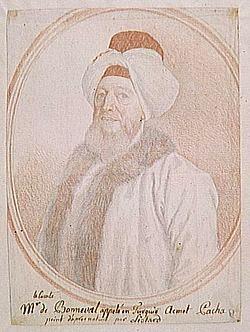
Claude Alexandre de Bonneval as Humbaracı Ahmet Paşa
Locations
People
Groups
Subjects
Regions
Subregions

Related Events
Showing 10 events out of 27058 total
Years: 1747 - 1747
Claude Alexandre de Bonneval as Humbaracı Ahmet Paşa
Locations
People
Groups
Subjects
Regions
Subregions