
Sultan Husayn, shah of Iran from 1694, …
Years: 1722 - 1722
February
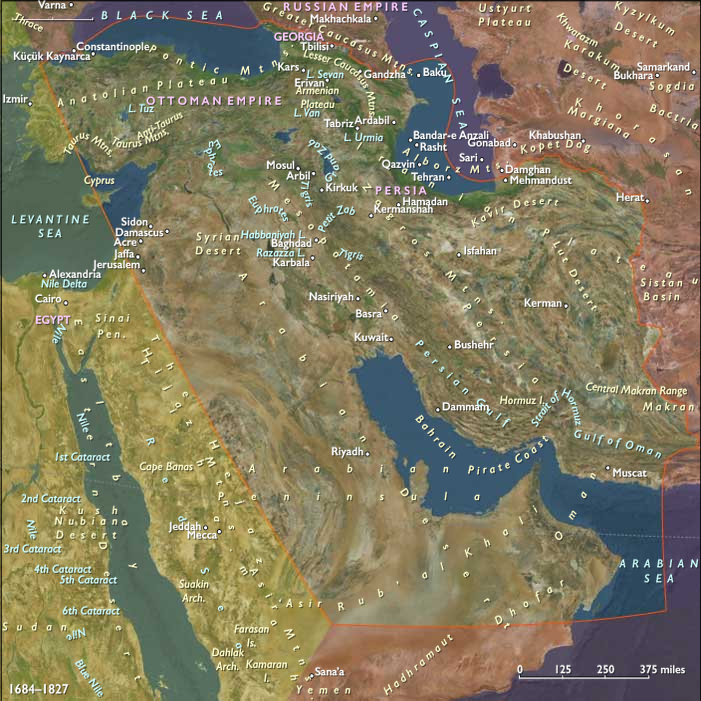
Sultan Husayn, shah of Iran from 1694, had been reared in the harem and has no knowledge of state affairs.
He has depleted the treasury for personal expenses and allowed the mullahs (clergy) to control the government.
He can defend himself neither from tribal raiding in the capital nor from interfering mujtahids led by Mohammad Baqir Majlisi (whose writings later will be important in the Islamic Republic of Iran).
The Russian and Ottoman empires have taken advantage of Husayn's weakness to seize border territory.
Despite these losses, Husayn has ruled in relative peace for twenty years, while the nation has slowly declined.
Of a pious temperament, Husayn is especially influenced by the Shi'ite divines, whose conflicting advice, added to his own procrastination, seals the sudden and unexpected fate of the Safavid empire.
Abruptly, he is faced with a series of revolts by his tribal subjects.
The most serious of these comes from one Mir Mahmud, a Ghilzay Pashtun and former Safavid vassal from Qandahar whose father, Hotaki dynasty founder Mirwais Khan Hotaki, had seized the throne of Afghanistan.
Locations
People
Groups
- Pashtun people (Pushtuns, Pakhtuns, or Pathans)
- Muslims, Sunni
- Muslims, Shi'a
- Ghilzai (Pashtun tribal confederacy)
- Ottoman Empire
- Persia, Safavid Kingdom of
- Russian Empire
- Persia, Hotaki Ghilzaid Kingdom of
Topics
Commodoties
Subjects
Regions
Subregions
Years: 1722 - 1722
February
Locations
People
Groups
- Pashtun people (Pushtuns, Pakhtuns, or Pathans)
- Muslims, Sunni
- Muslims, Shi'a
- Ghilzai (Pashtun tribal confederacy)
- Ottoman Empire
- Persia, Safavid Kingdom of
- Russian Empire
- Persia, Hotaki Ghilzaid Kingdom of
Topics
Commodoties
Subjects
Regions
Subregions