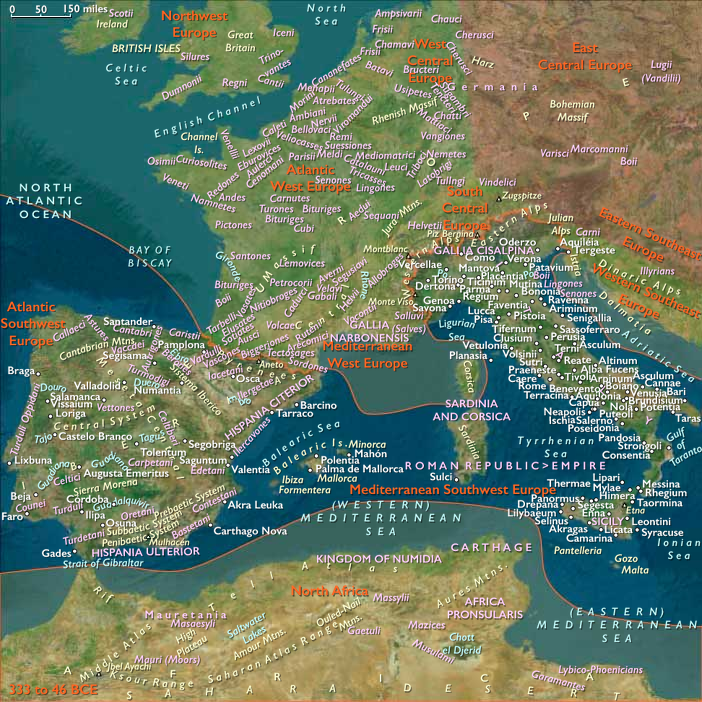
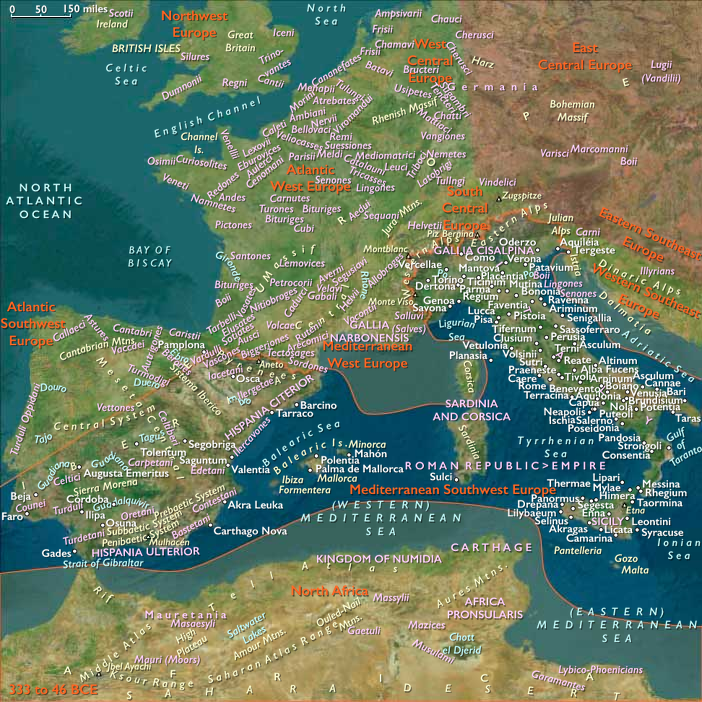
Sulla, the war in Italy having ended, …
Years: 82BCE - 82BCE
Sulla, the war in Italy having ended, sends Pompey against the Marians in Sicily and Africa.
Carbo has meanwhile fled Africa for the island of Cossyra (Pantelleria), where he is arrested and ...
Locations
People
- Gaius Marius the Younger
- Gnaeus Papirius Carbo
- Lucius Cornelius Sulla
- Pompey
- Quintus Caecilius Metellus Pius
Groups
Topics
Commodoties
Subjects
Regions
Subregions
Related Events
Filter results
Showing 10 events out of 62760 total
The Pontian defenders defeat Murena in 82 BCE, and Rome suspends hostilities.
...taken in chains before Pompey at Lilybaeum.
After securing Sicily, guaranteeing Rome's grain supply, he executes Carbo and his supporters out of hand, which may have led to his dubbing as the adulescens carnifex (adolescent butcher).
Sulla has by 82 BCE conducted an ethnic cleansing campaign against the Samnites, this most stubborn and persistent of Rome's adversaries, and forced the remnant to disperse.
So great is the destruction brought upon them that it is recorded that "the towns of Samnium have become villages, and most have vanished altogether.” (Strabo, Geography, Book V, Section 4.11.)
Carbo opens the campaign year of 82 BCE by taking his forces to the north to oppose Pompey while Marius moves against Sulla in the south.
Carbo fights an indecisive engagement with Sulla near Clusium, but ...
…he is defeated with great loss in an attack on the camp of Sulla's general, Quintus Caecilius Metellus Pius, near Faventia.
Attempts to defeat Pompey fail; Metellus and his African forces, along with Pompey, secure northern Italy for Sulla.
In the south, young Marius gathers a large host of Samnites who assuredly would lose influence with the anti-popular Sulla in charge of Rome.
Marius meets Sulla at Sacriportus and the two forces engage in a long and desperate battle.
In the end, many of Marius' men switch sides over to Sulla and he has no choice but to retreat with around seven thousand surviving troops, along with the treasury of the Capitoline temple, to …
…the fortress city of Praeneste.
Sulla follows the son of his arch-rival and lays siege to the town, leaving his prefect Quintus Lucretius Ofella to conduct the siege, throttling the town with a ring of rapidly constructed earth and tuff barricades.
Sulla himself moves north to push Carbo, who has withdrawn to Etruria to stand between Rome and the forces of Pompey and Metellus.
Marius gives orders to Lucius Junius Brutus Damasippus, the Urban Praetor, to kill all those who are likely to support Sulla’s return, including his father-in-law, Quintus Mucius Scaevola Pontifex, the ex-consul Lucius Domitius, Publius Antistius and Papirius Carbo among others.
Although both Gnaeus Papirius Carbo and Damasippus attempt to break the siege, they are unsuccessful.
Indecisive battles are fought between Carbo and Sulla's forces but Carbo knows that his cause is lost.
News arrives of a defeat by Norbanus in Gaul, and that he has also switched sides to Sulla.
Although Carbo still has a large army and the Samnites remain faithful to him, he is caught between three enemy armies and with no hope of relief.
So disheartened by his failure to relieve Praeneste, he decides to leave Italy, fleeing to Africa.
It is not yet the end of the resistance however, those remaining Marian forces gather together and attempted several times to relieve young Marius at Praeneste.
A Samnite force under Pontius Telesinus joins in the relief effort but the combined armies are still unable to break Sulla.
Rather than continue trying to rescue Marius, Telesinus moves north to threaten Rome.
Towards the end of the siege, Marius makes one final attempt to escape, this time by digging a tunnel under the walls, but the attempt is uncovered.
Marius commits suicide so as not to fall into enemy hands.

The two forces meet on November 1 of 82 BCE, at the battle of the Colline Gate, just outside of Rome.
The battle is a huge and desperate final struggle with both sides certainly believing their own victory will save Rome.
Sulla is pushed hard on his left flank with the situation so dangerous that he and his men are pushed right up against the city walls.
Crassus' forces, fighting on Sulla's right, however, manage to turn the opposition's flank and drive them back.
The Samnites and the Marian forces fold up and break.
In the end, over fifty thousand combatants lose their lives and Sulla stands alone as the master of Rome.
Having observed the violent results of radical popular reforms, Sulla is naturally conservative.
As such, he seeks to strengthen the aristocracy, and by extension the Senate.
At the end of 82 BCE or the beginning of 81 BCE, the Senate appoints Sulla dictator legibus faciendis et reipublicae constituendae causa ("dictator for the making of laws and for the settling of the constitution").
The decision is subsequently ratified by the "Assembly of the People", with no limit set on his time in office.
Sulla has total control of the city and republic of Rome, except for Hispania (which Marius's general Quintus Sertorius has established as an independent state).
This unusual appointment (used hitherto only in times of extreme danger to the city, such as the Second Punic War, and then only for six-month periods) represents an exception to Rome's policy of not giving total power to a single individual.
Sulla can be seen as setting the precedent for Julius Caesar's dictatorship, and the eventual end of the Republic under Augustus.
The Middle East: 81–70 BCE
The Third Mithridatic War and the Rise of Parthia
Between 81 and 70 BCE, significant geopolitical shifts occur in the Middle East as Rome consolidates its dominance in the region and Parthia emerges as a significant power.
Peace is initially restored between Pontus and Rome on the orders of Lucius Cornelius Sulla, ending the Second Mithridatic War. However, stability proves fleeting, and the Third Mithridatic War (73–63 BCE) soon erupts as the last and most prolonged conflict between Mithridates VI of Pontus and his allies against the Roman Republic. The alliance formed between Mithridates VI and Quintus Sertorius, leader of the anti-Sullan faction, creates a formidable coalition capable of threatening Roman supremacy in the region.
The immediate catalyst for this war is the bequest to Rome by King Nicomedes IV of Bithynia upon his death in 74 BCE, leaving his kingdom to the Roman Republic. Exploiting the simultaneous revolt of Sertorius in Spain, Mithridates launches an offensive in Asia Minor, initially encountering minimal resistance. The Roman Senate responds by dispatching the consuls Lucius Licinius Lucullus and Marcus Aurelius Cotta. While Lucullus governs Cilicia, Cotta is assigned to Bithynia. With Rome's attention divided and its forces stretched thin—Pompey, Rome’s preeminent general, occupied in Gaul and Spain suppressing the Sertorian rebellion—Mithridates finds an opening for early successes.
Meanwhile, in Mesopotamia, the city of Hatra emerges as a significant commercial and religious center. Located strategically sixty-eight miles southwest of modern Mosul, Iraq, Hatra gains prominence as the capital of Araba, a semi-autonomous state under increasing Parthian influence, benefiting from its location along critical caravan trade routes.
In Parthia, the historical record during this period is fragmented, though the reign of King Orodes ends amidst internal strife. The subsequent succession is initially obscure until the ascent of Sanatruces around 77 BCE, stabilizing the Arsacid dynasty. The only direct reference to Orodes as king of kings is found in a Babylonian account of a lunar eclipse dated to April 11, 80 BCE.
Thus, this period, from 81 to 70 BCE, sees the continuing struggle for dominance between Rome and Pontus, the strengthening of Parthian influence in Mesopotamia, and the rise of critical regional centers such as Hatra, shaping the geopolitical landscape for future centuries.
Peace is restored between Pontus and Rome on the orders of Sulla, ending the Second Mithridatic War.
The Third Mithridatic War (73–63 BCE) is the last and longest of three Mithridatic Wars fought between Mithridates VI of Pontus and his allies and the Roman Republic.
The alliance between Mithridates VI and Quintus Sertorius, the main leader of the opposition to Sulla, joins these two threats into a unity much larger than its parts and has the serious potential of overturning Roman power.
The immediate cause of the Third War is the bequest to Rome by King Nicomedes IV of Bithynia of his kingdom upon his death in 74 BCE.
Having launched an attack at the same time as a revolt by Sertorius sweeps through the Spanish provinces, Mithridates is initially virtually unopposed.
The Senate responds by sending the consuls Lucius Licinius Lucullus and Marcus Aurelius Cotta to deal with the Pontic threat.
The only other possible general for such an important command, Pompey, is in Gaul, marching to Hispania to help crush the revolt led by Sertorius.
Lucullus is sent to govern Cilicia and Cotta to Bithynia.
Years: 82BCE - 82BCE
Locations
People
- Gaius Marius the Younger
- Gnaeus Papirius Carbo
- Lucius Cornelius Sulla
- Pompey
- Quintus Caecilius Metellus Pius