
Sugarcane, a perennial grass of the genus …
Years: 7101BCE - 6958BCE
Sugarcane, a perennial grass of the genus Saccharum, is cultivated for its juice, which people chew raw to extract its sweetness.
Saccharum officinarum, originally from tropical South Asia and Southeast Asia, has been developed from a wild cane species, Saccharum robustom, and cultivated by natives of southern Pacific Islands.
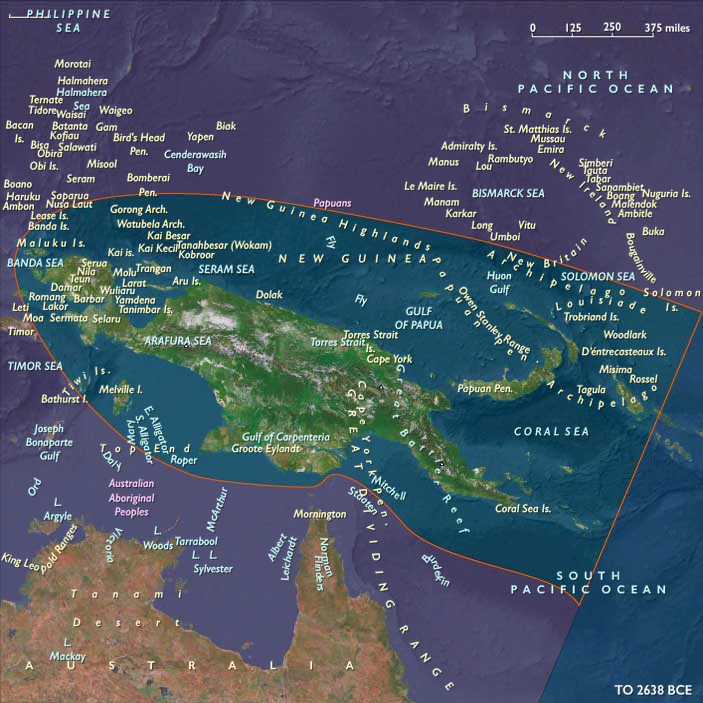
As early as 7000 BCE, the inhabitants of the island of New Guinea have developed, perhaps partly through indirect contact with developments in Southeast Asia, one of the earliest agricultural complexes, based on root crops and sugarcane cultivation.
Groups
Topics
- Neolithic Revolution
- Boreal Period
- Neolithic Subpluvial, or Holocene climatic optimum, or Holocene Wet Phase
Commodoties
Subjects
- Commerce
- Environment
- Labor and Service
- Conflict
- Faith
- Government
- Technology
- Anthropology
- Archaeology
Regions

Subregions
Related Events
Filter results
Showing 10 events out of 69201 total
The area west of Makassar Strait, sometimes called Sundaland, encompasses the areas of the Asian continental shelf that was exposed during the last ice age.
It includes the Malay Peninsula on the Asian mainland, the large islands of Borneo, Java, and Sumatra, and their surrounding islands.
It consists of a web of watered plains, because the seas have been some one hundred and fifty feet, or fifty meters, lower than they are now.
The stone tools used by hunting and gathering societies across Southeast Asia during this period of lowered sea levels show a remarkable degree of similarity in design and development.
Some scholars (e.g., Oppenheimer) locate the origin of the Austronesian languages in Sundaland and its upper regions.
Genetic research reported in 2008 indicates that the islands, which are the remnants of Sundaland, were likely populated as early as fifty thousand years ago.
The sea levels rise in about 7000 BCE to form the islands of Sundaland, home to many Asian mammals including elephants, monkeys, apes, tigers, tapirs, and rhinoceros.
Over seventy sites have been identified with the Peiligang culture, a name given by archaeologists to a group of Neolithic communities in the Yi-Luo river basin in Henan Province, China, named after the site discovered in 1977 at Peiligang (in Xinzheng county).
The site at Jiahu, dating to around 7000, is one of the earliest sites associated with this culture, which practices agriculture in the form of cultivating millet and animal husbandry in the form of raising pigs.
Archaeologists think that the Peiligang culture, one of the first in China to make pottery, was egalitarian, with little political organization.
Evidence of the earliest rice cultivation in the Yellow River basin comes from carbonized rice grains from the Yuezhuang site in Jinan, Shandong.
The carbonized rice is dated using AMS radiocarbon dating to 7050±80.
Archaeologists also excavated millet from the Yuezhuang site.
The people of Lepenski Vir, an important Mesolithic archaeological site located on the banks of the Danube in eastern Serbia, within the Iron Gates gorge, near Donji Milanovac, probably represent the descendants of the early European population of the Brno-Predmost hunter-gatherer culture from the end of the last ice age.
Archaeological evidence of human habitation of the surrounding caves dates back to around 20,000 BCE.
The first settlement on the low plateau dates to 7000 BCE, a time when the climate becomes significantly warmer.
Seven successive settlements will be built on the site, providing a rare opportunity to observe the gradual transition from the hunter-gatherer way of life of early humans to the agricultural economy of the Neolithic.
The remains of one hundred and thirty-six residential and sacral buildings dating from 6500 BCE to 5500 BCE demonstrate the increasingly complex social structure that influences the development of planning and self-discipline necessary for agricultural production.
The Middle East (7101–6958 BCE): Early Metallurgy and Agricultural Communities
Settlement at Hacilar
Between 7101 and 6958 BCE, the archaeological site of Hacilar in southwestern Anatolia emerged prominently. Radiocarbon dating, uncalibrated, indicates that the earliest stages of Hacilar’s development date to approximately 7040 BCE. Structures at the site were constructed from mud brick, wood, and stone, showcasing the sophistication of architectural practices in these early farming communities.
Early Metallurgy and Agricultural Practices
Around 7000 BCE, small rural farming communities across the ancient Near East began practicing simple forms of metallurgy. Evidence from Çayönü, a Neolithic ceremonial site in southern Turkey inhabited approximately from 7200 to 6600 BCE, includes crude examples of cold-hammered copper dating as early as 7000 BCE, representing some of the earliest known metallurgy.
Domestication and Environmental Context at Çayönü
The settlement at Çayönü holds particular significance due to its possible role in the initial domestication of pigs (Sus scrofa). The site's diverse wild fauna included wild boar, wild sheep, wild goats, and cervids. Its environment featured marshes and swamps near the Bogazcay River, open woodland, patches of steppe, and almond-pistachio forest-steppe to the south.
Notably, research by the Max Planck Institute for Breeding Research in Cologne has identified Mount Karaca (Karaca Dag), located near Çayönü, as home to the genetically common ancestor of sixty-eight contemporary cereal varieties. This ancestor still grows wild on the mountain slopes, underscoring the site's crucial role in early agricultural developments.
This period illustrates significant technological advancements, particularly in metallurgy, alongside essential agricultural innovations that collectively supported the growing complexity and stability of Neolithic societies in the Middle East.
Hacilar, an archaeological site in southwestern Anatolia radiocarbon-dated, uncalibrated, to 7040 BCE at its earliest stage of development, features houses of mud brick, wood, and stone.
Small rural farming communities in the ancient Near East practce imple metallurgy sby at least 7000 BCE.
Crude examples of cold hammered copper from Çayönü, a Neolithic ceremonial settlement in southern Turkey inhabited around 7200 to 6600 BCE, date from as early as 7000.
Çayönü is possibly the place where the pig (Sus scrofa) was first domesticated.
The wild fauna include wild boar, wild sheep, wild goat, and cervids.
The Neolithic environment includes marshes and swamps near the Bogazcay, open wood, patches of steppe and almond-pistachio forest-steppe to the south.
The genetically common ancestor of sixty eight contemporary types of cereal still grows as a wild plant on the slopes of Mount Karaca (Karaca Dag), which is located in close vicinity to Çayönü, according to the Max Planck Institute for Breeding Research in Cologne (reported in Der Spiegel of either March 6 or June 3, 2006.)
Agriculture and Neolithic settlement begins at Mehrgarh, in present Baluchistan, Pakistan, about fifty kilometers west of Sibi, at the foot of the Bolan Pass, in about 7000 BCE.
Archaeologists divide the occupation at the site into several periods.
Mehrgarh Period I, 7000 BCE–5500 BCE, was Neolithic and aceramic (i.e., without the use of pottery).
Early Mehrgarh residents live in mud brick houses with four internal subdivisions.
They have an extremely well developed agricultural system, storing their grain in granaries, fashioning tools with local copper ore, and lining their large basket containers with bitumen.
They cultivate six-row barley, einkorn and emmer wheat, jujubes and dates, and herd sheep, goats and cattle.
Numerous burials have been found, many with elaborate goods such as baskets, stone and bone tools, beads, bangles, pendants and occasionally animal sacrifices, with more goods left with burials of males.
Ornaments of seashell, limestone, turquoise, lapis lazuli, sandstone, and polished copper have been found, along with simple figurines of women and animals.
Sea shells from far seashore and lapis lazuli found far in Badakshan, Afghanistan shows good contact with those areas.
A single ground stone ax was discovered in a burial, and several more were obtained from the surface.
These ground stone axes are the earliest to come from a stratified context in the South Asia.
Mehrgarh is now seen as a precursor to the Indus Valley Civilization.
The Neolithic Subpluvial, an extended period of wet and rainy conditions in the climate history of northern Africa, begin in the seventh millennium BCE and remains strong for about two thousand years; it wanes over time and ended in the fourth millennium BCE.
Then the drier conditions that had prevailed before the Neolithic Subpluvial returned; desertification advance, and the Sahara desert forms (or re-forms).
Arid conditions continue through to the present day.
Large areas of North, Central, and East Africa at this time have hydrographic profiles significantly different from later norms.
Existing lakes have surfaces tens of meters higher than today, sometimes with alternative drainages: Lake Turkana, in present-day Kenya, drains into the Nile River basin.
Lake Chad reaches a maximum extent of some four hundred thousand square kilometers in surface area, larger than the modern Caspian Sea, with a surface level about thirty meters (one hundred feet) higher than its twentieth-century average.
Some shallower lakes and river systems existe in the Subpluvial era that will later disappear entirely, and are detectable today only via radar and satellite imagery.
North Africa enjoys a fertile climate during the Neolithic Subpluvial; what is now the Sahara supports a savanna type of ecosystem, with elephant, giraffe, and other grassland and woodland animals now typical of the Sahel region south of the desert.
Clement and fertile conditions support human settlement of the Nile Valley in Egypt, as well as Neolithic societies in Sudan and throughout the region.
The culture that creates the rock art of Tassili n'Ajjer in southeastern Algeria flourishes during the subpluvial period.
The donkey and such crop plants as teff allow the beginning of agriculture in the Ethiopian Highlands around 7000 BCE, but lowland barriers and diseases carried by the tsetse fly will prevent the donkey and agriculture from spreading southwards until relatively recent times.
Years: 7101BCE - 6958BCE
Groups
Topics
- Neolithic Revolution
- Boreal Period
- Neolithic Subpluvial, or Holocene climatic optimum, or Holocene Wet Phase
Commodoties
Subjects
- Commerce
- Environment
- Labor and Service
- Conflict
- Faith
- Government
- Technology
- Anthropology
- Archaeology
