
Stuyvesant, wishing to further formalize agreements with …
Years: 1658 - 1658
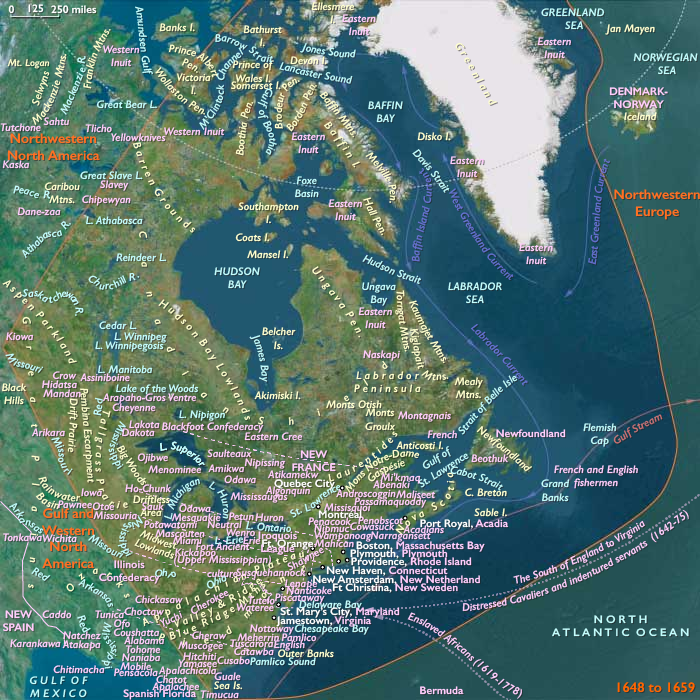
Stuyvesant, wishing to further formalize agreements with the Lenape, agrees in 1658 to "re-purchase" the area "by the great rock above Wiehacken," taking in the sweep of land on the peninsula west of the Hudson and east of the Hackensack River extending down to the Kill Van Kull in Bayonne.
Locations
People
Groups
- Lenape or Lenni-Lenape (later named Delaware Indians by Europeans)
- Wappinger (Amerind tribe)
- Netherlands, United Provinces of the (Dutch Republic)
- New Netherland (Dutch Colony)
- Dutch West India Company
- New Sweden (Swedish Colony)
Topics
Commodoties
Subjects
Regions

Subregions
Related Events
Filter results
Showing 10 events out of 31368 total
During the reign of Emperor Fasilides (1632–1667), Ethiopia entered a period of restoration and stabilization following the turbulent religious conflicts triggered by his predecessor, Emperor Susenyos. Fasilides decisively expelled the Jesuits and European Catholic missionaries whose presence had previously provoked widespread unrest, firmly reestablishing Ethiopian Orthodox Christianity and reducing European influence in the empire. His policies significantly reshaped the religious and political landscape, reaffirming central imperial authority and fostering a renewed sense of Ethiopian sovereignty and identity.
To secure the Solomonic monarchy against internal challenges, Fasilides reinstated the ancient practice of confining royal family members to remote mountaintops, isolating potential rivals and minimizing dynastic conflicts. Recognizing the symbolic importance of historic religious and cultural sites, he notably undertook the reconstruction of the Cathedral of Axum, which had been devastated by the forces of Ahmad ibn Ibrahim al-Ghazi a century earlier, signaling both religious revival and imperial continuity.
Fasilides also established a new and lasting capital at Gondar, which rapidly developed from a royal encampment into a major political and cultural hub. Under his direction, Gondar became the focal point of an artistic and architectural renaissance, exemplified by grand palaces, elaborately decorated churches, and public structures combining indigenous Ethiopian styles with foreign architectural influences. This "Gondarine" cultural flourishing extended well beyond his reign, influencing Ethiopian art and architecture for over a century.
Yet, despite his substantial achievements, Fasilides was unable to fully reverse the decentralization of power that had taken place during the previous decades of religious strife and Oromo incursions. The nobility, having gained considerable autonomy and economic power, particularly in peripheral regions of the empire, retained substantial independence, limiting the full extent of the emperor's centralized authority. This decentralization set a lasting political precedent, shaping the Ethiopian imperial structure into a complex network of semi-autonomous regional rulers under nominal imperial oversight.
The new settlement trades out of necessity with the neighboring Khoikhoi, but theirs is not a friendly relationship, and the company authorities have made deliberate attempts to restrict contact.
Partly as a consequence, VOC employees find themselves faced with a labor shortage.
To remedy this, they release a small number of Dutch from their contracts and permit them to establish farms, with which they are to supply the VOC settlement from their harvests.
This arrangement has proven highly successful, producing abundant supplies of fruit, vegetables, wheat, and wine; they also later raise livestock.
The small initial group of free burghers, as these farmers are known, has steadily increased in number and have begun to expand their farms further north and east into the territory of the Khoikhoi.
In addition to establishing the free burgher system, van Riebeeck and the VOC have also begun to import large numbers of enslaved people, primarily from Madagascar and Indonesia.
These slaves will often marry Dutch settlers, and their descendants will become known as the Cape Coloureds and the Cape Malays.
Vermeer might have found a patron in the local art collector Pieter van Ruijven, who lent him some money in 1657.
The Milkmaid (De Melkmeid or Het Melkmeisje), sometimes called The Kitchen Maid, an oil-on-canvas painting of a "milkmaid", in fact a domestic kitchen maid, is today housed in the Rijksmuseum in Amsterdam, Netherlands, which esteems it as "unquestionably one of the museum's finest attractions".
The exact year of the painting's completion is unknown, with estimates varying by source.
The Rijksmuseum estimates it as circa 1658.
According to the Metropolitan Museum of Art in New York City, it was painted in about 1657 or 1658.
The "Essential Vermeer" website gives a broader range of 1658–1661.
The painting is strikingly illusionistic, conveying not just details but a sense of the weight of the woman and the table.
Rembrandt's style had changed again in the 1650s.
Paintings have increased in size, colors have become richer and brush strokes more pronounced.
With these changes, Rembrandt has distanced himself from earlier work and current fashion, which increasingly inclines toward fine, detailed works.
His singular approach to paint application may have been suggested in part by familiarity with the work of Titian, and can be seen in the context of the current discussion of 'finish' and surface quality of paintings.
Contemporary accounts sometimes remark disapprovingly of the coarseness of Rembrandt's brushwork, and the artist himself is said to have dissuaded visitors from looking too closely at his paintings.
The tactile manipulation of paint may hearken to medieval procedures, when mimetic effects of rendering informed a painting's surface.
The end result is a richly varied handling of paint, deeply layered and often apparently haphazard, which suggests form and space in both an illusionistic and highly individual manner.
Willem Claeszoon Heda, the son of the Haarlem city architect Claes Pietersz and Anna Claesdr, member of the Heda family, and nephew of the painter Cornelis Claesz Heda., had become a member of the Haarlem Guild of St. Luke in 1631.
A contemporary and comrade of Dirck Hals, akin to him in pictorial touch and technical execution, Heda is more careful and finished than Hals, showing considerable skill and taste in the arrangement and coloring of his chased cups, beakers and tankards of both precious and inferior metals.
Nothing is so appetizing as his fare: presentation upon rich plate of such delicacies as oysters (seldom without cut lemon), bread, champagne, olives and pastry.
Even the more commonplace meals have charm, comprising sliced ham, bread, walnuts and beer.
Heda is famous for his "ontbijt" or breakfast pieces, and in this regard he is often compared to his contemporary Pieter Claesz.
One of Heda's early masterpieces, dated 1623 and in Alte Pinakothek, Munich, is as homely as a later one of 1651 in the Liechtenstein Gallery at Vienna.
A more luxurious repast is a "Luncheon" in the Augsburg Gallery, dated 1644.
Thomas Hobbes publishes the final section of his philosophical system in 1658, completing the scheme he had planned more than twenty years before.
De Homine consists for the most part of an elaborate theory of vision.
The remainder of the treatise deals cursorily with some of the topics more fully treated in the Human Nature and the Leviathan.
In addition to publishing some controversial writings on mathematics and physics, Hobbes also continues to produce philosophical works.
A group of Jews fleeing Brazil and denied the right to stay in New Amsterdam are in 1658 allowed to settle in Newport.
The Newport congregation, now referred to as Congregation Jeshuat Israel, is the second oldest Jewish congregation in the United States (and meets today in the oldest standing synagogue in the United States, Touro Synagogue).
The Iroquois war with the Susquehannock and their Delaware and Province of Maryland allies from 1658.
The westward movement of the Iroquois Confederacy in the first half of the seventeenth century has displaced the Miami, who move south through Wisconsin.
The migration is likely a result of their being invaded by the more powerful Iroquois, who travel far from their territory of New York for better hunting during the beaver fur trade wars.
The Miami in 1658 occupy a region to the northeast of Lake Winnebago.
The Miami language, a member of the Algonquian phylum, forms a dialect continuum with the Illiniwek, or Illinois confederacy, and is part of a larger Central and Plains sprachbund.
Peter Stuyvesant, Director-General of New Amsterdam, orders the consolidation and fortification of the settlement on high ground in what today is Uptown Kingston in the spring of 1658, naming the colony Wiltwijck.
The building of the defensive Stockade increased the conflicts. Tensions break out in the Esopus Wars.
Years: 1658 - 1658
Locations
People
Groups
- Lenape or Lenni-Lenape (later named Delaware Indians by Europeans)
- Wappinger (Amerind tribe)
- Netherlands, United Provinces of the (Dutch Republic)
- New Netherland (Dutch Colony)
- Dutch West India Company
- New Sweden (Swedish Colony)
