Students of Galileo, Evangelista Torricelli and Vincenzo …
Years: 1657 - 1657
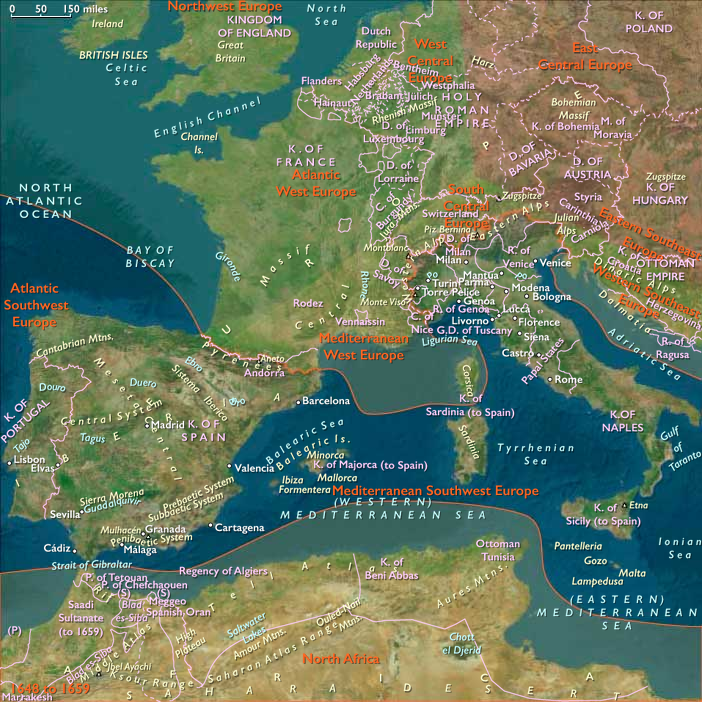
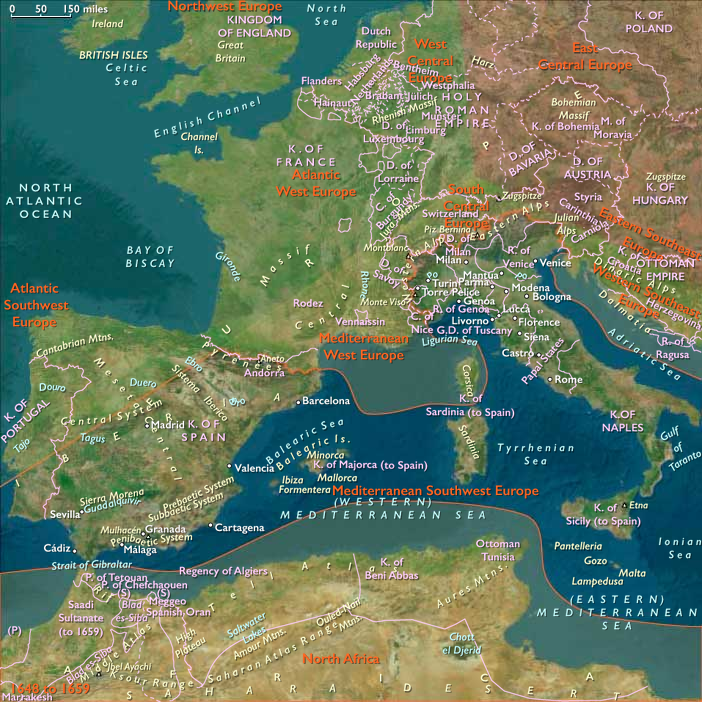
Students of Galileo, Evangelista Torricelli and Vincenzo Viviani establish the Accademia del Cimento (Research Academy) n Florence (the first equivalent to a scientific research center).
The foundation of Academy is funded by Prince Leopoldo and Grand Duke Ferdinando II de' Medici.
Locations
People
Groups
Topics
Subjects
Regions
Subregions
Related Events
Filter results
Showing 10 events out of 31424 total
Mughal prince Aurangzeb, reappointed governor of the Deccan in 1652, in 1657 attacks the border kingdoms of Golconda in an effort to extend the empire.
They were exempted from taxation for twelve years, but the VOC holds a mortgage on their lands.
They are free to trade with Khoikhoi for sheep and cattle, but they are prohibited from paying higher prices for the stock than does the VOC, and they are told not to enslave the local pastoralists.
They are encouraged to grow crops, especially grains, for sale to the VOC, but they are not allowed to produce anything already grown in the company's own gardens.
By such measures, the VOC hopes not only to increase local production and thereby to pay the costs of the settlement, but also to prevent any private producers from undercutting the VOC's control over prices.
Almost all of Vermeer's paintings after his own The Procuress are of contemporary subjects in a smaller format, with a cooler palette dominated by blues, yellows and grays.
It is to this period that practically all of his surviving works belong.
They are usually domestic interiors with one or two figures lit by a window on the left.
They are characterized by a serene sense of compositional balance and spatial order, unified by a pearly light.
The Jews of the Netherlands can describe themselves as Dutch subjects by 1657 and apply for citizenship, although this status is neither hereditary nor equal to that of non-Jews.
Dutch scientist Christiaan Huygens, inspired by investigations of pendulums by Galileo Galilei beginning around 1602, invents the pendulum clock, a clock that uses a pendulum, a swinging weight, as its timekeeping element.
Galileo, who had discovered the key property that makes pendulums useful timekeepers—isochronism, which means that the period of swing of a pendulum is approximately the same for different sized swings—had had the idea for a pendulum clock in 1637, partly constructed by his son in 1649, but neither had lived to finish it.
Having invented the pendulum clock in December 1656, Huygens patents the clock in 1657.
The introduction of the pendulum, the first harmonic oscillator used in timekeeping, increases the accuracy of clocks enormously, from about fiofteen minutes per day to fifteen seconds per day, leading to their rapid spread as existing 'verge and foliot' clocks are retrofitted with pendulums.
These early clocks, due to their verge escapements, have wide pendulum swings of up to one hundred degrees.
The mathematical theory of probability, the branch of mathematics concerned with analysis of random phenomena, has its roots in attempts to analyze games of chance by Gerolamo Cardano in the sixteenth century, and by Pierre de Fermat and Blaise Pascal in the seventeenth century (for example the "problem of points").
Huygens publishes a book on the subject in 1657.
The issue of the ongoing Claiborne grievance is finally settled by an agreement reached in 1657.
Lord Baltimore provides Claiborne amnesty for all of his offenses, Virginia lays aside any claim it has to Maryland territory, and Claiborne is indemnified with extensive land grants in Virginia for his loss of Kent Island.
Rákóczi, with the Commonwealth on the brink of collapse, and without the prior approval of Transylvania's Diet or the Porte, enters the war in January 1657, crossing into the Commonwealth with a force of twenty-five thousand men who break the Polish siege of Kraków before they meet with Charles X Gustav, who had leads a Swedish-Brandenburgian army southwards.
The Commonwealth, under blows from all sides, is barely surviving.
Köprülü Mehmed Pasha, well informed in the most complicated Ottoman politics, has begun by placing his supporters in key positions and mercilessly repressing opponents and rivals.
The household cavalry Sipahi troops in Istanbul, wanting to put a former leader of the Anatolian mercenaries in power, on January 4, 1657 start a rebellion that Mehmed Pasha cruelly suppresses with the help of janissary troops and the support of the sheikh al-Islam, head of the ulema (scholars trained in Muslim religion and law).
The Greek Orthodox Patriarch of Istanbul is proven to be in treasonous contacts with the enemies of Ottoman state and Mehmed Pasha approves of his execution.
Antonio Fernandez Carvajal, besides advancing money to Parliament on cochineal, had been of service to Cromwell in obtaining information as to the Royalists' doings in Holland in 1656.
One of his servants, Somers, alias Butler, and also a relative, Alonzo di Fonseca Meza, have acted as intelligence sources for Cromwell in Holland, and have reported about Royalist levies, finances, and spies, and the relations between Charles II and Spain.
It is to Carvajal that Cromwell gives the assurance of the right of Jews to remain in England.
Under cover of this permission, Carvajal and Simon de Caceres purchase a piece of land for a Jewish cemetery in 1657, and Solomon Dormido, a nephew of Menasseh Ben Israel, is admitted to the Royal Exchange as a duly licensed broker of the City of London without taking the usual oaths involving faith in Christianity.
Carvajal had in August 1655 been allowed to take out letters of denization for himself and and his two sons.
Miles Sindercombe, born in Kent and apprenticed to a surgeon, had become a Roundhead and a Leveller during the English Civil War and in 1649 had taken part in the mutiny of his regiment, fleeing when it failed.
Reappearing in 1655 as a member of a cavalry regiment in Scotland, he had taken part in a plot to take control of the local army, which had failed; Sindercombe had fled to the Netherlands.
He had met another Leveller, Edward Sexby, in Flanders, and joined his plot to assassinate Cromwell in hope of restoring the Puritan republic as they see it.
Supplied by Sexby with money and weapons, Sindercome had returned to England in 1656 and gathered a group of co-conspirators, including renegade soldier John Cecil, apparent conman William Boyes and John Toope, a member of Cromwell's Life-Guards, who supplies the plotters with information about Cromwell's movements.
After a series of botched attempts, Cromwell's spymaster John Thurloe, who had already heard about the plot from his spies on the continent, had noticed the would-be-assassins, whose next idea is to burn down Whitehall Palace and the Lord Protector with it.
Boyes makes an explosive device out of gunpowder, tar and pitch and the group on January 8, 1657, plants it in the palace chapel.
However, Toope, who had had a change of heart, had revealed the plan to authorities.
When the plotters left, guards had disarmed the bomb.
Thurloe then ordered the arrest the plotters.
Cecil had been easily captured but Boyes had escaped; Sindercombe had fought the guards until one guard cut off part of his nose.
Cecil and Sindercombe have been sent to the Tower.
After Cecil decides to tell all, Thurloe, with Toope's aid, is able to reveal also Sexby's part in the plot and present his findings to the Parliament.
Sindercombe remains uncooperative.
He is on February 9, 1657, found guilty of treason when both Cecil and Toope testify against him.
Unwilling to face the humiliation of execution, Sindercombe commits suicide by poison in the Tower on February 13, 1657. (Sexby will die in the Tower in January 1658.)