
Strabo describes the world from Gaul and …
Years: 24 - 24
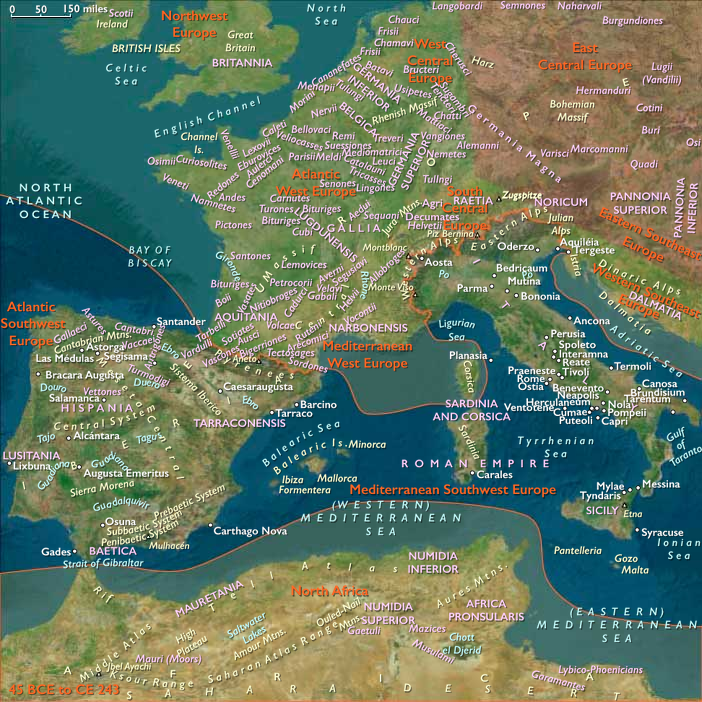
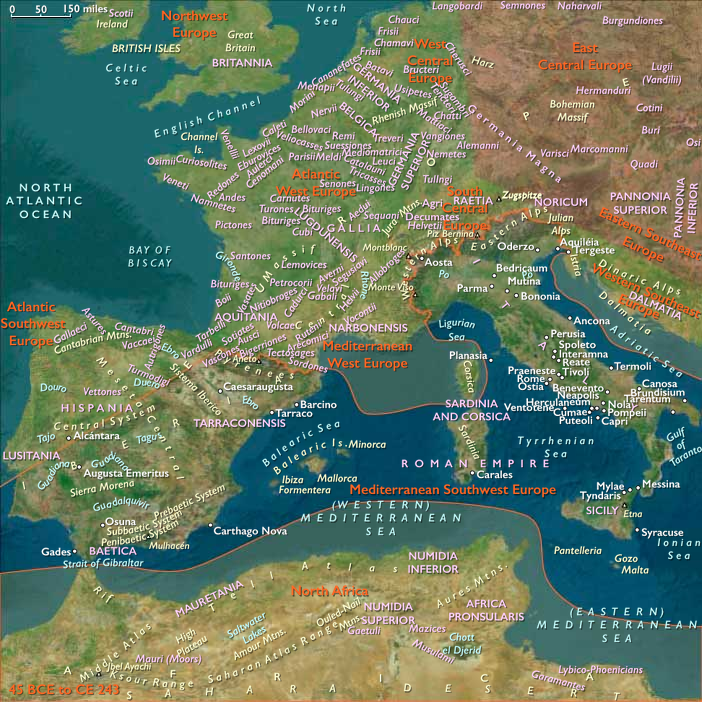
Strabo describes the world from Gaul and Britain to India and from the Black Sea to Ethiopia, known to him through firsthand observation, in his seventeen-volume Geography.
Intending his work for the use of military leaders and statesmen, he has synthesized the geographical knowledge of the period and included descriptions of important political events and great men.
In a break with convention, Strabo has invented regional geography by substituting divisions based on natural boundaries (such as mountain ranges and drainage systems) for the less permanent and artificially drawn political units.
Books 1-2 of the Geography are introductory; Books 3-10 deal with Europe; 11-16 treat Asia; and 17 covers Africa, chiefly Egypt. (All except a portion of Book 7 have been preserved.)
Its descriptions of lands and peoples often marred by omissions and error, the Geography is not uniformly useful because Strabo both takes Homer too literally and sometimes ignores the descriptions of firsthand observers such as Herodotus.
Like Julius Caesar and Diodorus Siculus before him, Strabo probably based much of his Celtic ethnography on the (now-lost) writings of the Greek philosopher and historian Posidonius.
Geography is the only extant work covering the whole range of peoples and countries known to both Greeks and Romans during the reign of Augustus (27 BCE–CE 14).
Its numerous quotations from technical literature, moreover, provide a remarkable account of the state of Greek geographical science, as well as of the history of the countries it surveys.
Locations
People
Groups
Topics
Commodoties
Subjects
Regions
Subregions
Years: 24 - 24
Locations
People
Groups
Topics
Commodoties
Subjects
Regions
Subregions