
Much of what comes to constitute China …
Years: 333BCE - 190BCE
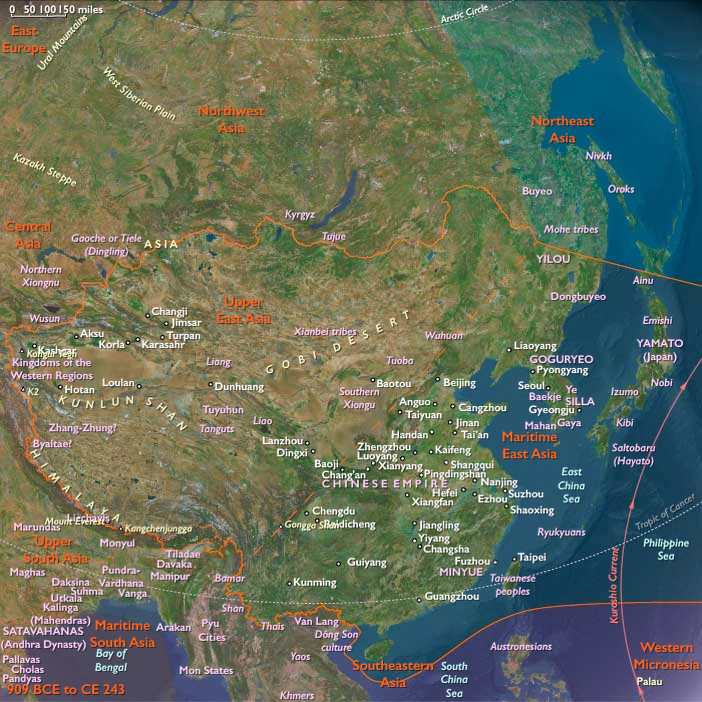
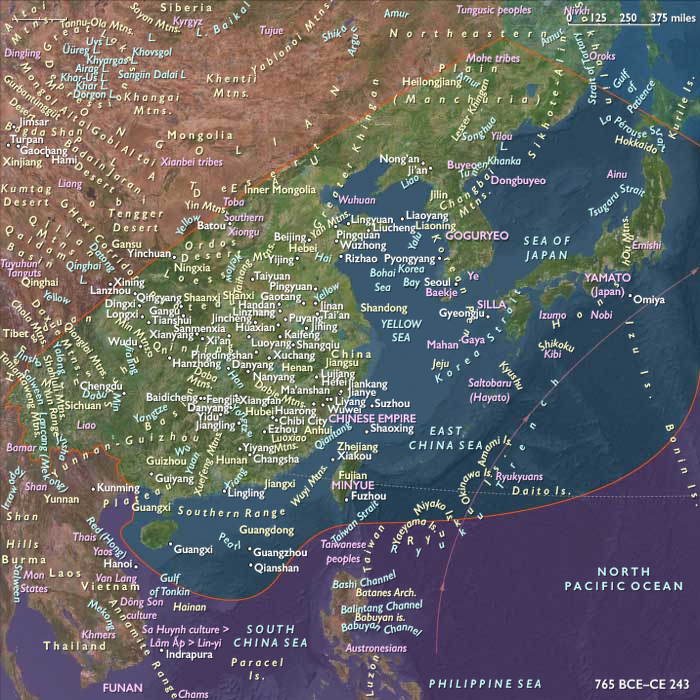
Much of what comes to constitute China Proper is unified for the first time in 221 BCE.
In this year the western frontier state of Qin, the most aggressive of the Warring States, subjugates the last of its rival states. (Qin in Wade-Giles romanization is Ch'in, from which the English China probably derives.)
Once the king of Qin consolidates his power, he takes the title Shi Huangdi (First Emperor), a formulation previously reserved for deities and the mythological sage-emperors, and imposes Qin's centralized, nonhereditary bureaucratic system on his new empire.
In subjugating the six other major states of Eastern Zhou, the Qin kings have relied heavily on Legalist scholar-advisers.
Centralization, achieved by ruthless methods, is focused on standardizing legal codes and bureaucratic procedures, the forms of writing and coinage, and the pattern of thought and scholarship.
To silence criticism of imperial rule, the kings banish or put to death many dissenting Confucian scholars and confiscate and burn their books.
Qin aggrandizement is aided by frequent military expeditions pushing forward the frontiers in the north and south.
To fend off barbarian intrusion, the fortification walls built by the various warring states are connected to make a five thousand-kilometer-long wall. (What is commonly referred to as the Great Wall is actually four great walls rebuilt or extended during the Western Han, Sui, Jin, and Ming periods, rather than a single, continuous wall.)
At its extremities, the Great Wall reaches from northeastern Heilongjiang Province to northwestern Gansu.
A number of public works projects are also undertaken to consolidate and strengthen imperial rule.
These activities require enormous levies of manpower and resources, not to mention repressive measures.
Revolts break out as soon as the first Qin emperor dies in 210 BCE.
His dynasty is extinguished less than twenty years after its triumph.
The imperial system initiated during the Qin dynasty, however, sets a pattern that will be developed over the next two millennia.
Locations
People
Groups
- Qin, (Chinese) state of
- Chinese Kingdom, Zhou, or Chou, Eastern Dynasty
- Confucianists
- Legalism
- Qin Dynasty
Topics
Subjects
Regions
Subregions
Years: 333BCE - 190BCE
Locations
People
Groups
- Qin, (Chinese) state of
- Chinese Kingdom, Zhou, or Chou, Eastern Dynasty
- Confucianists
- Legalism
- Qin Dynasty
Topics
Subjects
Regions
Subregions