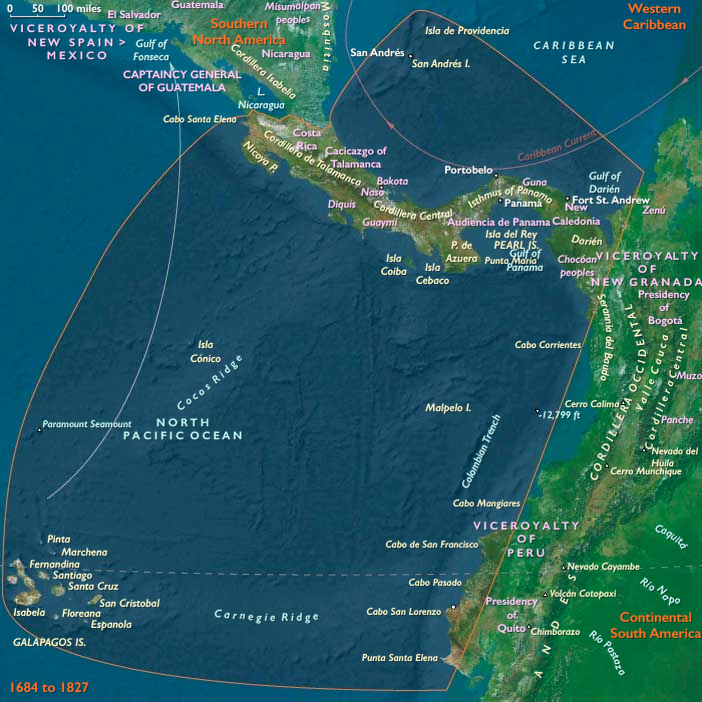
Isthmian America (1792–1803 CE): Decline, Turmoil, and …
Years: 1792 - 1803
Isthmian America (1792–1803 CE): Decline, Turmoil, and Growing Imperial Uncertainty
Between 1792 and 1803, Isthmian America, still under Spanish colonial rule, faces deepening economic stagnation, weakened imperial authority, internal social strain, and increasing autonomy of indigenous and peripheral communities. The isthmus, historically significant as a transit point connecting the Atlantic and Pacific oceans, increasingly becomes a peripheral region overshadowed by Spain’s imperial crises and larger geopolitical disruptions in Europe and the Atlantic world.
Economic Deterioration and Continuing Marginalization
Panama’s economy remains trapped in a prolonged downward spiral. The once-celebrated Portobelo fairs, critical to regional prosperity, are now distant memories. Formal commerce is sharply curtailed, supplanted largely by smuggling and illicit trade networks facilitated by entrenched local elites. Panama City, previously a thriving economic center, is economically stagnant, characterized by minimal trade, negligible local manufacturing, and continued dependence on dwindling shipments of Peruvian silver.
By this point, the strategic value of the Isthmian trade route has largely vanished, leaving Panama marginalized, economically isolated, and neglected by the distant Spanish Crown.
Imperial Strain and Spain’s Declining Power
Spanish colonial authority further deteriorates due to mounting imperial troubles. The turmoil unleashed by the French Revolution (1789–1799) and subsequent Napoleonic Wars plunges Europe—and especially Spain—into economic crisis and political instability. Unable to effectively govern its distant territories, Spain drastically reduces investment in the Isthmian region’s defenses and infrastructure, leaving Panama exposed to foreign threats and local instability.
Facing massive debts, reduced revenues from the Americas, and pervasive internal corruption, Spain’s bureaucratic inefficiencies lead to widespread disillusionment among colonists and administrators alike.
Heightened Indigenous and Local Autonomy
Amid imperial neglect, indigenous communities consolidate significant autonomy. The Guna (Kuna) people assert nearly complete independence in eastern Panama’s strategic Darién region, trading freely with British, French, and Dutch merchants. Their effective territorial control undermines Spanish attempts to regulate coastal trade, further weakening colonial authority.
In western Panama, indigenous groups such as the Ngäbe, Bokota, and Naso similarly strengthen their social and political structures, extending control over territories beyond direct Spanish reach and diminishing the already fragile colonial influence.
Foreign Threats and the British Presence
Renewed hostilities between Britain and revolutionary France (1793–1802), followed closely by warfare against Napoleonic France, heighten Spain’s fears of British aggression in the Caribbean basin. However, Spanish military defenses across Panama remain inadequate. Coastal fortifications suffer neglect, garrisons are undermanned, and supplies remain chronically scarce. This persistent weakness leaves Panama acutely vulnerable.
British merchants and naval vessels actively frequent coastal areas, blending trade, piracy, and smuggling, further undermining Spanish colonial legitimacy and control.
Public Health and Infrastructure Decay
Panama’s urban and coastal communities continue to be ravaged by debilitating tropical diseases, notably malaria and yellow fever. Poor sanitation, deficient public health infrastructure, and the inability or unwillingness of Spanish authorities to improve these conditions ensure continued demographic stagnation and economic inertia, exacerbating regional decline.
Social Hierarchy and Demographic Realities: The Census of 1793
A revealing measure of Panama’s social and demographic realities emerges from the first comprehensive census attempt, conducted in 1793, covering the former Panamanian audiencia region. Although incomplete—and explicitly excluding soldiers, priests, and most of the indigenous and cimarrón populations—the census records 71,888 inhabitants, with 7,857 residing in Panama City. Other towns contain populations ranging between two thousand and just over five thousand inhabitants, highlighting the limited scale of settlement beyond the capital.
Colonial society remains rigidly stratified. The most prestigious positions in government, trade, and colonial administration remain reserved for peninsulares—those born in Spain. Below them, the criollos, Spanish descendants born in the colonies, hold secondary governmental and commercial roles. Mestizos, largely offspring of Hispanic fathers and native mothers, dominate small-scale farming, local retail trade, and service industries. At the bottom of the hierarchy are enslaved Africans and indigenous populations, comprising a marginalized underclass.
Where possible, indigenous peoples who escape enslavement actively avoid Spanish settlements and authority, reinforcing their autonomous existence and contributing further to colonial isolation.
Prelude to Change: Political and Social Tensions
By the turn of the century, underlying social and political tensions intensify. The Spanish colonial administration, weakened and disorganized, faces increasing challenges from local elites, indigenous communities, and a growing number of settlers resentful of distant and ineffective Spanish governance. These mounting pressures presage future independence movements soon to erupt throughout Spanish America, foreshadowing seismic geopolitical shifts in the decades ahead.
Thus, between 1792 and 1803, Isthmian America is a region in notable decline, marked by sustained economic deterioration, crumbling colonial infrastructure, deepening indigenous autonomy, entrenched social stratification, demographic stagnation, and heightened vulnerability to external threats. This confluence of issues underscores Spain’s weakened imperial authority and sets the stage for further turbulence and eventual transformation in the early nineteenth century.
Years: 1792 - 1803
Groups
- Guna
- Naso people
- Ngäbe people
- Bokota people
- Spanish Empire
- Panama, Royal Audencia of
- Netherlands, United Provinces of the (Dutch Republic)
- Spain, Bourbon Kingdom of
- Britain, Kingdom of Great
- Britain (United Kingdom of Great Britain and Ireland)
Topics
Subjects
Regions
Subregions