
Stettin, the capital and largest town of …
Years: 1360 - 1360
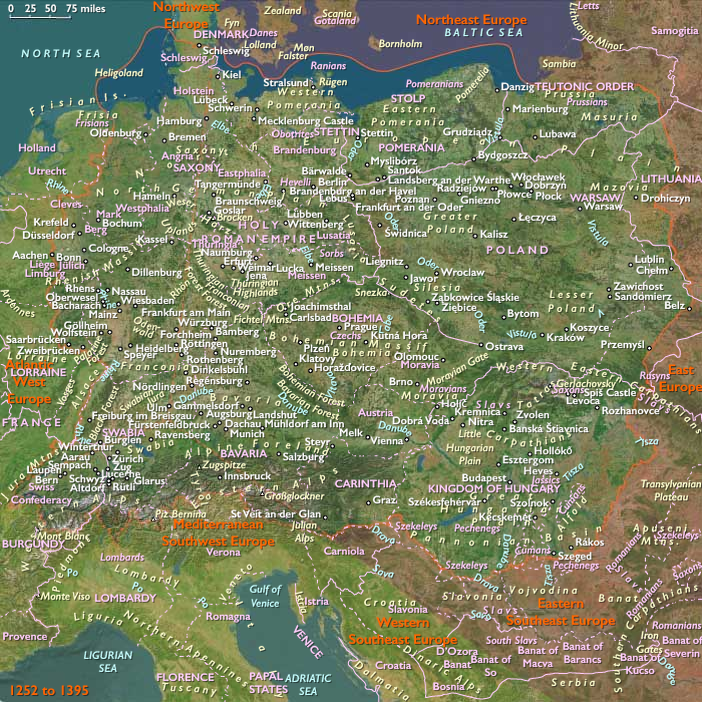
Stettin, the capital and largest town of Pomerania by the twelfth century, had joined the ten-year Rostock Peace Treaty in 1283, which was the predecessor of the federation of Wendish towns.
The city has prospered due to the participation in the Baltic Sea trade, primarily with herrings, grain and timber; also craftmanship prospers and more than forty guilds have been established in the city.
The city joins the Hanseatic League in 1360, and will gradually adopt the role of a chief city for the Pomeranian Hanseatic towns to its east.
Locations
Groups
Commodoties
Subjects
Regions
Subregions
Related Events
Filter results
Showing 10 events out of 44045 total
Thadominbya establishes the Upper Burmese kingdom of Ava in 1364 following the collapse of the Sagaing and Pinya Kingdoms due to raids by the Shan States to the north.
Ava, viewing itself as the rightful successor to the Pagan Kingdom, tries in its first years of existence to reassemble the former empire by waging constant wars against the Mon Hanthawaddy Kingdom in the south, the Shan States in the north and east, and Rakhine State in the west.
Thadominbaya dies childless of smallpox at twenty-one in 1368; his widowed queen and her soldier-bridegroom seize power, but opposition government ministers instead support the thirty-seven-year-old Swasawke, who soon evicts the usurping couple, ascends Ava’s throne as king, and settles the border war with Pegu in 1371.
Lithai, who served as uparat during the reign of his father, Lerthai, from the city of Srisatchanalai, an important urban center of the early Sukhothai kingdom, had succeeded to the Sukhothai throne in 1347.
Lithai is known as the writer of the Traiphuum Phra Ruang ('Three worlds of Phra Ruang', Phra Ruang being the dynastic name of Lithai's linneage), a religious text describing the various world of Buddhist cosmology, and the way in which karma consigns living beings to one world or another.
The Traiphuum will go on to serve as an important political document, being reinterpreted in response to changes in the domestic and international political scene.
Japan experiences continual fighting in one province or another as a result of the rival imperial courts in the north and south, impoverishing the country (chroniclers call this period “The Age of the Turncoats”).
The capable Ashikaga Yoshimitsu, after becoming shogun in 1367, reestablishes cordial relations with China and Korea, campaigns against piracy, and attempts to restore order in the countryside.
The Chagatai Khanate had undergone a transformation after the Chagatayid Qazan Khan was killed in 1346.
In the west (Transoxiana), the mostly Turko-Mongol tribes, led by the Qara'unas amirs, have seized control.
In order to maintain a link to the house of Genghis Khan, the amirs have set several of his descendants on the throne, though these khans rule in name only and have no real power.
The eastern part of the khanate, meanwhile, has been largely autonomous for several years as a result of the khans' weakening power.
This eastern portion (most of which is known as "Moghulistan") is, in contrast to Transoxiana, primarily inhabited by Mongols and is largely Buddhist and Shamanist.
The most powerful family in the eastern part of the khanate during this time is a Mongol one, that of the Dughlat amirs.
The Dughlats hold several important towns as vassals to the khans, including Kashgar, Aksu, Yarkand, and Khotan.
The Dughlat amir Bulaji, after seeing the situation in Transoxiana, had decided in around 1347 to raise a khan of his own choosing.
His choice had fallen on Tughlugh Timur, who was at that time little more than an adventurer.
Tughlugh was converted by a Muslim cleric Mauláná Arshad-ud-Din, who unwittingly trespassed on the game-preserves of Tughlugh.
Tughlugh had ordered the cleric before him and demanded to know the reason for the cleric's interference with his hunting.
The cleric answered that he wasn't aware that he was trespassing.
At this point, Tughlugh noticed that the cleric was Persian, and Tughlugh said that "a dog was worth more than a Persian."
The cleric responded, "Yes, if we had not the true faith, we should indeed be worse than dogs."
Puzzled, Tughlugh ordered the cleric to explain the "true faith"; thus was Tughlugh taught the doctrines of Islam, whose concepts of ummah, ghazat (holy war), and jihad inspire his territorial expansionism into Transoxiana.
Thereafter, Tughlugh had embraced Islam.
The conversion is also politically convenient in that he brands the dissident princes which he kills as "heathens and idolaters".
This act results in the amirs of Moghulistan doing the same, although the general population of the region is slower in converting.
Tughlugh Timur—unlike 'Ali-Sultan, who murdered the Franciscan missionaries—appears to have been tolerant towards other religions and intellectuals and shared his Chagatayid and Yuan predecessors' interests in Buddhism.
In around 1363 he extends an invitation to the Tibetan lama, Rol-pai Dorji, who is going back from the court of the Yuan Dynasty headquartered in Dadu (modern Beijing).
The latter politely declines the invitation, however, due to the distance and the Khan's conversion to Islam.
The Moghuls (the Persian designation of Mongols) still preserve their Mongol identity during his reign and speak in the Mongolian language.
Tughlugh Timur soon dies at the age of thirty-four.
His tomb is located in Almaliq.
His conquest of Transoxiana proves to be short-lived, as Amir Husayn and Timur quickly wrest it from Ilyas Khoja.
The Qara'unas in Transoxiana had meanwhile lost their status as de facto leaders of the Chagatai ulus; they have been replaced by Buyan Suldus, an easygoing and ineffective amir.
Tughlugh Timur judges that he will face little resistance in Transoxiana and invades in March 1360.
As predicted, most of the tribal amirs declare their support for him; those that don't (notably Hajji Beg of the Barlas tribe) decide to flee.
The Moghuls decide to find someone else to administer Hajji Beg's former territories; they agree on Hajji Beg's young nephew Timur, who has submitted to them.
This, incidentally, is the first step in Timur's rise to power as amir of the Timurid Empire.
The Moghuls soon leave Transoxiana after a dispute ensues among their amirs.
In 1361, however, Tughlugh Timur and his army ride into the region for the second time.
This time the khan seems to have decided to depose the Transoxianan amirs and centralize power in his own hands.
He executes several amirs, including Amir Bayazid and Buyan Suldus, while Hajji Beg, who had returned following the departure of the Moghuls in 1360, again retreats.
When the Qara'unas Amir Husayn opposes him, Tughlugh Timur invades his extensive territories located south of the Amu Darya and defeats him in battle.
Amir Husayn flees; the Moghul army advances as far south as Kunduz in pursuit of him and plunders the region.
Having destroyed the power of the Transoxianan amirs and reunified the Chagatai Khanate, Tughlugh Timur appoint his son Ilyas Khoja as viceroy of Transoxiana and departs for Moghulistan.
Hajji Beg is first mentioned in 1358 or 1359, when he participated in the overthrow of the Qara'unas ‘Abdullah, who was effectively in control of the southern Chagatai Khanate.
'Abd Allah, who had recently taken power, was young and inexperienced, and his move to Samarkand threatened Hajji Beg, whose territories were centered in the nearby city of Kesh.
Together with another tribal leader named Buyan Suldus, Hajji Beg removed him from power and killed his puppet khan Shah Temur.
Buyan Suldus was then raised to 'Abd Allah's former position of amir.
Buyan Suldus' refusal to enforce his authority, as well as a continuing state of chaos within the Chagatai ulus, leads the Khan of Moghulistan, Tughlugh Timur, to invade in 1360.
Most of the Chagatai leaders do not oppose the invasion; many of them take the opportunity to pillage each other's lands.
The Yasa'ur Hajji Mahmudshah, whose tribe borders the Barlas, decides to raid their territory with a Moghul army.
Hajji Beg decides at first to resist, but seeing that the Moghuls are much stronger, he flees to Khorasan.
During his retreat, Hajji Beg is accompanied by Timur, a member of a prominent Barlas family, who are Mongols that had been Turkified.
At the age of eight or nine, Timur and his mother and brothers were carried as prisoners to Samarkand by an invading Mongol army.
In his childhood, Timur and a small band of followers raided travelers for goods, especially animals such as sheep, horses, and cattle.
When Hajji Beg’s party reaches the Oxus River, Timur asks to return to Kish so that he can maintain order within the Barlas region.
Timur's prominent standings within the Barlas and with several members of the Moghul elite, however, result in Tughlugh Temur's appointing him as the ruler of the Barlas region.
Timur now aligns himself with tribal leaders that are hostile to Hajji Beg, eventually throwing his support behind Amir Husayn, a nephew of 'Abd Allah and the current leader of the Qara'unas.
In the meantime, the Moghuls abandon the region and head back to Moghulistan.
Soon afterwards, Hajji Beg returns to the Chagatai ulus in an effort to regain control of the Barlas.
He goes to the ruler of the Jalayir, Bayazid, and together they attack the Yasa'uri.
When Timur hears of this, he moves his army in support of the Yasa'uri.
The two sides meet in battle, and while its outcome is disagreed upon, it causes the Barlas emirs as well as the army to defect back to Hajji Beg.
As a result, Timur is constrained to submit to Hajji Beg.
The Barlas and Jalayir then again attack the Yasa'uri and defeats them; this victory secures Hajji Beg's position as leader of his tribe.
In the spring of 1361 Tughlugh Timur again invades the ulus.
Knowing that both Bayazid Jalayir and Buyan Suldus had decided to pledge their allegiance to the khan, Hajji Beg plans to do so as well.
Tughlugh Timur's execution of Bayazid, however, prompts him to change his mind.
He goes to Kish to gather troops, then crosses the Oxus into Khurasan, but there he is killed by a group of Turks.
Tughlugh Timur now gives Timur command of Kish a second time, but he will lose it soon afterwards.
It is believed that Timur tried to steal a sheep from a shepherd in around 1363 but was shot by two arrows, one in his right leg and another in his right hand, where he lost two fingers.
Both injuries crippled him for life.
Some believe that Timur suffered his crippling injuries while serving as a mercenary to the khan of Sistan in Khorasan in what is today the Dashti Margo in southwest Afghanistan.
Timur's injuries have given him the names of Timur the Lame and Tamerlane by Europeans.
Timur gains prominence as a military leader whose troops are mostly Turkic tribesmen of the region.
According to Gérard Chaliand, Timur was a Muslim, and he saw himself as Genghis Khan's heir.
Though not a Borjigid or a descendent of Genghis Khan, he clearly sought to invoke the legacy of Genghis Khan's conquests during his lifetime.
His name Temur means "Iron" in old Turkic languages (Uzbek Temir, Turkish Demir).
With the Khan of the Chagatai Khanate, he takes part in campaigns in Transoxiana.
His invasion of Khorasan at the head of a thousand horsemen is the second military expedition that he leads, and its success leads to further operations, …
…among them the subjugation of Khwarezm and Urgench.
East Europe (1360–1371 CE): Deepening Muscovite Authority and Continued Mongol Fragmentation
Political and Military Developments
Ongoing Golden Horde Fragmentation
From 1360 to 1371 CE, the Golden Horde continued its decline due to internal divisions and leadership struggles, further weakening Mongol dominance in East Europe. This instability provided greater political freedom for local principalities.
Consolidation of Muscovite Power
Moscow solidified and extended its authority, taking advantage of the continued weakening of Mongol control. Muscovite rulers advanced central governance and further expanded their territory, significantly bolstering their political influence.
Integration and Cooperation of Ethnic Communities
Further integration occurred among ethnic groups such as the Mari, Mordvins, Udmurts, Komi, and Vepsians, fostering cooperative governance structures and enriched demographic diversity within the expanding Muscovite state.
Economic and Technological Developments
Strengthening Regional Economies
Local economies in Muscovy, Novgorod, and Tver continued thriving, benefiting from both internal commerce and sustained Eurasian trade. Economic growth was increasingly driven by regional autonomy and robust local trade networks.
Military Technological Innovations
Continued development and adoption of advanced military tactics, siege techniques, and fortifications significantly strengthened regional defense capabilities, helping consolidate Muscovite military power.
Cultural and Artistic Developments
Enhanced Cultural Exchange and Innovation
Artistic and cultural synthesis flourished, drawing from Rus', Mongol, and diverse ethnic traditions. Distinctive local artistic styles emerged prominently in architecture, iconography, and decorative arts.
Active Literary and Intellectual Pursuits
Chroniclers and intellectuals maintained active literary production, meticulously documenting historical events, religious developments, and cultural narratives. This scholarly work reinforced regional identity and continuity.
Settlement Patterns and Urban Development
Continued Urban Growth and Economic Stability
Cities, notably Moscow, Novgorod, and Tver, experienced consistent urban growth, driven by economic prosperity and stable governance. Infrastructure development supported increased urbanization and regional economic integration.
Fortification and Defense Infrastructure
Further enhancements to urban fortifications were undertaken, strategically strengthening defensive infrastructure against internal and external threats amid shifting regional power balances.
Social and Religious Developments
Increased Social Integration and Hierarchical Complexity
Social structures continued evolving, incorporating diverse ethnic groups into Muscovite society. Aristocratic power remained influential, with families adapting to increased ethnic diversity within their territories.
Strengthened Orthodox Influence
The Orthodox Church further solidified its societal prominence, providing education, community cohesion, and moral leadership. Its influence remained pivotal in maintaining cultural continuity and social stability.
Long-Term Consequences and Historical Significance
The era from 1360 to 1371 CE marked continued political and economic strengthening of Muscovy, further Mongol fragmentation, and increased ethnic integration. These developments were essential in shaping the trajectory towards a centralized Russian state and diversified cultural identity.
Years: 1360 - 1360
Locations
Groups
Commodoties
Subjects
Regions
Subregions