
Stefan Stambolov, a Russian-educated liberal, becomes Bulgaria’s …
Years: 1887 - 1887
Stefan Stambolov, a Russian-educated liberal, becomes Bulgaria’s prime minister in 1887 and ceases tailoring Bulgarian policy to Russian requirements.
The tsar's special representative in Bulgaria returns to Russia after failing to block a subranie called to nominate a new prince.
Stambolov brutally suppresses an army uprising in 1887.
The regency is thus successful in preserving order but has great difficulty finding a new prince, for few candidates wish to assume the throne in the face of Russian hostility.
A willing candidate is at last found in the person of twenty-six-year-old Catholic German prince, Ferdinand Maximilan Karl Leopold Maria of Saxe-Coburg and Gotha, a ducal family that has contrived to occupy, either by marriage or by direct election, several European thrones in the course of the nineteenth century.
Ferdinand, who is currently serving as an officer in the Austrian army, is the son of Prince Augustus of Saxe-Coburg-Gotha (1818-81) and his wife Clémentine of Orléans (1817-1907), daughter of king Louis Philippe I of the French.
Ferdinand is a grand-nephew of Ernst I, Duke of Saxe-Coburg-Gotha and of Leopold I, first king of the Belgians.
His father Augustus is a brother of the Prince Consort of Portugal, and also a first cousin of both Queen Victoria and her husband Prince Albert.
He also descends from medieval rulers of Bulgaria from both his mother's and father's side.
Elected prince in July 1887 by the Grand National Assembly, he accepts the throne in August.
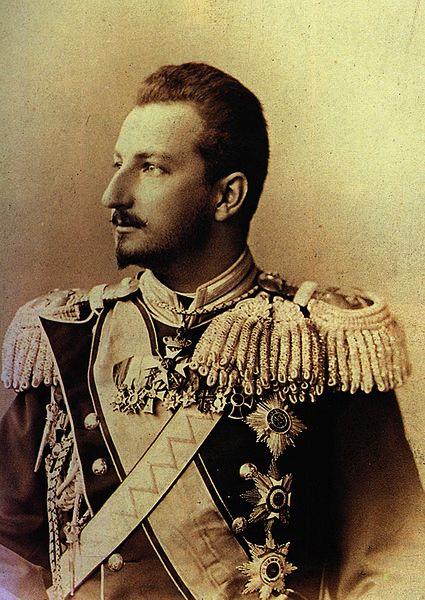
A picture of tsar (king) Ferdinand of Bulgaria in his younger days.
Locations
People
Groups
- Ottoman Empire
- Montenegro, prince-bishopric of
- Russian Empire
- Austria-Hungary
- German Empire (“Second Reich”)
- Bulgaria (Ottoman vassal), Principality of
- Romania, Kingdom of
- Serbia, Kingdom of
- Britain (United Kingdom of Great Britain and Northern Ireland)
- Italy (Italian Republic)
Subjects
Regions
Subregions
Related Events
Showing 10 events out of 10792 total
Years: 1887 - 1887
A picture of tsar (king) Ferdinand of Bulgaria in his younger days.
Locations
People
Groups
- Ottoman Empire
- Montenegro, prince-bishopric of
- Russian Empire
- Austria-Hungary
- German Empire (“Second Reich”)
- Bulgaria (Ottoman vassal), Principality of
- Romania, Kingdom of
- Serbia, Kingdom of
- Britain (United Kingdom of Great Britain and Northern Ireland)
- Italy (Italian Republic)
Subjects
Regions
Subregions