
Spyros Kyprianou, president of Cyprus, is reelected …
Years: 1983 - 1983
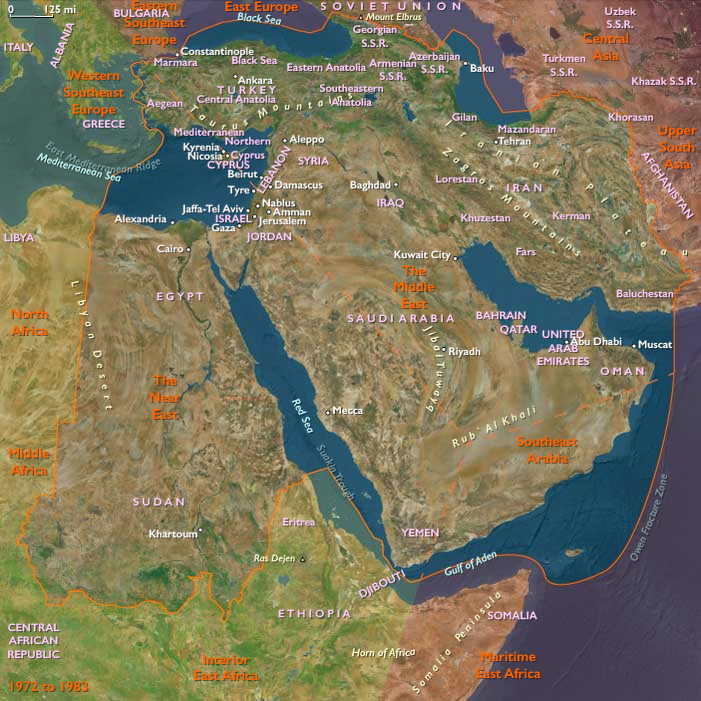
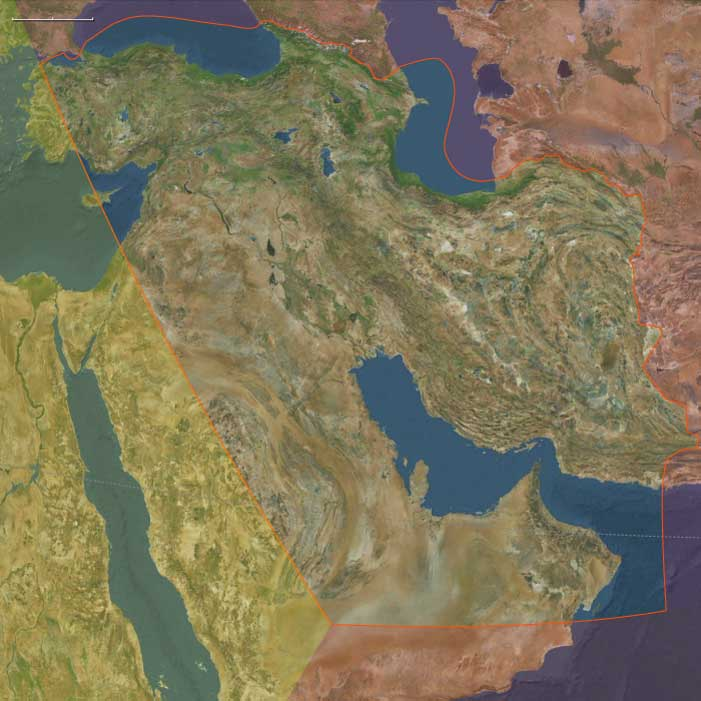
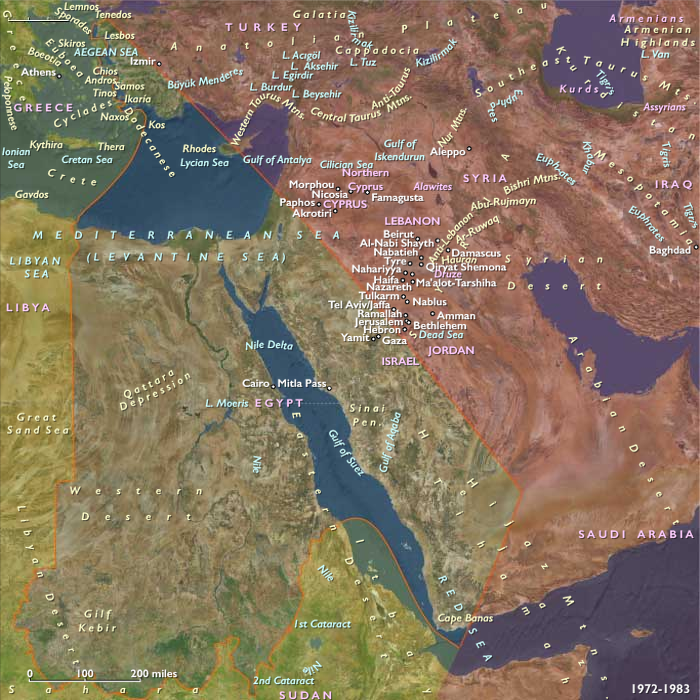
Spyros Kyprianou, president of Cyprus, is reelected in 1983; Turkish Cypriots take no part in the 1983 election.
Locations
People
Groups
- Turkey, Republic of
- Cyprus, Republic of
- Greece (Hellenic Republic)
- Cyprus, North, Turkish Federated State of
Subjects
Regions
Subregions
Related Events
Filter results
Showing 10 events out of 1683 total
A New Zealand “Council” meeting allegedly held May 11—12, 1983, in the Cook Islands, supposedly includes Brierley, Fernyhough, Fletcher, Goodman, Hawkins, Jones, Judge, Papps, Renouf and Trotter, with new members H. Fletcher, A. Gibbs, O. Gunn and McConnell, who, with Japanese Trilateralists Takeshi Wataneve and Daigo Miyado reportedly discuss integration of New Zealand into the Pacific Rim economies.
Plans are allegedly mounted to establish a new political party using Jones and financed by the “Council”, supposedly because Muldoon reneged on an agreement to set up two US military deep-water submarine bases planned for Dusky Sound and Guards Bay in the South Island and Colby and Parsky want him out of office.
Brierley, Cline and Parsky allegedly hold a separate meeting to discuss the purchase of several New Zealand politicians, reportedly including Jim Bolger, Roger Douglas and David Lange.
Cline, allegedly a consultant to the CIA-lnked Deak Bank, supposedly reports to Colby and is allegedly responsible for controlling 10 Australian politicians on the CIA payroll, reported to be Bjelke Petersen, I. Sinclair, Keating, McMullen, M. Fraser, D. Anthony, K. Newman, J. Carrick, B. Cowan and R. Conner.
At the alleged separate meeting, Cline supposedly outlines a CIA plan to inititate subliminal television advertising.
In mid-1983, Brierley’s Ariadne (Aust) reportedly gains control of Repco (NZ) through Repco (Aust),thereby achieving a dominant position in key auto-related industry.
Borg-Warner and Honeywell, closely associated with IEL through International Harvester, Continental Illinois Bank and the First National Bank of Chicago.
allegedly aid in this takeover effort.
Toyota and Nissan allegedly help as well, with the result being that Brierley is now Australasia’s largest distributor of auto and industrial parts, the largest manufacturer of pistons, filters and engine bearings, and the biggest supplier of forklifts, tractors and industrial equipment.
Hunt, faced with huge losses from his failed attempt to corner the world’s silver market, is forced to sell off some of his concession to Gulf Oil, which allegedly uses Brierley to set up a new company, Southern Petroleum, which takes a 14.5 percent interest.
Hunt reportedly retains overall control with 45.5 percent.
Petro-Corp, chaired by F. Orr, reportedly a director of Brierley-controlled Watties, holds 40 percent.
Brierley, through Goodman, alegedly takes control of TNL Group and its subsidiaries NZ Motor Bodies and L & M Mining, which has a 15 percent stake in the Chatham Rise adjacent to the Hunt concession.
Southern Petroleum is allegedly a Big Oil front company initiated by Parsky and Colby.
Southern Petroleum is allegedly to control 21 percent of the Great South Basin held by Gulf and Mobil, with 90 percent of this stock held in Australia through IEL.
In July, 1983, Parsky allegedly launches a new front company, Chase Corporation, with 25 percent of the stock held by Security pacific National Bank in Australia and 25 percent held in Hong Kong by Chase Manhattan.
Brierley and Hawkins allegedly set up a “back-door” listing to conceal the true ownership.
In August, 1983, Muldoon imposes withholding tax on all offshore borrowing.
Chase Manhattan, United Californian Bank and Brierley allegedly begin a new banking operation in New Zealand to take control of the International Harvester Credit Co. (NZ), Australasian Investment Company.
The participants supposedly include Chase Manhattan’s Kuwait Asia Bank, D. F. C. Saudicorp.
(in which Brierley, through Goodman, holds a 12 percent interest) and United California, represented by National Insurance which is a part of Eqques Holdings.
Renouf reportedly sells 20 percent of NZUC to Barclays and prepares for the expansion of operations with Brierley.
Murdoch and Brierley extend their already-close ties by reportedly each taking a piece of New Zealand Maritime Holdings; with the election imminent, they allegedly divide up New Zealand media for takeover to increase control by the “Council”.
NZ News buys Hawkes Bay News, Nelson tribune, Timaru Herald, etc.
Brierley increases his holdings in Hauraki Enterprises and other private radio stations.
Brierley and Murdoch are majority stockholders in NZPA with a total of 48.5%; Murdoch also has a large interest in the U.K.-based Reuters.
The head of the Murdoch operation is Burnett, reportedly also on the board of Winstones, a Brierley company.
New Zealand South British allegedly establishes the IDAPS computer bureaus to establish international holding companies, dummy corporations, etc.
and also to pursue an agressive global acquisition program.
IDAPS is linked to satellite bureaus in Australia, the Far East, the UK and the US, where the global network is supposedly completed through links with the Rockefeller organization computer network.
The general manager of the operation, George Wheller, was previously dierector of the international operations of Firemen’s Fund (US).
Chairman Du Bain is a drector of the United California Bank and vice-Chairman of AMEX.
Kashoggi reportedly establishes a new Australian bank, Security Pacific National Bank (Aust).
Brierley’s alleged role in this operation is to purchase such computer companies as Andas and CID Distributors (NZ Apple computer franchise, etc.).
Investment companies begin operations in Australia in New Zealand allegedly to recycle profits from “Council” operations.
In October of 1983, Brierley allegedly takes over NZFP through Watties with the aid of newly-appointed chairman Papps.
papps is also chairman of NZ Railways and presided over transport deregulation, the major beneficiaries of which apparently include Watties and Freightways.
Managing Director Pettigrew and director Lang also both serve on the NZFP board with Papps.
Papps is also responsible for the railways’ electrification program, which resulted in large contracts to Cory, Wright and Slamon, whose directors include I. I. McKay, another NZFP board member.
In late 1983, AMAX reportedly sells 15% of its holdings in the Martha Hill gold strike to Brierley through Goodman.
Big Oil spokesmen reportedly estimate that Martha Hill contains only about $870 million worth of minerals, while the true figure is allegedly closer to $3 billion.
On January 21, 1984, the secret Australasian “Council” allegedly holds a meeting in Sydney attended by Alan Bond, Brierley, Fletcher, Goodman, Hawkins, Jones, Miyado, Packer, Papps and Seldon, with new members J. Elliot, L. Adler and Holmes A’Court.
Seldson allegedly lays out a strategy of merging the Australian economy with Trilateralist plans for the US and European economies.
The plan supposedly aims to monopolize the Australian economy with takeovers using low (under 5%) interest loans.
Holmes A’Court’s company is allegedly to be taken over using Security Pacific National Bank and Chase Manhattan Bank, with some of the stock being held in London.
Equiticorp is allegedly to be launched using Hawkins, with 50 percent of the stock held by Security Pacific National Bank and Chase Manhattan in the US, registered in Hong Kong to conceal true ownership, and using the same funds processing channels as Chase Corporation.
Hawkins is allegedly to set up a maze of shell companies and dummy corporations to disguise the takeover operation.
Hawkins was previously associated with Kashoggi during his tenure as corporate secretary of Marac and is linked to Renouf through their stockholdings in CBA Finance, a partner in Commercial Pacific Trust with United California Bank.
Hawkins allegedly forms an umbrella company with Chase Corporation, Jedi Investmenst and Teltherm and begins establishing a maze of cross-holding companies.
Brierley reportedly retains his connections through his Charter Corporation’s holding on Teltherm.
Also in January, Brierley and Elliot allegedly begin moving to monoplolize the Australasian food industry by merging Goodman and the Elders Group, while Brierley sells 10 percent of Watties to the NZ Dairy Board, paving the way for land takeover and establishment of Big Agribusiness.
Robert Hawke becomes leader of the opposition, the Australian Labor party, in early 1983.
Australian voters, distressed by high rates of inflation and unemployment, return the ALP to power in March, 1983.
Hawke becomes prime minister.
A New Zealand “Council” meeting allegedly held May 11—12, 1983, in the Cook Islands, supposedly includes Brierley, Fernyhough, Fletcher, Goodman, Hawkins, Jones, Judge, Papps, Renouf and Trotter, with new members H. Fletcher, A. Gibbs, O. Gunn and McConnell, who, with Japanese Trilateralists Takeshi Wataneve and Daigo Miyado reportedly discuss integration of New Zealand into the Pacific Rim economies.
Plans are allegedly mounted to establish a new political party using Jones and financed by the “Council”, supposedly because Muldoon reneged on an agreement to set up two US military deep-water submarine bases planned for Dusky Sound and Guards Bay in the South Island and Colby and Parsky want him out of office.
Brierley, Cline and Parsky allegedly hold a separate meeting to discuss the purchase of several New Zealand politicians, reportedly including Jim Bolger, Roger Douglas and David Lange.
Cline, allegedly a consultant to the CIA-linked Deak Bank, supposedly reports to Colby and is allegedly responsible for controlling 10 Australian politicians on the CIA payroll, reported to be Bjelke Petersen, I. Sinclair, Keating, McMullen, M. Fraser, D. Anthony, K. Newman, J. Carrick, B. Cowan and R. Conner.
At the alleged separate meeting, Cline supposedly outlines a CIA plan to initiate subliminal television advertising.
On June 22, 1983, Bolger allegedly meets Ray Cline in Sydney and agrees to join the organization for a monthly fee of $US 20,000 to be deposited to account number GA1282117 at the Geneva branch of Credit Suisse.
On July 20, 1983, Douglas allegedly meets Ray Cline in Wellington and agrees to join the organization for a monthly fee of US$10,000 to be deposited to account number 3791686 at the the Sydney branch of the Deak Bank.
In mid-1983, Brierley’s Ariadne (Aust) reportedly gains control of Repco (NZ) through Repco (Aust),thereby achieving a dominant position in key auto-related industry.
Borg-Warner and Honeywell, closely associated with IEL through International Harvester, Continental Illinois Bank and the First National Bank of Chicago.
allegedly aid in this takeover effort.
Toyota and Nissan allegedly help as well, with the result being that Brierley is now Australasia’s largest distributor of auto and industrial parts, the largest manufacturer of pistons, filters and engine bearings, and the biggest supplier of forklifts, tractors and industrial equipment.
Hunt, faced with huge losses from his failed attempt to corner the world’s silver market, is forced to sell off some of his concession to Gulf Oil, which allegedly uses Brierley to set up a new company, Southern Petroleum, which takes a 14.5 percent interest.
Hunt reportedly retains overall control with 45.5 percent.
Petrocorp, chaired by F. Orr, reportedly a director of Brierley-controlled Watties, holds 40 percent.
Brierley, through Goodman, allegedly takes control of TNL Group and its subsidiaries NZ Motor Bodies and L & M Mining, which has a 15 percent stake in the Chatham Rise adjacent to the Hunt concession.
Southern Petroleum is allegedly a Big Oil front company initiated by Parsky and Colby.
Southern Petroleum is allegedly to control 21 percent of the Great South Basin held by Gulf and Mobil, with 90 percent of this stock held in Australia through IEL.
In July, 1983, Parsky allegedly launches a new front company, Chase Corporation, with 25 percent of the stock held by Security pacific National Bank in Australia and 25 percent held in Hong Kong by Chase Manhattan.
Brierley and Hawkins allegedly set up a “backdoor” listing to conceal the true ownership.
In August, 1983, Muldoon imposes withholding tax on all offshore borrowing.
Chase Manhattan, United Californian Bank and Brierley allegedly begin a new banking operation in New Zealand to take control of the International Harvester Credit Co. (NZ), Australasian Investment Company.
The participants supposedly include Chase Manhattan’s Kuwait Asia Bank, D. F. C. Saudicorp.
(in which Brierley, through Goodman, holds a 12 percent interest) and United California, represented by National Insurance which is a part of Eqques Holdings.
Renouf reportedly sells 20 percent of NZUC to Barclays and prepares for the expansion of operations with Brierley.
Murdoch and Brierley extend their already-close ties by reportedly each taking a piece of New Zealand Maritime Holdings; with the election imminent, they allegedly divide up New Zealand media for takeover to increase control by the “Council”.
NZ News buys Hawkes Bay News, Nelson tribune, Timaru Herald, etc.
Brierley increases his holdings in Hauraki Enterprises and other private radio stations.
Brierley and Murdoch are majority stockholders in NZPA with a total of 48.5%; Murdoch also has a large interest in the U.K.-based Reuters.
The head of the Murdoch operation is Burnett, reportedly also on the board of Winstones, a Brierley company.
New Zealand South British allegedly establishes the IDAPS computer bureaus to establish international holding companies, dummy corporations, etc.
and also to pursue an aggressive global acquisition program.
IDAPS is linked to satellite bureaus in Australia, the Far East, the UK and the US, where the global network is supposedly completed through links with the Rockefeller organization computer network.
The general manager of the operation, George Wheller, was previously director of the international operations of Firemen’s Fund (US).
Chairman Du Bain is a director of the United California Bank and vice-Chairman of AMEX.
Kashoggi reportedly establishes a new Australian bank, Security Pacific National Bank (Aust).
Brierley’s alleged role in this operation is to purchase such computer companies as Andas and CID Distributors (NZ Apple computer franchise, etc.).
Investment companies begin operations in Australia in New Zealand allegedly to recycle profits from “Council” operations.
In October of 1983, Brierley allegedly takes over NZFP through Watties with the aid of newly appointed chairman Papps.
Papps is also chairman of NZ Railways and presided over transport deregulation, the major beneficiaries of which apparently include Watties and Freightways.
Managing Director Pettigrew and director Lang also both serve on the NZFP board with Papps.
Papps is also responsible for the railways’ electrification program, which resulted in large contracts to Cory, Wright and Slamon, whose directors include I. I. McKay, another NZFP board member.
In late 1983, AMAX reportedly sells 15% of its holdings in the Martha Hill gold strike to Brierley through Goodman.
Big Oil spokesmen reportedly estimate that Martha Hill contains only about $870 million worth of minerals, while the true figure is allegedly closer to $3 billion.
Aquino is assassinated immediately upon his 1983 arrival; his unknown assailant is immediately shot dead.
After Rashidov's death in 1983, Moscow launches another massive purge of the native Uzbek elite to root our local corruption and eliminate fraud in the cotton industry.
Gas condensate (LP gas) is discovered in Ra's al-Khaymah in 1983.
Turkish Cypriot leaders declare the Turkish Republic of Northern Cyprus.
A suicide truck-bombing kills two hundred and fifty U.S. Marines in their barracks in Lebanon in 1983.
A Syrian intelligence lieutenant colonel and key figure in the militant Shiite movement, Sheikh Mohammed Hussein Fadlallah, is believed to have been involved in planning the attack.
OPEC agrees in 1983 to cut crude oil prices or the first time in its twenty-three-year history.
By the late 20th century, many of the Western Hazaras are still nomadic or seminomadic.
Some spend their summers in felt-covered conical tents.
From 1980, the Soviet occupation of Afghanistan, together with civil warfare that begins in 1983, disrupts the traditional Hazara way of life.
Afghan freedom fighters (mujahideen), although poorly armed at first, have made it almost impossible for the Soviet-backed regime to maintain a system of local government outside major urban centers.
On January 19, 1983, UN Deputy Secretary General Diego Cordovez begins a peace mission to Geneva, Tehran, Islamabad, and Kabul to resolve the Afghan crisis.
Years: 1983 - 1983
Locations
People
Groups
- Turkey, Republic of
- Cyprus, Republic of
- Greece (Hellenic Republic)
- Cyprus, North, Turkish Federated State of
Subjects
Regions
Subregions