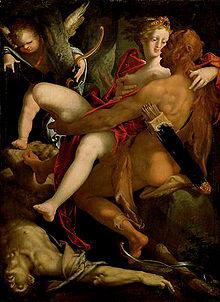
Spranger, noted for his paintings of nudes …
Years: 1585 - 1585
Spranger, noted for his paintings of nudes executed in the late Mannerist style, employs mannered poses, slender, elongated bodies, and a gleaming, brittle texture in his efforts to develop a Northern artistic canon of the human figure.
The figures smile invitingly, and the influence of Parmigianino and Correggio is evident in their voluptuous contours.
Related Events
Filter results
Showing 10 events out of 1256 total
Germain Pilon, sculptor royal from 1568, and appointed controller of the mint in 1572, has contributed to French medal casting a distinguished series of bronze medallions in 1575.
Pilon has had a successful career as a portraitist, his finest work in the genre being the kneeling figure of Cardinal René de Birague (1583–85; Louvre).
French diplomat and soldier Michel de Castelnau, sieur de la Mauvissière, had as a young man served under local commanders in Piedmont and in Picardy.
After the Peace of Cateau-Cambrésis in 1559, he had entered the king's service and been sent on diplomatic missions in 1560 to England, Germany, Savoy, and Rome.
After the death of King Francis II he had been charged with accompanying the widowed queen, Mary Stewart, back to Scotland.
Castelnau had returned to France in 1562 to fight against the Huguenots in Brittany and Normandy.
In 1572, however, King Charles IX had sent him to England, Germany, and Switzerland to appease the anger aroused by the massacre of French Protestants on St. Bartholomew's Day.
From 1575 he has been Henry III's ambassador to Elizabeth I of England.
During his years in England, he has written his Mémoires, with an eye to the moral instruction of his son.
Covering the years 1559–70, they provide a well-informed account of the beginnings of the Wars of Religion.
He returns to France in 1585, when the Holy League is about to dominate Paris.
Because he refuses to join the league, he is excluded from official appointments.
The Holy League's popular support throughout France forces Henry III to placate it.
After three months of continuous effort, in order to avert a public breach between the crown and the Guises, Catherine de Médicis is obliged, by the Treaty of Nemours (July 1585), to commit the King to making war against the Huguenots.
French humanist Jean Dorat, a brilliant Hellenist, one of the poets of the Pléiade, and their mentor for many years, belongs to a noble family; after studying at the Collège de Limoges, he had become tutor to the pages of Francis I.
He had tutored Jean-Antoine de Baïf, whose father he succeeded as director of the Collège de Coqueret.
There, besides Baïf, his pupils had included Pierre de Ronsard, Rémy Belleau, and Pontus de Tyard.
Joachim du Bellay was added to this group by Ronsard, and these five young poets, along with and under the direction of Dorat, formed a society for the reform of French language and literature.
They had increased their number to seven with the dramatist Étienne Jodelle and named themselves La Pléiade, in emulation of the seven Greek poets of Alexandria.
The election of Dorat as their president proved his personal influence, but as a writer of French verse he is the least important of the seven.
Dorat had stimulated his students to intensive study of Greek and Latin poetry, while he himself writes incessantly in both languages.
He is said to have composed more than fifteen thousand Greek and Latin verses.
His influence and fame as a scholar extends to England, Italy, and Germany.
He had in 1556 been appointed professor of Greek at the Collège Royal, a post that he had held until he retired in 1567.
He publishes a collection of the best of his Greek and Latin verse in 1586.
Baïf, the most learned of the seven, had received a classical education and in 1547 had gone with Ronsard to study under Dorat where they planned, with du Bellay, to transform French poetry by imitating the ancients and the Italians.
To this program Baïf had contributed two collections of Petrarchan sonnets and Epicurean lyrics, Les Amours de Méline (1552) and L'Amour de Francine (1555).
Le Brave, ou Taillebras, Baïf's lively adaptation of Plautus' Miles gloriosus, had been played at court and published in 1567.
Baïf—who was the natural son of Lazare de Baïf, humanist and diplomat—has enjoyed royal favor and received pensions and benefices from Charles IX and Henry III.
His Euvres en rime (1573; “Works in Rhyme”) reveal great erudition: Greek (especially Alexandrian), Latin, neo-Latin, and Italian models are imitated for mythological poems, eclogues, epigrams, and sonnets.
His verse translations include Terence's Eunuchus and Sophocles' Antigone.
Baïf is a versatile, inventive poet and experimenter who, for example, has invented and made use of a system of phonetic spelling.
With the musician Thibault de Courville, Baïf had founded a short-lived Academy of Poetry and of Music in order to promote certain Platonic theories on the union of poetry and music.
His metrical inventions include a vers baïfin, a verse of fifteen syllables.
His theories had been exemplified in Etrénes de poezie fransoèze en vers mezurés (1574; “Gifts of French Poetry in Quantitative Verse”) and in his little songs, Chansonnettes mesurées (1586), with music written by Jacques Mauduit.
His Mimes, enseignements et proverbes (1576; “Mimes, Lessons, and Proverbs”) is considered to be his most original work.
A personal poet whose gifts are inferior to his genius for invention of form and language, Baïf has a talent for vivid, realistic description, particularly in scenes of country life and in satire.

Jehan Cousin the son, noted for his painting, engraving, stained glass, sculpture, and book illustration, has, like his father, achieved fame for his versatility and independent style.
Notable later works include his engraving Moses Showing the Serpent to the People, his stained glass Judgment of Solomon (1586), and his illustrations for Ovid's Metamorphosis.
Bruno had returned in October 1585 to Paris, where he has found a changed political atmosphere.
Henry III has abrogated the edict of pacification with the Protestants, and the King of Navarre has been excommunicated.
Far from adopting a cautious line of behavior, however, Bruno enters into a polemic with a protégé of the Catholic party, the mathematician Fabrizio Mordente, whom he ridicules in four Dialogi, and in May 1586 he dares to attack Aristotle publicly in his Centum et viginti articuli de natura et mundo adversus Peripateticos (“One hundred and twenty Articles on Nature and the World Against the Peripatetics”).
The Politiques disavow him, and Bruno leaves Paris for Germany.
Articles of the Treaty of Nemours (or Treaty of Saint-Maur) had been agreed upon in writing and signed in Nemours on July 7, 1585 between the Queen Mother of France, Catherine de' Medici acting for the King, and representatives of the House of Guise, including the Duke of Lorraine.
Catherine had then hastened to Saint-Maur-des-Fossés, where on July 13 the treaty had been signed between King Henry III of France and the leaders of the Catholic League, including Henri, duc de Guise.
The king had been pressured by members of the Catholic League to sign the accord, which was recognized by contemporaries as a renewal of the old French Wars of Religion.
The Treaty of Nemours, and the events that ensued, are responsible for the advent of the War of the Three Henrys, the final phase of the French Wars of Religion.
The War of the Three Henrys, the eighth and final conflict in the series of civil wars known as the French Wars of Religion, has been fought since 1584 between Henry of Guise, Henry of Navarre (also Henry Bourbon) and Henry III of France.
Henry of Navarre, the heir presumptive and a Protestant, leads the Huguenot forces.
Henry of Guise is the "ultra-Catholic" head of the House of Guise and leader of the Holy League.
King Henry III commands the royal forces.
The King had at first tried to co-opt the head of the Catholic League and steer it towards a negotiated settlement.
This was anathema to the Guise leaders, who want to bankrupt the Huguenots and divide their considerable assets with the King.
The situation had degenerated into open warfare.
Henry of Navarre had again sought foreign aid from the German princes and Elizabeth I of England.
Meanwhile, the solidly Catholic people of Paris, under the influence of the Committee of Sixteen have become dissatisfied with Henry III and his failure to defeat the Calvinists.
Guise has sent his cousin Charles, Duke of Aumale, to lead a rising in Picardy (which could also support the retreat of the Spanish Armada).
An alarmed Henry III orders Guise to remain in Champagne; he defies the king and on May 9, 1588, enters Paris, bringing to a head his ambiguous challenge to royal authority three days later in the Day of the Barricades, a popular uprising that raises barricades on the streets of Paris to defend the Duke of Guise against the alleged hostility of the king; Henry III flees the city.
The Committee of Sixteen takes complete control of the government, while the Guise protect the surrounding supply lines.
The mediation of Catherine de' Medici, the Queen Mother, leads to the Edict of Union, signed at Rouen and registered at Paris on July 21, in which the crown accepts almost all the League's demands.
The King promises by its terms never to conclude a truce or peace with the "hérétiques", to forbid public office to any who would not take a public oath of their Catholicity and never to leave the throne to a prince who was not Catholic; secret clauses extend amnesty to all deeds of the Catholic League, accord support to its troops and make over to the League additional fortified places.
King Henry, reaffirming the Treaty of Nemours in August 1588, had recognized Cardinal de Bourbon as heir, and made the duc de Guise Lieutenant-General of France.
Refusing to return to Paris, Henry calls in September of this year for an Estates-General at Blois.
The news of Henry III's death is received inside the city with a joy near delirium; some hail the assassination as an act of God.
League partisans see Clément as a martyr.
Soon praised by Pope Sixtus V to the degree that canonization is even discussed, Clément never does achieve sainthood.
The childless Henry III, who is interred at the Saint Denis Basilica, is the last of the Valois kings; Henry III of Navarre has succeeded him as Henry IV, the first of the Bourbon kings, but the League refuses to recognize the Protestant king’s legitimacy.
The League instead proclaims Charles, Cardinal de Bourbon as king, while still a prisoner and in the castle of Chinon, and immediately begins issuing coins in his name from fifteen mints, including Paris.
Charles, however, renounces the royal title and recognizes his nephew as the rightful king.
Henry IV moves on Paris, but retreats before Mayenne's forces on November 1.