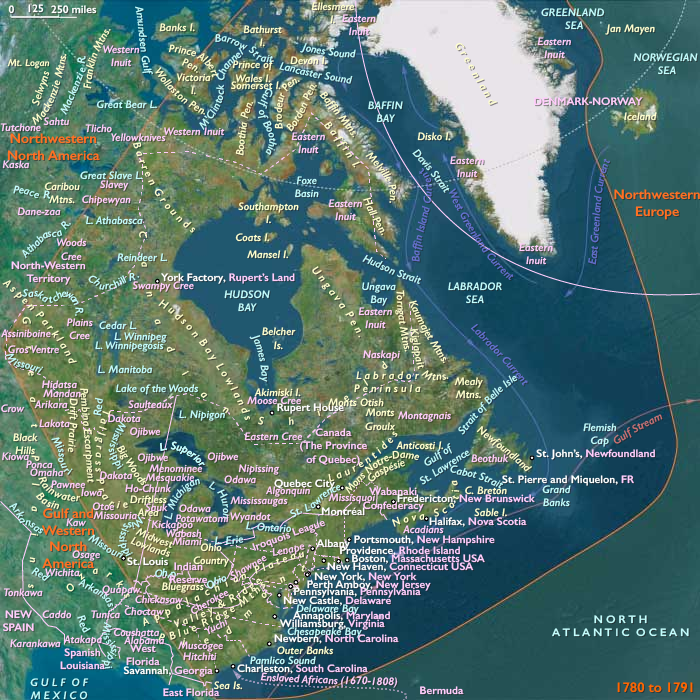
The United States, having won its independence …
Years: 1780 - 1791
The United States, having won its independence from Great Britain through revolution from 1775, remains threatened internally by destabilizing sectional conflicts over slavery, taxation, and the distribution of wealth.
After the signing of the Paris Peace Treaty ending the American Revolution in 1783, the United States has yet to form formal government organizations and the constitutional convention has yet to convene.
The prosperity that reigned at war's end soon devolves into a severe economic depression.
Property holders begin losing their possessions through seizures for overdue debts and delinquent taxes and become subject to debtor's imprisonment.
Demonstrations ensue, with threats of violence against the courts handling the enforcement and indictments.
In what comes to be known as Shays' Rebellion, farmers and working people in Massachusetts begin organizing in protest against dictatorial and oppressive governmental and court systems and against excessive salaries for government and court officials.
The authors of the Constitution are heavily influenced by the country's experience under the Articles of Confederation (1781-89), which had attempted to retain as much independence and sovereignty for the states as possible and to assign to the central government only those nationally important functions that the states could not handle individually.
The events of the years 1781 to 1787, including the national government's inability to act during Shays' Rebellion, show that the Articles are unworkable because they deprive the national government of many essential powers, including direct taxation and the ability to regulate interstate commerce.
Its framers hope that the new Constitution will remedy this problem.
Years: 1780 - 1791
Groups
- United States of America (US, USA) (Philadelphia PA)
- Massachusetts, Commonwealth of (U.S.A.)
- United States of Americs (US, USA) (Annapolis MD)
- United States of America (US, USA) (New York NY)
- United States of America (US, USA) (Philadelphia PA)
Topics
Commodoties
Subjects
Regions
Subregions