
South Atlantic (7,821 – 6,094 BCE): Early …
Years: 7821BCE - 6094BCE
South Atlantic (7,821 – 6,094 BCE): Early Holocene — Ice Retreat, Green Shores, and Ocean Corridors of Life
Geographic & Environmental Context
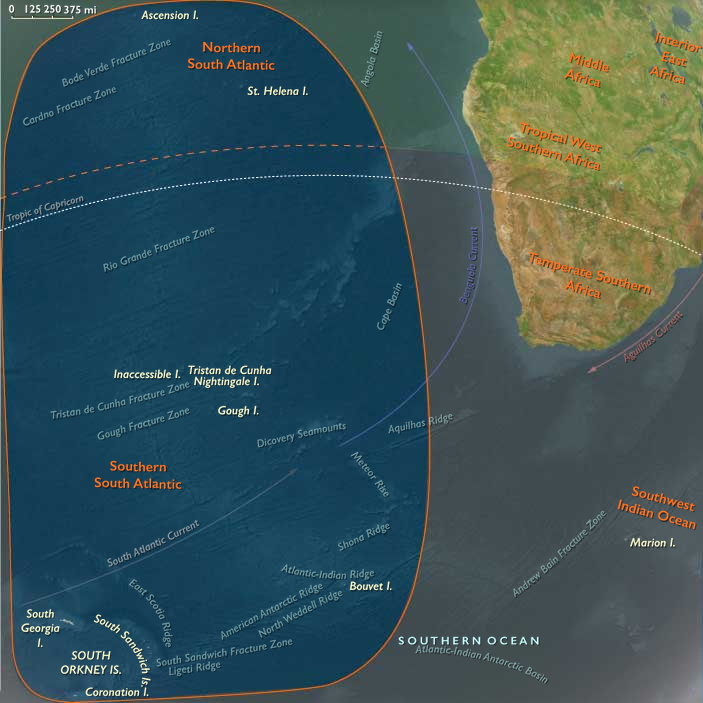
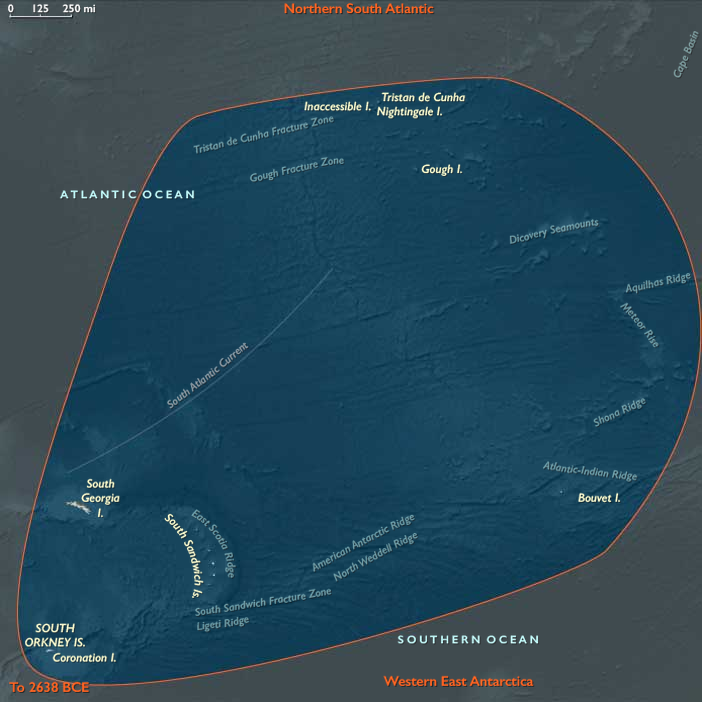
The South Atlantic in the Early Holocene stretched from the tropical gyre islands of Saint Helena and Ascension to the storm-lashed subantarctic arc of Tristan da Cunha, Gough, Bouvet, South Georgia, the South Sandwich, and South Orkney Islands.
All were volcanic outposts rising from the Southern Ocean, encircled by the Antarctic Circumpolar Current (ACC)and bound together by the migrations of whales, seals, and seabirds.
-
Northern chain: Saint Helena and Ascension—mid-ocean plateaus of basalt cliffs and crater basins, catching cloud moisture from persistent trades.
-
Southern chain: Tristan da Cunha, Gough, Bouvet, South Georgia, South Sandwich, and the South Orkneys—glaciated islands fringed by fjords and tundra benches newly freed from ice.
Between them rolled one of Earth’s most productive ocean gyres, linking the tropics, temperate South Atlantic, and the Antarctic seas.
Climate & Environmental Shifts
The Holocene Thermal Maximum brought general warming and sea-level rise toward modern positions:
-
In the north, SSTs increased, precipitation rose slightly, and windward slopes developed cloud-forest pockets.
-
In the south, ice retreated rapidly on South Georgia and the Orkneys, exposing valleys and headlands; Bouvet remained mostly ice-clad; the westerlies intensified, yet summers lengthened.
The ocean entered a period of nutrient-rich stability—a constant, wind-driven upwelling system that sustained vast krill and plankton blooms.
Subsistence & Settlement
No humans yet reached these remote latitudes. Instead, ecosystems re-colonized freshly exposed ground:
-
Northern South Atlantic:
Vegetation thickened on Saint Helena and Ascension—ferns, grasses, and early shrubland in moist hollows; seabirds nested in cliffs and lava tubes; green turtles returned annually to pocket beaches. -
Southern South Atlantic:
On Tristan and Gough, tussock grasslands, mosses, and herbs spread across volcanic slopes; penguin colonies (king, gentoo, macaroni) multiplied on ice-free shores; fur and elephant seals crowded new beaches.
South Georgia’s fjords, newly deglaciated, filled with seals and seabirds; whales converged in summer feeding grounds.
Bouvet and the South Sandwich remained marginal but hosted pioneer colonies on isolated ledges.
Across the region, biological communities advanced unimpeded by human presence—true Holocene sanctuaries of natural succession.
Technology & Material Culture
While humans elsewhere were shaping stone, bone, and clay into the first farming toolkits, the South Atlantic islands remained entirely pre-anthropic. No technology, no fire, no modification—only the slow architecture of wind, waves, ice, and guano.
Movement & Interaction Corridors
Life circulated on planetary scales:
-
The ACC distributed nutrients among the islands, while gyre eddies funneled warm and cold currents that defined ecological boundaries.
-
Whales and seals migrated annually—south in summer to feed in krill-rich waters, north in winter to breed.
-
Albatrosses, petrels, and shearwaters traced hemispheric orbits linking Africa, South America, and Antarctica.
-
Turtles rode equatorial drifts to forage around the northern islands.
In effect, the South Atlantic was a biological highway, joining three continents through movement alone.
Cultural & Symbolic Expressions
No human symbolism yet touched these shores. The island “rituals” were ecological: the cyclic return of penguins and turtles, the synchronous molting of seals, the seasonal whale chorus—natural calendars of abundance and renewal.
Environmental Adaptation & Resilience
Ecological resilience was dynamic and self-reinforcing:
-
Plants colonized bare moraines and lava soils, stabilizing slopes with root mats and peat.
-
Seabird guano enriched sterile ground, accelerating plant succession and sustaining dense invertebrate webs.
-
Marine populations adjusted to new coastlines and variable ice margins, shifting breeding grounds as glaciers retreated.
-
Nutrient loops—sea → land → sea—tightened, maintaining productivity even through storm seasons.
Long-Term Significance
By 6,094 BCE, the South Atlantic had fully entered the Holocene balance:
-
Northern islands supported patchy but resilient green belts amid the trades.
-
Southern islands thrived as booming subantarctic rookeries and whale pastures.
-
The ACC and westerlies operated as stable planetary engines, ensuring continuous biological exchange.
Untouched by humankind, these archipelagos became primeval laboratories of resilience—proving how, at the meeting of ocean and ice, life could rebound, diversify, and endure long before human sails crossed the horizon.
Subjects
Regions
Subregions
Related Events
Showing 10 events out of 69350 total
Years: 7821BCE - 6094BCE
Subjects
Regions
Subregions