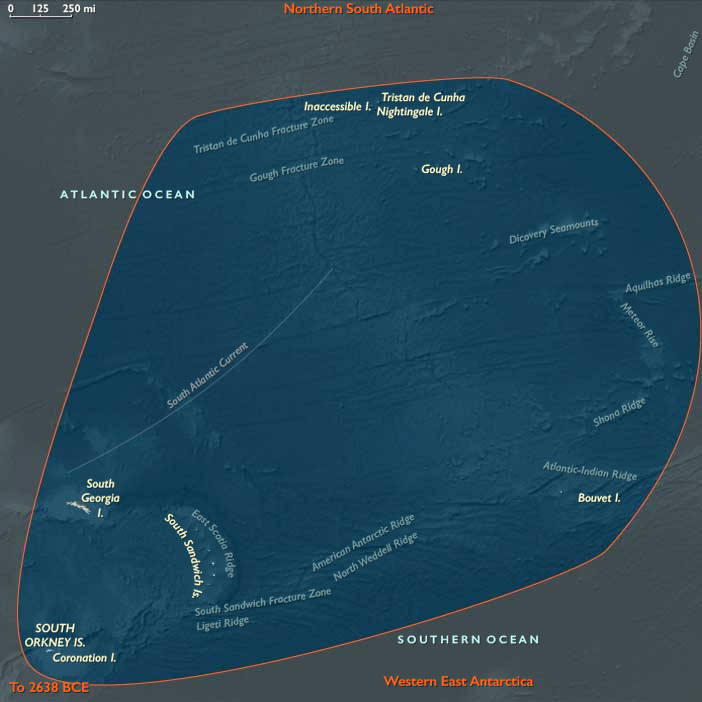
Southern South Atlantic (6,093–4,366 BCE): Holocene Flourishing …
Years: 6093BCE - 4366BCE
Southern South Atlantic (6,093–4,366 BCE): Holocene Flourishing in Subantarctic Isles
Geographic & Environmental Context
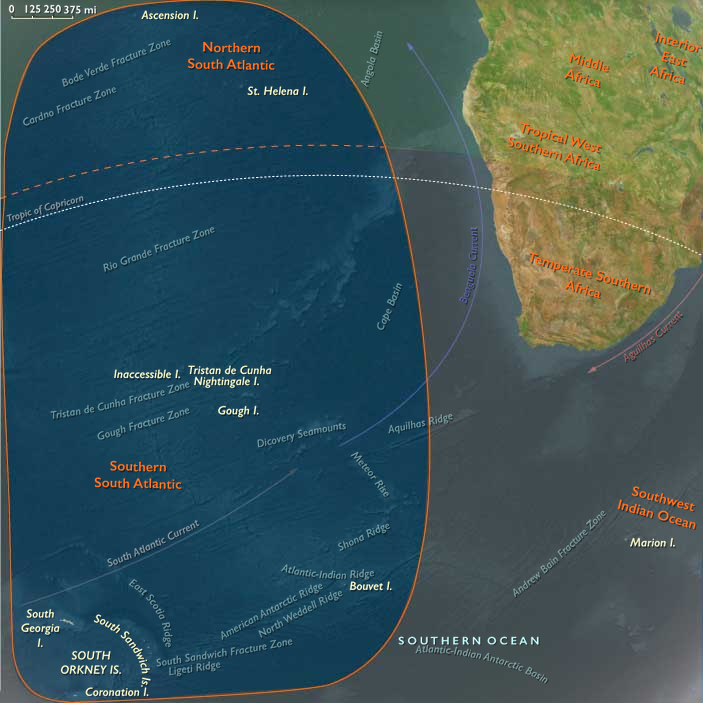
The subregion of Southern South Atlantic includes the Tristan da Cunha archipelago, Bouvet Island, South Georgia and the South Sandwich Islands, and the South Orkney Islands (including Coronation Island). Each island group stood as a distinct ecological enclave in the storm-lashed South Atlantic. Tristan da Cunha and Gough supported volcanic highlands with enlarging vegetated zones. Bouvet remained an ice-covered volcanic cone. South Georgia and the South Orkneys exhibited fjords, glaciers, and expanding ice-free valleys, while the South Sandwich Islands were narrow, steep volcanic ridges amid turbulent seas.
Climate & Environmental Shifts
By this mid-Holocene epoch, warming had peaked globally. In the Southern South Atlantic, glaciers on South Georgia and the South Orkneys retreated further, revealing new headlands and bays, though ice persisted at higher elevations. Sea level had reached near-modern positions. Westerly winds remained strong, and the Antarctic Circumpolar Current (ACC) maintained nutrient-rich circulation. Seasonal sea ice was reduced compared to glacial maxima, though it still advanced in winter, structuring marine productivity.
Subsistence & Settlement
Humans remained absent, but ecological systems thrived. Vegetation on Tristan and Gough expanded to include ferns, grasses, mosses, and cushion plants, while tussock grasslands thickened on deglaciated coastal plains of South Georgia. Penguin colonies expanded dramatically, exploiting beaches and rocky promontories. Seals (fur seals, elephant seals, and sea lions) established dense rookeries. Seabirds (albatrosses, petrels, skuas) flourished, while offshore, krill swarms sustained baleen whales and predatory fish. Bouvet and the South Sandwich Islands, though harsher, supported scattered rookeries along coasts free of ice.
Technology & Material Culture
Elsewhere, humans refined pottery, ground stone tools, and domestication of crops and animals. In river valleys and plains worldwide, agriculture was spreading. Yet the Southern South Atlantic remained far beyond human contact, its ecosystems untouched by material culture or technological influence.
Movement & Interaction Corridors
The ACC tied these islands into global ocean circulation. Migratory whales exploited rich feeding grounds in summer, departing northward in winter. Seabirds linked the islands to South America, Africa, and Antarctica, traversing hemispheric distances. Penguins and seals redistributed rookeries as glaciers retreated, occupying new ice-free zones.
Cultural & Symbolic Expressions
No human cultural systems existed here. Symbolic continuity was ecological: the reliable return of penguins to breeding grounds, the seasonal swell of whales, and the flourishing of seabird colonies marked cycles of time and renewal.
Environmental Adaptation & Resilience
Flora and fauna adapted dynamically to expanding habitats. Plants colonized fresh soils on Tristan, Gough, and South Georgia. Penguins and seals diversified breeding sites. Krill and plankton adjusted to fluctuating ice extents, sustaining predators. Ecological resilience was robust, rooted in mobility, reproductive flexibility, and colonization of new niches.
Transition
By 4,366 BCE, the Southern South Atlantic was a thriving ecological arena. Vegetation spread on volcanic and deglaciated landscapes, rookeries of seabirds and seals thickened, and marine ecosystems surged with productivity. Still unknown to humans, the islands stood as flourishing outposts of the Holocene Southern Ocean.
Years: 6093BCE - 4366BCE
Subjects
Regions
Subregions