
Southern South Atlantic (49,293–28,578 BCE): Subantarctic Shores …
Years: 49293BCE - 28578BCE
Southern South Atlantic (49,293–28,578 BCE): Subantarctic Shores in the Upper Paleolithic
Geographic & Environmental Context
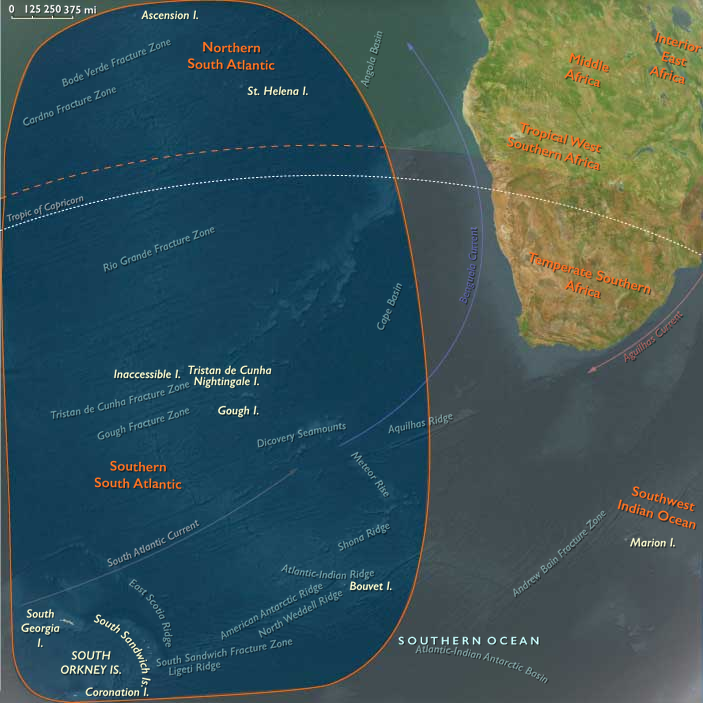
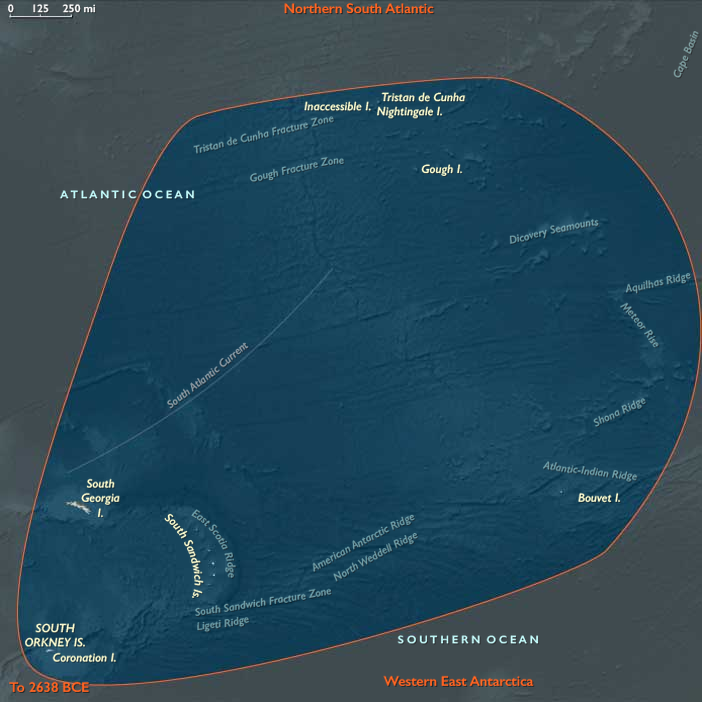
The subregion of Southern South Atlantic includes the Tristan da Cunha archipelago, Bouvet Island, South Georgia and the South Sandwich Islands, and the South Orkney Islands (including Coronation Island). These islands were volcanic or glaciated outposts scattered across the stormy South Atlantic, lying between the subtropics and the Antarctic margin. Tristan da Cunha and Gough Island were volcanic highlands with fertile soils and rugged coasts; Bouvet was a small, ice-cloaked volcano adrift in the mid-ocean; South Georgia, the South Sandwich Islands, and the South Orkneys were larger, glacier-bound landmasses, with towering peaks, fjords, and ice shelves descending into icy seas. Offshore, the Antarctic Circumpolar Current (ACC) swept nutrients around the islands, binding them into global marine circuits.
Climate & Environmental Shifts
This age unfolded during the height of the Last Glacial period. Global sea levels stood 60–90 meters lower than today, broadening coastal shelves around Tristan and Gough but leaving steep islands largely unaltered. The climate was colder, windier, and stormier: glaciers expanded on South Georgia, the South Orkneys, and Bouvet, while snow and ice capped high volcanic summits. Sea ice advanced further north in winter, narrowing open-water habitats. Yet these glacial conditions also enriched the surrounding seas, intensifying upwellings and sustaining robust marine productivity.
Subsistence & Settlement
No humans reached these islands in this epoch. Their ecosystems were purely natural. Coastal cliffs and ice-free ridges supported seabird colonies—petrels, albatrosses, and penguins—while seals and sea lions hauled out on rocky shores. Offshore, rich krill swarms and fish populations supported whale migrations. Vegetation was sparse: mosses, lichens, and cushion plants clung to ice-free pockets on Tristan and Gough, while South Georgia and the Orkneys remained dominated by ice.
Technology & Material Culture
Globally, Upper Paleolithic humans advanced stone blade industries, bone tools, and symbolic art traditions (e.g., Lascaux, Blombos). But none of these reached the Southern South Atlantic. Human technologies had not yet penetrated such latitudes. The islands’ isolation meant they remained outside the reach of even the most expansive Paleolithic migrations.
Movement & Interaction Corridors
The ACC and strong westerlies defined movement here. Seabirds migrated vast distances, linking South Georgia and the Orkneys with Antarctica and South America. Whale migrations converged seasonally, feeding in krill-rich waters during summer before moving northward in winter. These corridors made the Southern South Atlantic a crucial biological crossroads, even without humans.
Cultural & Symbolic Expressions
No human symbolic traditions attached to these islands. In global terms, however, myths of southern lands were millennia away; the region existed only as ecological reality. Symbolically, continuity was inscribed only through natural cycles—penguin rookeries, whale migrations, and glacial rhythms.
Environmental Adaptation & Resilience
Ecosystems displayed resilience under extreme conditions. Seabirds and seals adapted breeding to brief summer ice retreats. Krill thrived under extended sea ice, feeding on under-ice algae and anchoring the marine food web. Pioneer plants colonized volcanic soils on Tristan and Gough, resisting frost and wind. Glaciers advanced and retreated with climate fluctuations, reshaping valleys and coasts.
Transition
By 28,578 BCE, the Southern South Atlantic was locked in glacial stability: glaciers pressed outward, seas teemed with marine life, and volcanic islands stood as ecological sentinels in the stormiest ocean on Earth. Humans remained absent, but the biological and climatic systems that would one day shape human encounters were already firmly in place.
Topics
Subjects
Regions
Subregions
Related Events
Showing 10 events out of 69706 total
Years: 49293BCE - 28578BCE
Topics
Subjects
Regions
Subregions