
East Melanesia (28,577 – 7,822 BCE): Upper …
Years: 28577BCE - 7822BCE
East Melanesia (28,577 – 7,822 BCE): Upper Paleolithic II — Deglaciation, Forest Intensification, and Inter-Island Voyaging
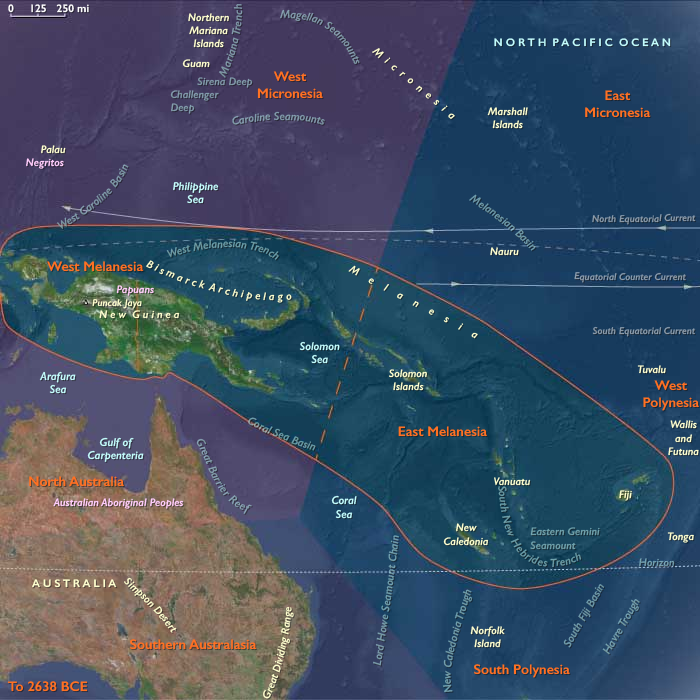
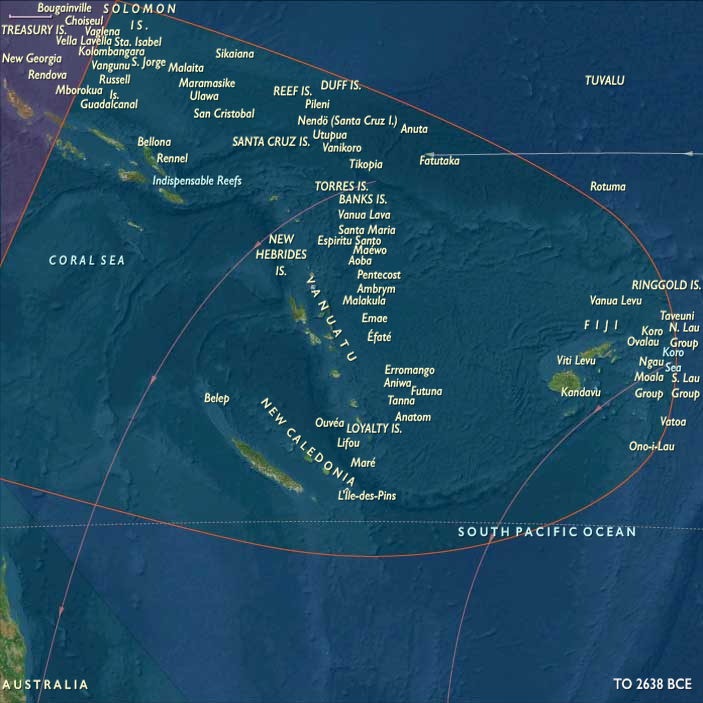
East Melanesia includes Vanuatu, Fiji, New Caledonia, and the Solomon Islands (excluding Bougainville, which belongs to West Melanesia).
-
Anchors: the Vanuatu chain (Efate, Espiritu Santo, Malekula, Tanna), the Fiji group (Viti Levu, Vanua Levu, Lau islands), New Caledonia (Grande Terre, Loyalty Islands), and the central/eastern Solomons (Guadalcanal, Malaita, Makira, Santa Cruz).
-
Rising seas fragmented lowland plains into the modern archipelagos.
-
Coral reef accretion surged during warming periods.
Climate & Environmental Shifts
-
Bølling–Allerød warming boosted rainfall and reef productivity.
-
Younger Dryas reversed briefly; Early Holocene warming stabilized environments.
Subsistence & Settlement
-
Expanded broad-spectrum diets: shellfish, reef fish, nuts, tuberous roots.
-
Seasonal settlements near estuaries and reef passes; evidence of increased sedentism.
-
Bird and reptile hunting added to diets.
Technology & Material Culture
-
Improved flake and adze production; ground stone emerges.
-
Shell ornaments; early canoe forms likely used for inter-island hops (Solomons to Vanuatu).
Movement & Interaction Corridors
-
Expanding seafaring capacity enabled colonization of Remote Oceania outliers (Santa Cruz, Reef Islands).
-
Seasonal voyaging tied New Caledonia–Vanuatu–Fiji shelves into a circuit.
Cultural & Symbolic Expressions
-
Shell jewelry, ochre in burials, carved motifs on bone/stone objects.
Environmental Adaptation & Resilience
-
Increasing reliance on reefs and nut forests provided resilience to deglacial sea-level changes.
Transition
By 7,822 BCE, East Melanesia hosted semi-sedentary forager–horticultural precursors, bridging Pleistocene mobility and Holocene intensification.
Topics
Subjects
Regions
Subregions
Years: 28577BCE - 7822BCE
Topics
Subjects
Regions
Subregions