
South Central Europe (1684–1827 CE) Late …
Years: 1684 - 1827
South Central Europe (1684–1827 CE)
Late Baroque Society, Enlightenment Currents, and Napoleonic Reshaping
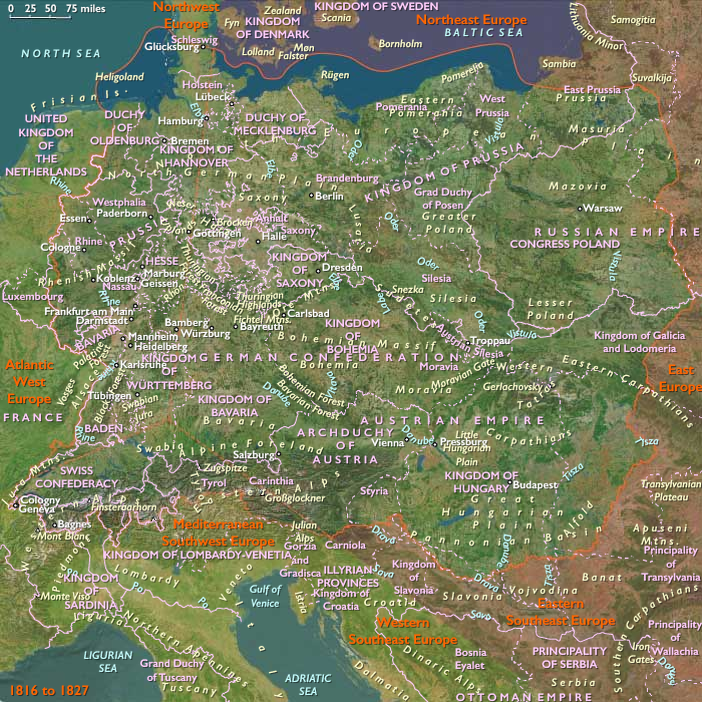
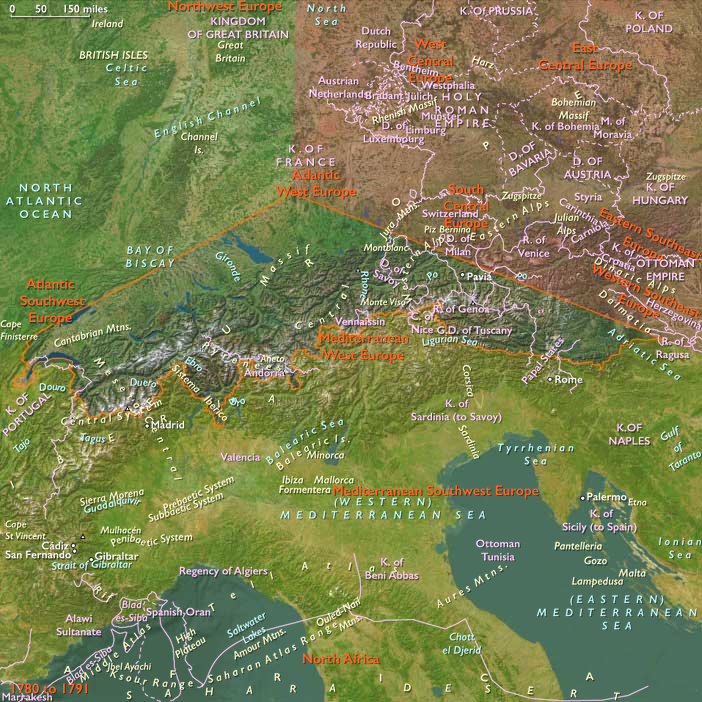
This subregion—Liechtenstein, most of Switzerland (excluding the far northwest), the extreme southern parts of Germany (southeastern Baden-Württemberg, southwestern Bavaria), and southwestern Austria—entered the late 17th century shaped by confessional boundaries set in earlier centuries, yet increasingly influenced by the intellectual, economic, and political transformations of the Enlightenment and the upheavals of the Napoleonic era.
Environmental and Agrarian Context
The Little Ice Age continued to bring colder winters and occasional harvest failures into the early 18th century, prompting improvements in storage, irrigation, and crop diversification. Alpine communities relied heavily on pastoral economies—dairy products, wool, and meat—while lowland valleys experimented with new crops such as potatoes and maize. Population growth from the mid-18th century onward intensified land use and spurred rural-to-urban migration.
Political and Institutional Developments
-
Swiss Neutrality Consolidated: The Swiss Confederation maintained its formal neutrality, a position gradually recognized by European powers after the Thirty Years’ War and reaffirmed by practice through the 18th century.
-
Liechtenstein’s Status: The Principality of Liechtenstein was established in 1719 when the Liechtenstein family consolidated its holdings into an imperial principality within the Holy Roman Empire.
-
Enlightenment Governance: In Austrian and German territories, rulers experimented with enlightened absolutism—centralized administration, codified law, and limited serfdom reforms—while church institutions retained considerable influence.
-
Religious Conflict Persists: Strife between Catholic and Protestant cantons erupted once more in the Second War of Villmergen (Toggenburg War) in 1712. This conflict shifted the confessional balance of power within the Confederation in favor of the Protestant cantons, altering the political dynamics that had been in place since the mid-17th century.
Economic and Trade Dynamics
The Alpine passes—Gotthard, Splügen, and Brenner—remained vital to north–south commerce. Swiss cantons exported precision goods, watches, textiles, and mercenary services; Austrian Vorarlberg expanded in linen weaving and cheese exports. The growth of banking in Geneva and Zürich connected the region to global financial networks.
Agricultural modernization—crop rotation, improved drainage, and selective breeding—boosted productivity, but unevenly across the subregion.
Cultural and Intellectual Life
-
Baroque and Rococo flourished in Catholic regions, producing richly decorated churches and monasteries (e.g., St. Gallen Abbey’s library).
-
Protestant cantons emphasized education, literacy, and a sober architectural aesthetic.
-
Enlightenment ideas—spread through books, salons, and academies—fostered scientific inquiry, legal reform debates, and political pamphleteering.
-
A vibrant print culture in Basel, Zürich, and Geneva facilitated exchanges across Europe.
Napoleonic Upheaval
The French Revolutionary and Napoleonic Wars profoundly reshaped the political map:
-
French Invasion (1798): Creation of the centralized Helvetic Republic abolished cantonal sovereignty, sparking rural uprisings against French rule.
-
Mediation Act (1803): Napoleon restored a federal Swiss structure while keeping it under French influence.
-
Liechtenstein was occupied by French and Russian troops during the War of the Second Coalition.
-
Post-1815, the Congress of Vienna confirmed Swiss neutrality as a cornerstone of European diplomacy.
Security and Conflict
While large-scale warfare generally bypassed the Alpine heartlands, the French occupation, anti-centralization revolts, and shifting alliances disrupted trade and strained local economies. Swiss mercenary regiments continued to serve abroad, notably in France and the Papal States.
People
Groups
- Holy Roman Empire
- Habsburg, House of
- Christians, Roman Catholic
- Constance, Bishopric of
- Austria, Archduchy of
- Schwyz, Swiss Canton of
- Uri, Swiss Canton of
- Swiss mercenaries
- Unterwalden, Swiss Canton of
- Lucerne, Swiss Canton of
- Nidwalden, Swiss Canton of
- Bern, Swiss Canton of
- Zürich, Swiss Canton of
- Glarus, Swiss Canton of
- Zug, Swiss Canton of
- League of God's House
- Gray League
- St. Gallen (Saint Gall), Imperial free city
- League of the Ten Jurisdictions
- Ottoman Empire
- Fribourg, Swiss Canton of
- Solothurn, Swiss Canton of
- Basel, Swiss Canton of
- Schaffhausen, Swiss canton of
- Appenzell, Swiss Canton of
- Swiss Reformed Church
- Geneva, Republic of
- Basel, Prince-Bishopric of
- Zurich, “Republic” of
- Calvinists
- Jesuits, or Order of the Society of Jesus
- Appenzell Innerrhoden, Swiss Canton of
- Appenzell Ausserrhoden, Swiss Canton of
- Habsburg Monarchy, or Empire
- Liechtenstein, Principality of
- Russian Empire
- French First Republic
- Helvetic Republic
- Switzerland
- France, (first) Empire of
Topics
- Little Ice Age (LIA)
- Villmergen War, Second
- Little Ice Age, Warm Phase III
- Second Coalition, War of the
- French Revolutionary Wars: Campaigns of 1798
- Swiss Revolt of 1798
- Napoleonic Wars
- Congress of Vienna
Commodoties
Subjects
Regions
Subregions
Related Events
Showing 10 events out of 30218 total
Years: 1684 - 1827
People
Groups
- Holy Roman Empire
- Habsburg, House of
- Christians, Roman Catholic
- Constance, Bishopric of
- Austria, Archduchy of
- Schwyz, Swiss Canton of
- Uri, Swiss Canton of
- Swiss mercenaries
- Unterwalden, Swiss Canton of
- Lucerne, Swiss Canton of
- Nidwalden, Swiss Canton of
- Bern, Swiss Canton of
- Zürich, Swiss Canton of
- Glarus, Swiss Canton of
- Zug, Swiss Canton of
- League of God's House
- Gray League
- St. Gallen (Saint Gall), Imperial free city
- League of the Ten Jurisdictions
- Ottoman Empire
- Fribourg, Swiss Canton of
- Solothurn, Swiss Canton of
- Basel, Swiss Canton of
- Schaffhausen, Swiss canton of
- Appenzell, Swiss Canton of
- Swiss Reformed Church
- Geneva, Republic of
- Basel, Prince-Bishopric of
- Zurich, “Republic” of
- Calvinists
- Jesuits, or Order of the Society of Jesus
- Appenzell Innerrhoden, Swiss Canton of
- Appenzell Ausserrhoden, Swiss Canton of
- Habsburg Monarchy, or Empire
- Liechtenstein, Principality of
- Russian Empire
- French First Republic
- Helvetic Republic
- Switzerland
- France, (first) Empire of
Topics
- Little Ice Age (LIA)
- Villmergen War, Second
- Little Ice Age, Warm Phase III
- Second Coalition, War of the
- French Revolutionary Wars: Campaigns of 1798
- Swiss Revolt of 1798
- Napoleonic Wars
- Congress of Vienna
Commodoties
Subjects
Regions
Subregions