
South Central Europe (1540–1683 CE) Reformation, …
Years: 1540 - 1683
South Central Europe (1540–1683 CE)
Reformation, Counter-Reformation, and Social Conflict in the Alpine World
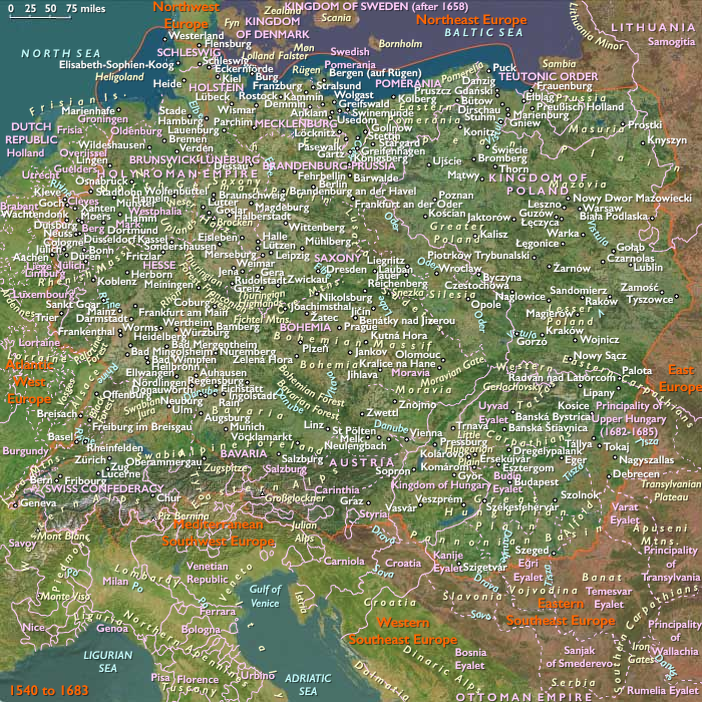
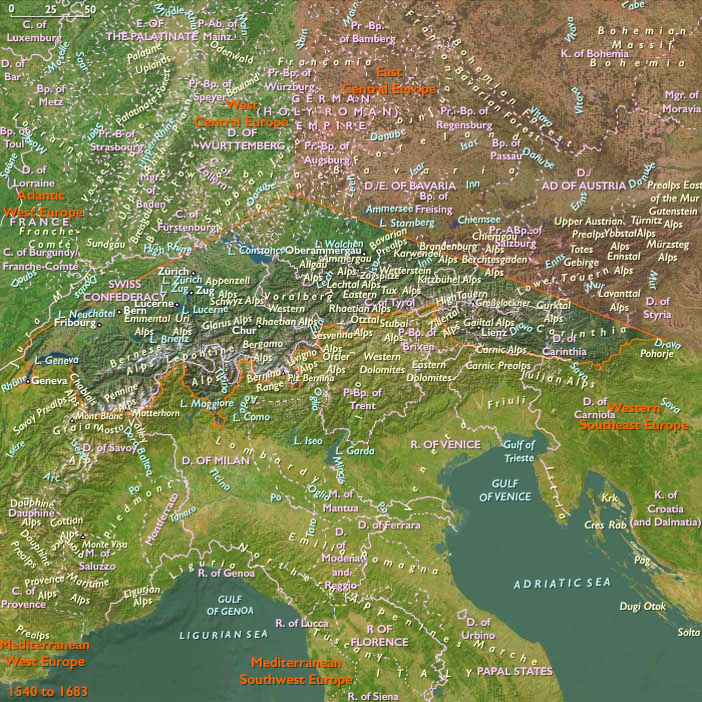
This subregion—Liechtenstein, most of Switzerland (excluding the far northwest), the extreme southern parts of Germany (southeastern Baden-Württemberg, southwestern Bavaria), and southwestern Austria—entered the early modern period in the wake of both religious upheaval and political reconfiguration. The era brought new confessional boundaries, shifting military alliances, and a reorientation of Alpine commerce under the pressures of European war.
Environmental and Agrarian Context
The Little Ice Age intensified in the 16th and early 17th centuries, bringing shorter growing seasons, harsher winters, and occasional alpine glacier advance. Farmers adapted by expanding meadow irrigation, improving storage of fodder, and diversifying livestock. Cheese, butter, and cured meats became even more important for trade, while grain surpluses were increasingly imported from lower-altitude regions in years of poor harvest.
Political and Institutional Developments
-
Reformation Impact: Many urban centers, particularly Zürich, Basel, and other northern Swiss cities, adopted Protestantism under leaders such as Zwingli and Calvin. Rural and eastern Alpine areas often remained Catholic, creating a patchwork of confessional allegiance.
-
Counter-Reformation Response: Catholic cantons, aided by the Jesuits and supported by Habsburg Austria, reinforced religious orthodoxy through education, renewed pilgrimage culture, and church building.
-
Swiss Neutrality: Though technically part of the Holy Roman Empire until the Peace of Westphalia (1648), the Swiss Confederacy maintained practical autonomy, avoiding direct devastation from the Thirty Years’ War while providing mercenaries to multiple European powers.
-
Habsburg Authority in the East: Southwestern Austria and adjacent Vorarlberg saw more direct imperial governance, with fortresses modernized against the Ottoman threat to the southeast.
Social and Political Unrest
In the mid-17th century, growing authoritarianism among Swiss patrician ruling families, combined with a postwar financial crisis following the Thirty Years’ War, sparked the Swiss Peasant War of 1653. This major rural revolt reflected deep economic grievances and resentment over political exclusion, though it was ultimately suppressed by the urban elite.
Confessional tension also persisted beneath the surface of Swiss political life. These divisions erupted again in the First War of Villmergen (1656), a brief but intense conflict between Protestant and Catholic cantons that reaffirmed the confessional balance established in earlier settlements without fundamentally resolving the rivalry.
Economic and Trade Dynamics
Alpine trade routes—Gotthard, Splügen, and Brenner—remained vital. Protestant merchant networks linked Geneva, Zürich, and Basel to the North Sea world, while Catholic routes through Milan and Venice persisted. Religious conflict in neighboring regions sometimes diverted commerce, but Swiss neutrality and strategic geography allowed for sustained transit trade.
Textile production, particularly linen and early cotton prints, expanded in proto-industrial form, as did arms manufacturing in some cantons. The export of mercenary services continued to be a major revenue source.
Cultural and Artistic Life
Confessional divides shaped art and architecture:
-
Protestant areas emphasized plain church interiors, the vernacular Bible, and moralistic printing.
-
Catholic regions embraced Baroque architecture and rich liturgical art, often sponsored by the Jesuits.
Urban printing houses produced theological works, political pamphlets, and scientific treatises, helping integrate the region into the wider European Republic of Letters.
Security and Conflict
-
While spared the direct destruction of the Thirty Years’ War (1618–1648), borderlands felt the impact of troop movements, refugee flows, and fluctuating markets.
-
The Habsburg–Ottoman wars indirectly influenced eastern Alpine defenses.
-
Localized confessional wars, particularly the First War of Villmergen, underscored the fragility of the Swiss balance of power in this period.
People
Groups
- Holy Roman Empire
- Habsburg, House of
- Christians, Roman Catholic
- Constance, Bishopric of
- Austria, Archduchy of
- Schwyz, Swiss Canton of
- Uri, Swiss Canton of
- Swiss mercenaries
- Unterwalden, Swiss Canton of
- Lucerne, Swiss Canton of
- Nidwalden, Swiss Canton of
- Bern, Swiss Canton of
- Zürich, Swiss Canton of
- Glarus, Swiss Canton of
- Zug, Swiss Canton of
- League of God's House
- Gray League
- St. Gallen (Saint Gall), Imperial free city
- League of the Ten Jurisdictions
- Ottoman Empire
- Fribourg, Swiss Canton of
- Solothurn, Swiss Canton of
- Basel, Swiss Canton of
- Schaffhausen, Swiss canton of
- Appenzell, Swiss Canton of
- Swiss Reformed Church
- Geneva, Republic of
- Basel, Prince-Bishopric of
- Zurich, “Republic” of
- Jesuits, or Order of the Society of Jesus
- Calvinists
- Appenzell Ausserrhoden, Swiss Canton of
- Appenzell Innerrhoden, Swiss Canton of
Topics
- Little Ice Age (LIA)
- Protestant Reformation
- Counter-Reformation (also Catholic Reformation or Catholic Revival)
- Little Ice Age, Warm Phase II
- Thirty Years' War
- Swiss peasant war of 1653
- Villmergen War, First
Commodoties
Subjects
Regions
Subregions
Related Events
Showing 10 events out of 37475 total
Years: 1540 - 1683
People
Groups
- Holy Roman Empire
- Habsburg, House of
- Christians, Roman Catholic
- Constance, Bishopric of
- Austria, Archduchy of
- Schwyz, Swiss Canton of
- Uri, Swiss Canton of
- Swiss mercenaries
- Unterwalden, Swiss Canton of
- Lucerne, Swiss Canton of
- Nidwalden, Swiss Canton of
- Bern, Swiss Canton of
- Zürich, Swiss Canton of
- Glarus, Swiss Canton of
- Zug, Swiss Canton of
- League of God's House
- Gray League
- St. Gallen (Saint Gall), Imperial free city
- League of the Ten Jurisdictions
- Ottoman Empire
- Fribourg, Swiss Canton of
- Solothurn, Swiss Canton of
- Basel, Swiss Canton of
- Schaffhausen, Swiss canton of
- Appenzell, Swiss Canton of
- Swiss Reformed Church
- Geneva, Republic of
- Basel, Prince-Bishopric of
- Zurich, “Republic” of
- Jesuits, or Order of the Society of Jesus
- Calvinists
- Appenzell Ausserrhoden, Swiss Canton of
- Appenzell Innerrhoden, Swiss Canton of
Topics
- Little Ice Age (LIA)
- Protestant Reformation
- Counter-Reformation (also Catholic Reformation or Catholic Revival)
- Little Ice Age, Warm Phase II
- Thirty Years' War
- Swiss peasant war of 1653
- Villmergen War, First
Commodoties
Subjects
Regions
Subregions